


 Cart
Cart
 sales@molnova.com



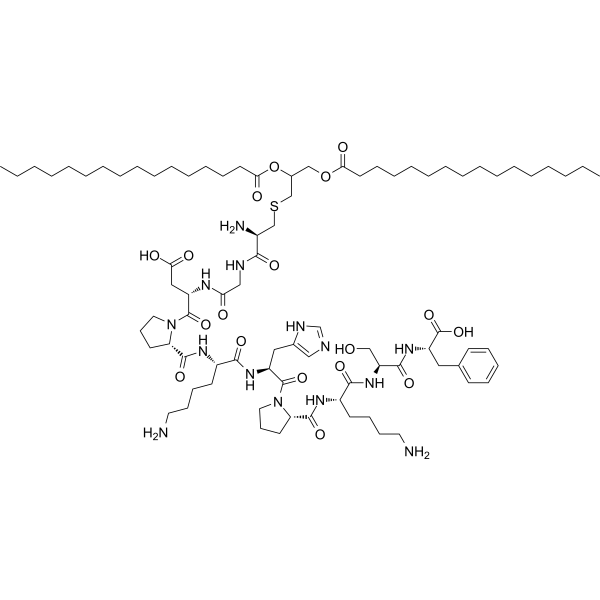
FSL 1
CAS No. 322455-70-9
FSL 1( —— )
Catalog No. M30690 CAS No. 322455-70-9
TLR2/6 agonist (also a putative TLR10 ligand). Activates NF-κB. Induces pro-inflammatory cytokines including IL-8, IL-1β, CCL20 and TNF-α in vitro. Synergizes with IFNγ to induce CXCL10 release from melanoma cells.
Purity : >98% (HPLC)
 COA
Datasheet
HNMR
HPLC
MSDS
Handing Instructions
COA
Datasheet
HNMR
HPLC
MSDS
Handing Instructions
| Size | Price / USD | Stock | Quantity |
| 100MG | Get Quote | Get Quote |


|
| 200MG | Get Quote | Get Quote |
|
| 500MG | Get Quote | Get Quote |
|
| 1G | Get Quote | Get Quote |
|
Biological Information
-
Product NameFSL 1
-
NoteResearch use only, not for human use.
-
Brief DescriptionTLR2/6 agonist (also a putative TLR10 ligand). Activates NF-κB. Induces pro-inflammatory cytokines including IL-8, IL-1β, CCL20 and TNF-α in vitro. Synergizes with IFNγ to induce CXCL10 release from melanoma cells.
-
DescriptionTLR2/6 agonist (also a putative TLR10 ligand). Activates NF-κB. Induces pro-inflammatory cytokines including IL-8, IL-1β, CCL20 and TNF-α in vitro. Synergizes with IFNγ to induce CXCL10 release from melanoma cells.
-
In VitroFSL-1 significantly reduces HSV-2 replication in vitro. FSL-1 reduces HSV-2 replication in human vaginal epithelial cells (EC).FSL-1 induces significant resistance to experimental genital HSV-2 infection through elaboration of a specific cytokine response profile.FSL-1 enhances phagocytosis of bacteria by macrophages through a Toll-like receptor 2-mediated signalling pathway. Cell Viability Assay Cell Line:V11I, V12I or V19I immortalized human vaginal EC Concentration:6 μg or 0.1 μg Incubation Time:Added at 24, 6 or just prior to HSV-2 inoculation (104pfu/well) Result:The 6 μg does produced significant reductions when delivered at 24 or 6 h prior to HSV-2 inoculation. The 0.1 μg dose produced reduced HSV-2 replication at 24 or 6 h prior to viral challenge.
-
In Vivo——
-
Synonyms——
-
PathwayGPCR/G Protein
-
TargetAntibacterial
-
Recptor——
-
Research Area——
-
Indication——
Chemical Information
-
CAS Number322455-70-9
-
Formula Weight1666.16
-
Molecular FormulaC84H140N14O18S
-
Purity>98% (HPLC)
-
Solubilitywater:2 mg/mL
-
SMILESCCCCCCCCCCCCCCCC(=O)OCC(CSC[C@@H](C(=O)NCC(=O)N[C@@H](CC(=O)O)C(=O)N1CCC[C@H]1C(=O)N[C@@H](CCCCN)C(=O)N[C@@H](CC2=CN=CN2)C(=O)N3CCC[C@H]3C(=O)N[C@@H](CCCCN)C(=O)N[C@@H](CO)C(=O)N[C@@H](CC4=CC=CC=C4)C(=O)O)N)OC(=O)CCCCCCCCCCCCCCC
-
Chemical Name——
Shipping & Storage Information
-
Storage(-20℃)
-
ShippingWith Ice Pack
-
Stability≥ 2 years
Reference
1. Okusawa et al (2004) Relationship between structures and biological activities of mycoplasmal diacylated lipopeptides and their recognition by toll-like receptors 2 and 6. Infect.Immun. 72 1657 PMID:
molnova catalog



related products
-
Proflavine
Proflavine (3,6-Diaminoacridine) is a disinfectant bacteriostatic against many gram-positive bacteria and is a topical antiseptic used mainly in wound dressings.
-
Acriflavine
Acriflavine (Acriflavinium chloride 3,6-Acridinediamine mix) is a papain-like protease (PL(pro)) inhibitor, a fluorescent dye for labeling high molecular weight RNAs.
-
ABMA
ABMA is a novel broad-spectrum inhibitor of intracellular toxins and pathogens, efficiently protects cells against various toxins and pathogens including viruses, intracellular bacteria and parasite.
