


 Cart
Cart
 sales@molnova.com



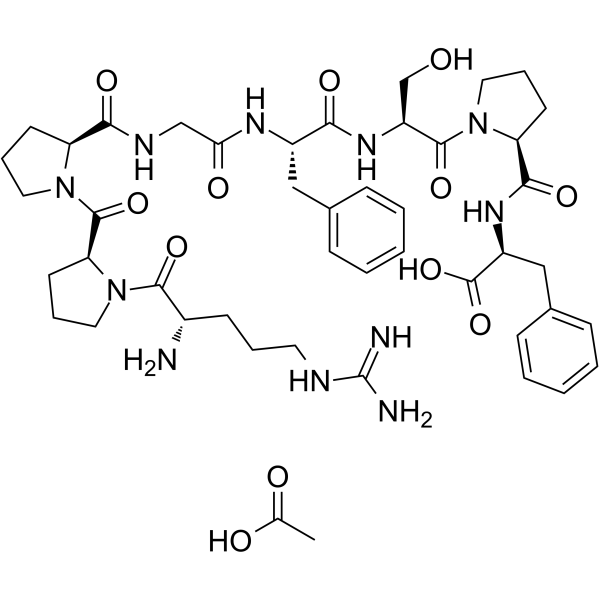
[Des-Arg9]-Bradykinin acetate
CAS No. 23827-91-0
[Des-Arg9]-Bradykinin acetate( —— )
Catalog No. M30144 CAS No. 23827-91-0
[Des-Arg9]-Bradykinin acetate is a Bradykinin(B1) receptor agonist.
Purity : >98% (HPLC)
 COA
Datasheet
HNMR
HPLC
MSDS
Handing Instructions
COA
Datasheet
HNMR
HPLC
MSDS
Handing Instructions
| Size | Price / USD | Stock | Quantity |
| 2MG | 29 | In Stock |


|
| 5MG | 45 | In Stock |
|
| 10MG | 73 | In Stock |
|
| 25MG | 168 | In Stock |
|
| 50MG | 237 | In Stock |
|
| 100MG | 323 | In Stock |
|
| 200MG | 479 | In Stock |
|
| 500MG | Get Quote | In Stock |
|
| 1G | Get Quote | In Stock |
|
Biological Information
-
Product Name[Des-Arg9]-Bradykinin acetate
-
NoteResearch use only, not for human use.
-
Brief Description[Des-Arg9]-Bradykinin acetate is a Bradykinin(B1) receptor agonist.
-
Description[Des-Arg9]-Bradykinin acetate is a Bradykinin(B1) receptor agonist.
-
In Vitro——
-
In Vivo——
-
Synonyms——
-
PathwayOthers
-
TargetOther Targets
-
RecptorBradykinin B1 receptor
-
Research Area——
-
Indication——
Chemical Information
-
CAS Number23827-91-0
-
Formula Weight964.07
-
Molecular FormulaC46H65N11O12
-
Purity>98% (HPLC)
-
SolubilityIn Vitro:?H2O : 100 mg/mL (103.73 mM)
-
SMILES——
-
Chemical Name——
Shipping & Storage Information
-
Storage(-20℃)
-
ShippingWith Ice Pack
-
Stability≥ 2 years
Reference



-
NCGC00378430
NCGC00378430 is a potent?SIX1/EYA2?interaction inhibitor that disrupts the SIX1/EYA2 complex, EMT, and Metastasis.
-
X-GAL
X-GAL is a widely used substrate of chromogenic β-galactosidase. β-galactosidase cleaves X-GAL and produces an insoluble blue compound.
-
PKC ζ pseudosubstrat...
Inhibitor of protein kinase C (PKC) ζ; attached to cell permeabilisation Antennapedia domain vector peptide. Consists of amino acids 113 - 129 of PKC ζ pseudosubstrate domain linked by a disulphide bridge to the Antennapedia domain vector peptide. The Antennapedia peptide is actively taken up by intact cells, at 4 or 37°C, ensuring rapid and effective uptake of the inhibitor peptide. Once inside the cell, the disulphide bonds are subjected to reduction in the cytoplasm leading to release of the inhibitor peptide. Induces mast cell degranulation by a PKC ζ-independent pathway.
