


 Cart
Cart
 sales@molnova.com



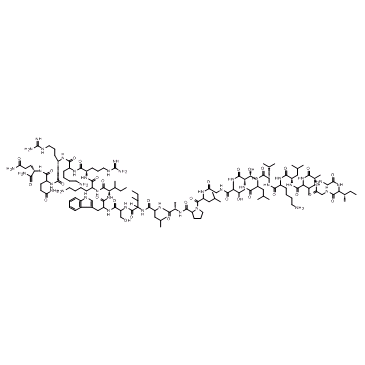
Melittin
CAS No. 20449-79-0
Melittin( —— )
Catalog No. M29998 CAS No. 20449-79-0
Melittin, a small protein containing 26 amino acid residues, is the principal toxic component of bee venom. Melittin is a PLA2 activator, stimulates the activity of the low molecular weight PLA2, while it does not the increase activity of the high molecular weight PLA2.
Purity : >98% (HPLC)
 COA
Datasheet
HNMR
HPLC
MSDS
Handing Instructions
COA
Datasheet
HNMR
HPLC
MSDS
Handing Instructions
| Size | Price / USD | Stock | Quantity |
| 5MG | 111 | In Stock |


|
| 100MG | Get Quote | In Stock |
|
| 200MG | Get Quote | In Stock |
|
| 500MG | Get Quote | In Stock |
|
| 1G | Get Quote | In Stock |
|
Biological Information
-
Product NameMelittin
-
NoteResearch use only, not for human use.
-
Brief DescriptionMelittin, a small protein containing 26 amino acid residues, is the principal toxic component of bee venom. Melittin is a PLA2 activator, stimulates the activity of the low molecular weight PLA2, while it does not the increase activity of the high molecular weight PLA2.
-
DescriptionMelittin, a small protein containing 26 amino acid residues, is the principal toxic component of bee venom. Melittin is a PLA2 activator, stimulates the activity of the low molecular weight PLA2, while it does not the increase activity of the high molecular weight PLA2.
-
In Vitro——
-
In Vivo——
-
Synonyms——
-
PathwayOthers
-
TargetOther Targets
-
RecptorPLA2
-
Research Area——
-
Indication——
Chemical Information
-
CAS Number20449-79-0
-
Formula Weight2846.46
-
Molecular FormulaC131H229N39O31
-
Purity>98% (HPLC)
-
SolubilityIn Vitro:?H2O : ≥ 50 mg/mL (17.57 mM)
-
SMILES——
-
Chemical Name——
Shipping & Storage Information
-
Storage(-20℃)
-
ShippingWith Ice Pack
-
Stability≥ 2 years
Reference
molnova catalog



related products
-
PF-4840154
PF-4840154 is a potent, selective agonist of the rat and human TrpA1 channel and elicited TrpA1-mediated nocifensive behaviour in mouse, with EC50 of 97 nM and 23 nM for rTrpA1 and hTrpA1, respectively.
-
[Lys15]-Amyloid β-Pr...
[Lys15]-Amyloid β-Protein (15-21)
-
Linderane
Linderane was characterized as a mechanism-based inactivator of CYP2C9.
