


 Cart
Cart
 sales@molnova.com



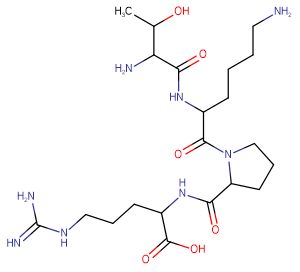
Tuftsin
CAS No. 9063-57-4
Tuftsin( —— )
Catalog No. M29991 CAS No. 9063-57-4
Tuftsin is a tetrapeptide (Thr-Lys-Pro-Arg) that specifically binds monocytes, macrophages, and polymorphonuclear leukocytes and potentiates their natural killer activity against tumors and pathogens.
Purity : >98% (HPLC)
 COA
Datasheet
HNMR
HPLC
MSDS
Handing Instructions
COA
Datasheet
HNMR
HPLC
MSDS
Handing Instructions
| Size | Price / USD | Stock | Quantity |
| 2MG | 29 | In Stock |


|
| 5MG | 46 | In Stock |
|
| 10MG | 65 | In Stock |
|
| 100MG | Get Quote | In Stock |
|
| 200MG | Get Quote | In Stock |
|
| 500MG | Get Quote | In Stock |
|
| 1G | Get Quote | In Stock |
|
Biological Information
-
Product NameTuftsin
-
NoteResearch use only, not for human use.
-
Brief DescriptionTuftsin is a tetrapeptide (Thr-Lys-Pro-Arg) that specifically binds monocytes, macrophages, and polymorphonuclear leukocytes and potentiates their natural killer activity against tumors and pathogens.
-
DescriptionTuftsin is a tetrapeptide (Thr-Lys-Pro-Arg) that specifically binds monocytes, macrophages, and polymorphonuclear leukocytes and potentiates their natural killer activity against tumors and pathogens.(In Vitro):Tuftsin is a tetrapeptide, Thr-Lys-Pro-Arg, which resides in the Fc-domain of the heavy chain of immunoglobulin G. Tuftsin possesses a broad spectrum of activities related primarily to the immune system function and exerts on phagocytic cells, notably on macrophages. Tuftsin's capacity to augment cellular activation is mediated by specific receptors that are identified, characterized, and recently isolated from rabbit peritoneal granulocytes. Tuftsin, a macrophage/microglial activator, dramatically improves the clinical course of experimental autoimmune encephalomyelitis (EAE), a well-established animal model for MS. Tuftsin administration correlates with upregulation of the immunosuppressive Helper-2 Tcell (Th2) cytokine transcription factor GATA-3. Tuftsin promotes phagocytic activity for cells of monocytic origin, such as neutrophils, macrophages and microglia, all of which are thought to express Tuftsin receptors.
-
In VitroTuftsin is a tetrapeptide, Thr-Lys-Pro-Arg, which resides in the Fc-domain of the heavy chain of immunoglobulin G. Tuftsin possesses a broad spectrum of activities related primarily to the immune system function and exerts on phagocytic cells, notably on macrophages. Tuftsin's capacity to augment cellular activation is mediated by specific receptors that are identified, characterized, and recently isolated from rabbit peritoneal granulocytes. Tuftsin, a macrophage/microglial activator, dramatically improves the clinical course of experimental autoimmune encephalomyelitis (EAE), a well-established animal model for MS. Tuftsin administration correlates with upregulation of the immunosuppressive Helper-2 Tcell (Th2) cytokine transcription factor GATA-3. Tuftsin promotes phagocytic activity for cells of monocytic origin, such as neutrophils, macrophages and microglia, all of which are thought to express Tuftsin receptors.
-
In Vivo——
-
Synonyms——
-
PathwayProteasome/Ubiquitin
-
TargetEndogenous Metabolite
-
RecptorHuman Endogenous Metabolite
-
Research Area——
-
Indication——
Chemical Information
-
CAS Number9063-57-4
-
Formula Weight500.59
-
Molecular FormulaC21H40N8O6
-
Purity>98% (HPLC)
-
SolubilityH2O : ≥ 160 mg/mL (319.62 mM)
-
SMILES——
-
Chemical NameSequence:Thr-Lys-Pro-Arg
Shipping & Storage Information
-
Storage(-20℃)
-
ShippingWith Ice Pack
-
Stability≥ 2 years
Reference
Fridkin M, et al. Tuftsin: its chemistry, biology, and clinical potential. Crit Rev Biochem Mol Biol. 1989;24(1):1-40.
molnova catalog



related products
-
Stigmastanol
Stigmastanol is a phytosterol isolated from Hypericum riparium, which is a Cameroonian medicinal plant.
-
2-Methoxybenzoic aci...
2-Methoxybenzoic acid is a novel antiemetic which prevents nausea and vomiting in humans.
-
1-Methylxanthine
1-Methylxanthine is a caffeine derivative. 1-Methylxanthine is an essential human urinary metabolite of caffeine and theophylline (1,3-dimethylxanthine, TP).
