


 Cart
 sales@molnova.com




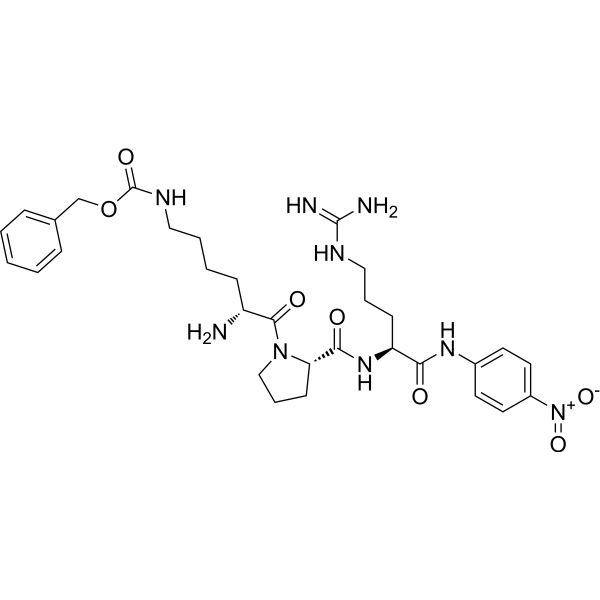
D-Lys(Z)-Pro-Arg-pNA
CAS No. 108963-69-5
D-Lys(Z)-Pro-Arg-pNA( Chromozym Pca )
Catalog No. M29895 CAS No. 108963-69-5
D-Lys(Z)-Pro-Arg-pNA is a luminescent substrate of activated protein C (APC).
Purity : >98% (HPLC)
 COA
Datasheet
HNMR
HPLC
MSDS
Handing Instructions
| Size | Price / USD | Stock | Quantity |
| 5MG | 311 | Get Quote |


|
| 10MG | 446 | Get Quote |
|
| 50MG | 1337 | Get Quote |
|
| 100MG | Get Quote | Get Quote |
|
| 200MG | Get Quote | Get Quote |
|
| 500MG | Get Quote | Get Quote |
|
| 1G | Get Quote | Get Quote |
|
Biological Information
-
Product NameD-Lys(Z)-Pro-Arg-pNA
-
NoteResearch use only, not for human use.
-
Brief DescriptionD-Lys(Z)-Pro-Arg-pNA is a luminescent substrate of activated protein C (APC).
-
DescriptionD-Lys(Z)-Pro-Arg-pNA is a luminescent substrate of activated protein C (APC).
-
In Vitro——
-
In Vivo——
-
SynonymsChromozym Pca
-
PathwayOthers
-
TargetOther Targets
-
Recptor——
-
Research Area——
-
Indication——
Chemical Information
-
CAS Number108963-69-5
-
Formula Weight653.73
-
Molecular FormulaC31H43N9O7
-
Purity>98% (HPLC)
-
Solubility——
-
SMILES——
-
Chemical NameSequence:{d-Lys(Z)}-Pro-Arg-pNA
Shipping & Storage Information
-
Storage(-20℃)
-
ShippingWith Ice Pack
-
Stability≥ 2 years
Reference


-
CADD522
CADD522 is a potent inhibitor of runt-related transcription factor-2 (RUNX2)-DNA binding with an IC50 of 10 nM, with antitumor activityCADD522 is a potent inhibitor of runt-related transcription factor-2 (RUNX2)-DNA binding( IC50 of 10 nM), has antitumor activity.
-
Anthrone
Anthrone is an organic compound commonly used as a dye and intermediate. It can be used to make products such as pigments, dyes and fluorescent whitening agents, and is widely used in certain industrial production fields such as textile manufacturing, soap making and paper making. In addition, this compound is also used as a reagent and catalyst in some organic synthesis reactions.
-
Lucidumol A
Lucidumol A has relatively good effect against aldose reductase with IC50 of 19.1uM. Lucidumol A has cytotoxic activity, it reduced cell growth in three human carcinoma cells (Caco-2, HepG2, and HeLa cells) dose dependently with LC50s from 20.87 to 84.36 uM.
