


 Cart
Cart
 sales@molnova.com



Conopressin S
CAS No. 111317-90-9
Conopressin S( Con-S )
Catalog No. M29891 CAS No. 111317-90-9
Conopressin S, isolated from Conus striatus, shows high affinity with vasopressin V1b receptor (AVPR1B), with a Ki of 8.3 nM.
Purity : >98% (HPLC)
 COA
Datasheet
HNMR
HPLC
MSDS
Handing Instructions
COA
Datasheet
HNMR
HPLC
MSDS
Handing Instructions
| Size | Price / USD | Stock | Quantity |
| 100MG | Get Quote | Get Quote |


|
| 200MG | Get Quote | Get Quote |
|
| 500MG | Get Quote | Get Quote |
|
| 1G | Get Quote | Get Quote |
|
Biological Information
-
Product NameConopressin S
-
NoteResearch use only, not for human use.
-
Brief DescriptionConopressin S, isolated from Conus striatus, shows high affinity with vasopressin V1b receptor (AVPR1B), with a Ki of 8.3 nM.
-
DescriptionConopressin S, isolated from Conus striatus, shows high affinity with vasopressin V1b receptor (AVPR1B), with a Ki of 8.3 nM.
-
In Vitro——
-
In Vivo——
-
SynonymsCon-S
-
PathwayOthers
-
TargetOther Targets
-
RecptorKi: 8.3 nM (AVPR1B)
-
Research Area——
-
Indication——
Chemical Information
-
CAS Number111317-90-9
-
Formula Weight1028.26
-
Molecular FormulaC41H73N17O10S2
-
Purity>98% (HPLC)
-
Solubility——
-
SMILES——
-
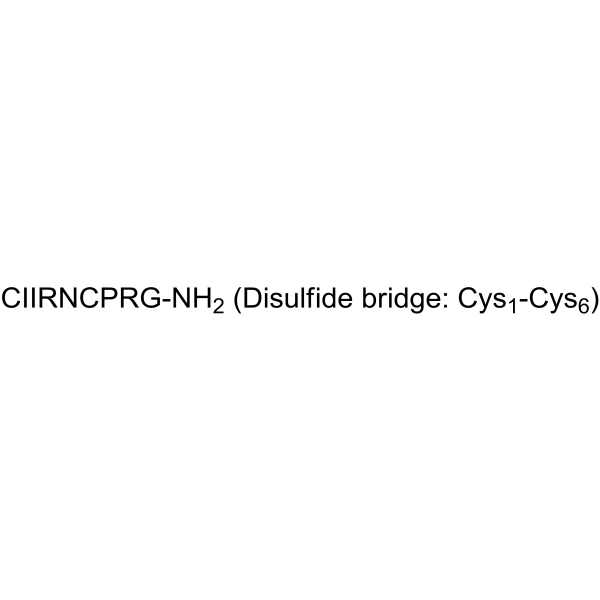
Chemical NameSequence:{Cys}{Ile}{Ile}{Arg}{Asn}{Cys}{Pro}{Arg}{Gly}-NH2(Disulfide bridge: Cys1-Cys6)
Shipping & Storage Information
-
Storage(-20℃)
-
ShippingWith Ice Pack
-
Stability≥ 2 years
Reference
Dutertre S, et al. Conopressin-T from Conus tulipa reveals an antagonist switch in vasopressin-like peptides. J Biol Chem. 2008 Mar 14;283(11):7100-8.
molnova catalog



related products
-
(-)-MK 801 Maleate
MK-801 is a potent, selective and non-competitive NMDA receptor antagonist with Kd of 37.2 nM in rat brain membranes.
-
Meloside A
Meloside A is a phenylpropanoid extracted from barley. Meloside A exhibits antioxidant and protective properties against excess UV-B radiation and has been linked to resistance to pathogens.
-
AG-10
AG-10 (Acoramidis) is an orally active and selective kinetic stabilizer of TTR (transthyretin). AG-10 exhibits activity for WT and V122I-TTR. AG-10 is used in the study of transthyretin amyloidosis.
