


 Cart
Cart
 sales@molnova.com



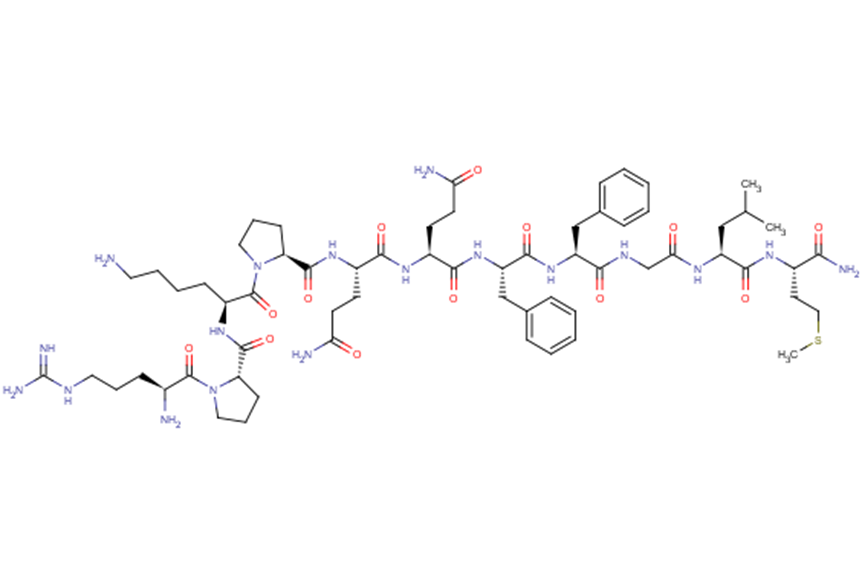
Substance P
CAS No. 33507-63-0
Substance P( —— )
Catalog No. M29786 CAS No. 33507-63-0
Substance P (SP) is an undecapeptide (a peptide composed of a chain of 11 amino acid residues) member of the tachykinin neuropeptide family.
Purity : >98% (HPLC)
 COA
Datasheet
HNMR
HPLC
MSDS
Handing Instructions
COA
Datasheet
HNMR
HPLC
MSDS
Handing Instructions
| Size | Price / USD | Stock | Quantity |
| 1 mL x 10 mM in DMSO | 297 | In Stock |


|
| 5MG | 112 | In Stock |
|
| 10MG | 179 | In Stock |
|
| 25MG | 380 | In Stock |
|
| 50MG | 553 | In Stock |
|
| 100MG | 790 | In Stock |
|
| 200MG | Get Quote | In Stock |
|
| 500MG | Get Quote | In Stock |
|
| 1G | Get Quote | In Stock |
|
Biological Information
-
Product NameSubstance P
-
NoteResearch use only, not for human use.
-
Brief DescriptionSubstance P (SP) is an undecapeptide (a peptide composed of a chain of 11 amino acid residues) member of the tachykinin neuropeptide family.
-
DescriptionSubstance P (SP) is an undecapeptide (a peptide composed of a chain of 11 amino acid residues) member of the tachykinin neuropeptide family.
-
In Vitro——
-
In Vivo——
-
Synonyms——
-
PathwayOthers
-
TargetOther Targets
-
RecptorHuman Endogenous Metabolite
-
Research Area——
-
Indication——
Chemical Information
-
CAS Number33507-63-0
-
Formula Weight1347.63
-
Molecular FormulaC63H98N18O13S
-
Purity>98% (HPLC)
-
SolubilityIn Vitro:?DMSO : 25 mg/mL (18.55 mM)
-
SMILES——
-
Chemical Name——
Shipping & Storage Information
-
Storage(-20℃)
-
ShippingWith Ice Pack
-
Stability≥ 2 years
Reference
molnova catalog



related products
-
8-CHLOROQUINAZOLIN-4...
8-CHLOROQUINAZOLIN-4(1H)-ONE is inhibitor of Poly [ADP-ribose] polymerase 1 (human).
-
SALMF amide 1 (S1)
SALMF amide 1 (S1)
-
SODIUM 2-HYDROXYBUTY...
2-Hydroxybutyric acid is formed as a by-product of the formation of alpha-ketobutyrate via a reaction catalyzed by lactate dehydrogenase (LDH) or alpha-hydroxybutyrate dehydrogenase (alphaHBDH).
