


 Cart
Cart
 sales@molnova.com



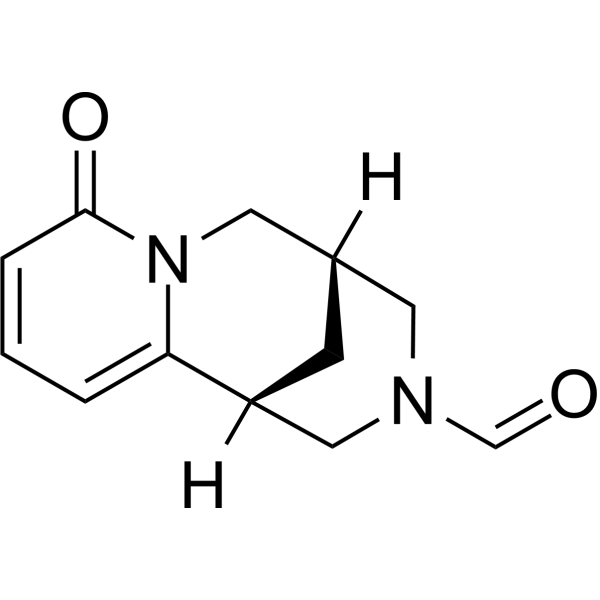
N-Formylcytisine
CAS No. 53007-06-0
N-Formylcytisine( (-)-N-Formylcytisine )
Catalog No. M29443 CAS No. 53007-06-0
N-Formylcytisine is a natural product isolated from the stem bark of Maackia amurensis.
Purity : >98% (HPLC)
 COA
Datasheet
HNMR
HPLC
MSDS
Handing Instructions
COA
Datasheet
HNMR
HPLC
MSDS
Handing Instructions
| Size | Price / USD | Stock | Quantity |
| 1 mL x 10 mM in DMSO | 97 | In Stock |


|
| 5MG | 89 | In Stock |
|
| 10MG | 131 | In Stock |
|
| 25MG | 220 | In Stock |
|
| 50MG | 319 | In Stock |
|
| 100MG | 458 | In Stock |
|
| 200MG | Get Quote | In Stock |
|
| 500MG | Get Quote | In Stock |
|
| 1G | Get Quote | In Stock |
|
Biological Information
-
Product NameN-Formylcytisine
-
NoteResearch use only, not for human use.
-
Brief DescriptionN-Formylcytisine is a natural product isolated from the stem bark of Maackia amurensis.
-
DescriptionN-Formylcytisine is a natural product isolated from the stem bark of Maackia amurensis.
-
In Vitro——
-
In Vivo——
-
Synonyms(-)-N-Formylcytisine
-
PathwayOthers
-
TargetOther Targets
-
Recptor——
-
Research Area——
-
Indication——
Chemical Information
-
CAS Number53007-06-0
-
Formula Weight436.5
-
Molecular FormulaC24H28N4O4
-
Purity>98% (HPLC)
-
SolubilityIn Vitro:?DMSO : 100 mg/mL (458.19 mM)
-
SMILESO=CN(C[C@H](C1)CN23)C[C@@H]1C3=CC=CC2=OO=CN(C[C@H](C1)CN23)C[C@@H]1C3=CC=CC2=O
-
Chemical Name——
Shipping & Storage Information
-
Storage(-20℃)
-
ShippingWith Ice Pack
-
Stability≥ 2 years
Reference
molnova catalog



related products
-
Boc-Met-Enkephalin
Boc-Met-Enkephalin
-
Aldosterone
Aldosterone, the primary mineralocorticoid, is synthesized and secreted by the zona glomerulosa of the adrenal cortex in response to activation of the renin-angiotensin system or high dietary potassium.
-
1-Ethoxycarbonyl-bet...
1-Ethoxycarbonyl-β-carboline is a natural product for research related to life sciences.
