


 Cart
Cart
 sales@molnova.com



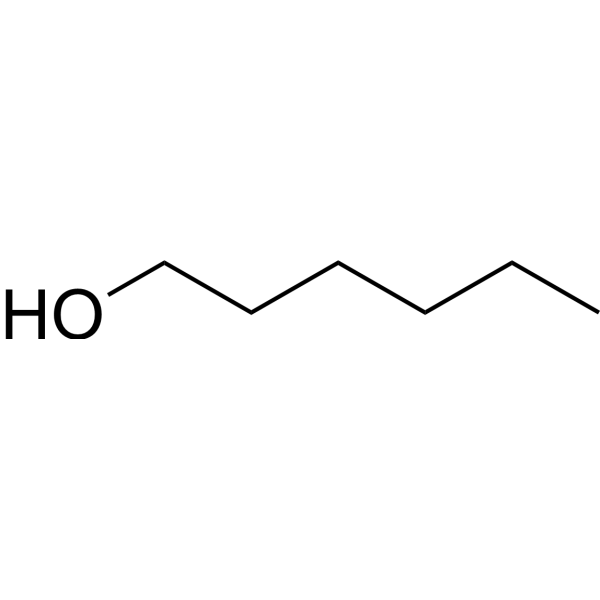
1-Hexanol
CAS No. 111-27-3
1-Hexanol( hexan-1-ol )
Catalog No. M29392 CAS No. 111-27-3
1-Hexanol is a natural product.1-Hexanol, a primary alcohol, is a surfactant that can be employed in industrial processes to enhance interfacial properties.
Purity : >98% (HPLC)
 COA
Datasheet
HNMR
HPLC
MSDS
Handing Instructions
COA
Datasheet
HNMR
HPLC
MSDS
Handing Instructions
| Size | Price / USD | Stock | Quantity |
| 1 mL x 10 mM in DMSO | 28 | In Stock |


|
| 100MG | Get Quote | In Stock |
|
| 200MG | Get Quote | In Stock |
|
| 500MG | 35 | In Stock |
|
| 1G | Get Quote | In Stock |
|
Biological Information
-
Product Name1-Hexanol
-
NoteResearch use only, not for human use.
-
Brief Description1-Hexanol is a natural product.1-Hexanol, a primary alcohol, is a surfactant that can be employed in industrial processes to enhance interfacial properties.
-
Description1-Hexanol is a natural product.1-Hexanol, a primary alcohol, is a surfactant that can be employed in industrial processes to enhance interfacial properties. 1-Hexanol uncouples mitochondrial respiration by a non-protonophoric mechanism.
-
In Vitro——
-
In Vivo——
-
Synonymshexan-1-ol
-
PathwayOthers
-
TargetOther Targets
-
Recptor——
-
Research Area——
-
Indication——
Chemical Information
-
CAS Number111-27-3
-
Formula Weight102.177
-
Molecular FormulaC6H14O
-
Purity>98% (HPLC)
-
SolubilityIn Vitro:?Ethanol : 100 mg/mL (978.76 m)
-
SMILESCCCCCCO
-
Chemical Name——
Shipping & Storage Information
-
Storage(-20℃)
-
ShippingWith Ice Pack
-
Stability≥ 2 years
Reference
molnova catalog



related products
-
δ-MSH | Delta-MSH
δ-MSH | Delta-MSH
-
H-DL-Val-OEt HCl
H-DL-Val-OEt HCl is a valine derivative that inhibits excessive secretion of sebum from the scalp.
-
Quercetin 3-O-β-D-xy...
Mutabiloside is a natural product with anti-allergic activity. Mutabiloside can be used in the study of complex allergic reactions.
