


 Cart
Cart
 sales@molnova.com



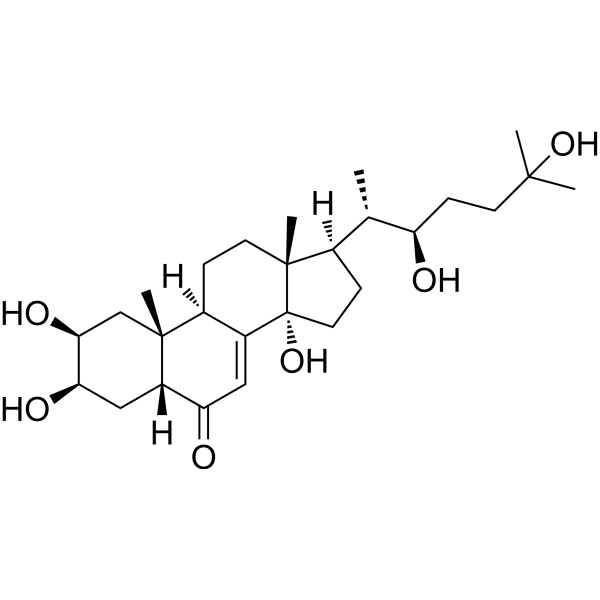
Ecdysone
CAS No. 3604-87-3
Ecdysone( α-Ecdysone )
Catalog No. M29297 CAS No. 3604-87-3
Ecdysone is a major steroid hormone in insects and herbs. Ecdysone triggers mineralocorticoid receptor activation and induces cellular apoptosis. Ecdysone signaling through Ecdysone receptor isoform B1 is required cell autonomously for the muscle death.
Purity : >98% (HPLC)
 COA
Datasheet
HNMR
HPLC
MSDS
Handing Instructions
COA
Datasheet
HNMR
HPLC
MSDS
Handing Instructions
| Size | Price / USD | Stock | Quantity |
| 5MG | 305 | In Stock |


|
| 10MG | 445 | In Stock |
|
| 25MG | 713 | In Stock |
|
| 50MG | 958 | In Stock |
|
| 100MG | 1293 | In Stock |
|
| 200MG | 1748 | In Stock |
|
| 500MG | Get Quote | In Stock |
|
| 1G | Get Quote | In Stock |
|
Biological Information
-
Product NameEcdysone
-
NoteResearch use only, not for human use.
-
Brief DescriptionEcdysone is a major steroid hormone in insects and herbs. Ecdysone triggers mineralocorticoid receptor activation and induces cellular apoptosis. Ecdysone signaling through Ecdysone receptor isoform B1 is required cell autonomously for the muscle death.
-
DescriptionEcdysone is a major steroid hormone in insects and herbs. Ecdysone triggers mineralocorticoid receptor activation and induces cellular apoptosis. Ecdysone signaling through Ecdysone receptor isoform B1 is required cell autonomously for the muscle death.(In Vitro):Ecdysone (10, 100 nM) induced the expression of a-smooth muscle actin (SMA). Ecdysone elevated the expression of cleaved caspase 3 in a dose dependent manner. Ecdysone (10, 100 nM) suppressed cell motility and scratch wound closure to a comparable extent. Ecdysone (100 nM) induced a branched spindle mesenchymal-like cell shape. Ecdysone (100 nM) caused renal tubular inner medullary collecting duct cells apoptosis.(In Vivo):In male C57BL/6 mice, Ecdysone (6 μg/g/day; s.c.) significantly impaired renal function, and BUN levels were statistically significantly increased, amplifying the renal expression of α-SMA. Ecdysone also displayed MR-dependent nephrotic effects.
-
In VitroEcdysone (α-Ecdysone; 100 nM; for 48 hours) causes renal tubular inner medullary collecting duct cells (IMCD) apoptosis. Ecdysone (10, 100 nM; for 48 hours) induces the expression of a-smooth muscle actin (SMA), a standard mesenchymal marker in a dose dependent fashion in inner medullary collecting duct cells (IMCD). Ecdysone elevates the expression of cleaved caspase 3 in a dose dependent fashion. Ecdysone (10, 100 nM; for 12, 24 hours) suppresses cell motility and scratch wound closure to a comparable extent. Ecdysone treatments (100 nM; for 24, 48 hours) induces a branched spindle mesenchymal-like cell shape. Apoptosis Analysis Cell Line:Inner medullary collecting duct cells (IMCD)Concentration:100 nM Incubation Time:For 48 hours Result:Caused renal tubular cell apoptosis.Western Blot Analysis Cell Line:IMCD cells Concentration:10, 100 nM Incubation Time:For 48 hours Result:Induced the expression of a-smooth muscle actin (SMA), a standard mesenchymal marker in a dose dependent fashion.
-
In VivoEcdysone (α-Ecdysone; 6 μg/g/day; SC; for 14 days) evidently impaires kidney function marked by a statistically significant increase in BUN levels and amplifies renal expression of α-SMA in male C57BL/6 mice aged 10 weeks. Ecdysone confers an MR dependent nephropathic effect.
-
Synonymsα-Ecdysone
-
PathwayApoptosis
-
TargetApoptosis
-
RecptorApoptosis
-
Research Area——
-
Indication——
Chemical Information
-
CAS Number3604-87-3
-
Formula Weight464.63
-
Molecular FormulaC27H44O6
-
Purity>98% (HPLC)
-
SolubilityIn Vitro:?DMSO : 50 mg/mL (107.61 mM)
-
SMILESC[C@H]([C@H](O)CCC(C)(C)O)C1CC[C@@]2(O)C3=CC(=O)[C@@H]4C[C@@H](O)[C@@H](O)C[C@]4(C)C3CC[C@]12C
-
Chemical Name——
Shipping & Storage Information
-
Storage(-20℃)
-
ShippingWith Ice Pack
-
Stability≥ 2 years
Reference
molnova catalog



related products
-
Examorelin Aceate (1...
Hexarelin?is a growth hormone capable of apoptosis inhibition.
-
Sandalore
Sandalore prolongs human hair growth by decreasing apoptosis and increasing the production of the anagen-prolonging growth factor IGF-1 in the outer root sheath. Sandalore is a selective agonist of olfactory receptor OR2AT4.
-
Flavokawain B
Flavokawain B is a natural chalcone that can induce apoptosis in androgen receptor-negative, hormone-refractory prostate cancer cell lines (IC50=3-50 uM).
