


 Cart
Cart
 sales@molnova.com



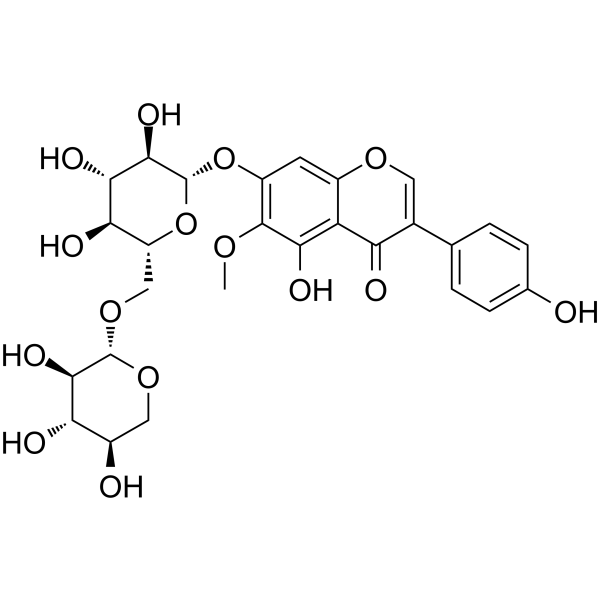
Tectorigenin 7-?O-?Xylosyl Glucoside
CAS No. 231288-19-0
Tectorigenin 7-?O-?Xylosyl Glucoside( Tectorigenin 7-O-xylosylglucoside )
Catalog No. M29234 CAS No. 231288-19-0
Tectorigenin 7-O-xylosylglucoside is a natural product.
Purity : >98% (HPLC)
 COA
Datasheet
HNMR
HPLC
MSDS
Handing Instructions
COA
Datasheet
HNMR
HPLC
MSDS
Handing Instructions
| Size | Price / USD | Stock | Quantity |
| 1 mL x 10 mM in DMSO | 372 | In Stock |


|
| 5MG | 244 | In Stock |
|
| 10MG | 361 | In Stock |
|
| 25MG | 606 | In Stock |
|
| 50MG | 828 | In Stock |
|
| 100MG | Get Quote | In Stock |
|
| 200MG | Get Quote | In Stock |
|
| 500MG | Get Quote | In Stock |
|
| 1G | Get Quote | In Stock |
|
Biological Information
-
Product NameTectorigenin 7-?O-?Xylosyl Glucoside
-
NoteResearch use only, not for human use.
-
Brief DescriptionTectorigenin 7-O-xylosylglucoside is a natural product.
-
DescriptionTectorigenin 7-O-xylosylglucoside is a natural product.
-
In Vitro——
-
In Vivo——
-
SynonymsTectorigenin 7-O-xylosylglucoside
-
PathwayOthers
-
TargetOther Targets
-
Recptor——
-
Research Area——
-
Indication——
Chemical Information
-
CAS Number231288-19-0
-
Formula Weight594.522
-
Molecular FormulaC27H30O15
-
Purity>98% (HPLC)
-
Solubility——
-
SMILESCOc1c(O[C@@H]2O[C@H](CO[C@@H]3OC[C@@H](O)[C@H](O)[C@H]3O)[C@@H](O)[C@H](O)[C@H]2O)cc2occ(-c3ccc(O)cc3)c(=O)c2c1O
-
Chemical Name——
Shipping & Storage Information
-
Storage(-20℃)
-
ShippingWith Ice Pack
-
Stability≥ 2 years
Reference



-
TAPI 2
ADAM-17 (TACE) and MMP inhibitor (Ki = 120 nM at ADAM-17). Sensitizes cancer stem cells to the lethal effects of 5-FU in vitro. Blocks shedding of TNF-α from cell membranes.
-
CCI-006
CCI-006 is a selective inhibitor and chemosensitizer of MLL-rearranged leukemia cells. It inhibits mitochondrial respiration resulting in insurmountable mitochondrial depolarization and a pro-apoptotic unfolded protein response in a subset of MLL-r leukemia cells.
-
2'-Deoxyadenosine 5'...
Adenosine is a nucleoside comprised of adenine attached to a ribose (ribofuranose) moiety via a -N9-glycosidic bond. Deoxyadenosine monophosphate is a derivative of the common nucleic acid ATP or adenosine triphosphate in which the -OH (hydroxyl) group on the 2' carbon on the nucleotide's pentose has been removed (hence the deoxy- part of the name).
