


 Cart
Cart
 sales@molnova.com



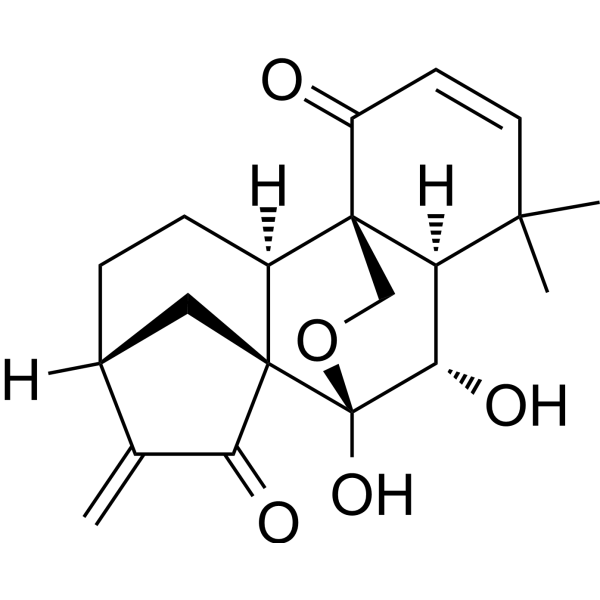
Eriocalyxin B
CAS No. 84745-95-9
Eriocalyxin B( —— )
Catalog No. M29139 CAS No. 84745-95-9
Eriocalyxin B induces apoptosis and cell cycle arrest in pancreatic adenocarcinoma cells through caspase- and p53-dependent pathways, should be considered a candidate for pancreatic cancer treatment.
Purity : >98% (HPLC)
 COA
Datasheet
HNMR
HPLC
MSDS
Handing Instructions
COA
Datasheet
HNMR
HPLC
MSDS
Handing Instructions
| Size | Price / USD | Stock | Quantity |
| 1 mL x 10 mM in DMSO | 699 | In Stock |


|
| 5MG | 655 | In Stock |
|
| 10MG | 924 | In Stock |
|
| 25MG | 1359 | In Stock |
|
| 50MG | 1795 | In Stock |
|
| 100MG | 2446 | In Stock |
|
| 200MG | Get Quote | In Stock |
|
| 500MG | Get Quote | In Stock |
|
| 1G | Get Quote | In Stock |
|
Biological Information
-
Product NameEriocalyxin B
-
NoteResearch use only, not for human use.
-
Brief DescriptionEriocalyxin B induces apoptosis and cell cycle arrest in pancreatic adenocarcinoma cells through caspase- and p53-dependent pathways, should be considered a candidate for pancreatic cancer treatment.
-
DescriptionEriocalyxin B induces apoptosis and cell cycle arrest in pancreatic adenocarcinoma cells through caspase- and p53-dependent pathways, should be considered a candidate for pancreatic cancer treatment; it is a specific inhibitor of STAT3, it directly targets STAT3 through a covalent linkage to inhibit the phosphorylation and activation of STAT3 and induces apoptosis of STAT3-dependent tumor cells.(In Vitro):In this study, we demonstrated that Eriocalyxin B was efficacious in experimental autoimmune encephalomyelitis (EAE), an animal model for multiple sclerosis. Treatment with Eriocalyxin B led to amelioration of EAE, which correlated with reduced spinal cord inflammation and demyelination. Eriocalyxin B treatment abolished encephalitogenic T-cell responses to myelin oligodendrocyte glycoprotein in an adoptive transfer EAE model. The underlying mechanism of Eriocalyxin B-induced effects involved inhibition of T helper (Th) 1 and Th17 cell differentiation through Janus Kinase/Signal Transducer and Activator Of Transcription and Nuclear factor-κB signaling pathways as well as elevation of reactive oxygen species.
-
In Vitro——
-
In Vivo——
-
Synonyms——
-
PathwayApoptosis
-
TargetApoptosis
-
RecptorApoptosis
-
Research Area——
-
Indication——
Chemical Information
-
CAS Number84745-95-9
-
Formula Weight344.407
-
Molecular FormulaC20H24O5
-
Purity>98% (HPLC)
-
Solubility——
-
SMILES[H][C@@]12CC[C@@H]3C[C@]1(C(=O)C3=C)[C@@]1(O)OC[C@]22C(=O)C=CC(C)(C)[C@@]2([H])[C@@H]1O
-
Chemical Name——
Shipping & Storage Information
-
Storage(-20℃)
-
ShippingWith Ice Pack
-
Stability≥ 2 years
Reference
molnova catalog



related products
-
5-Amino-5-deoxyadeno...
5'-Amino-5'-deoxyadenosine (NH2dAdo) is an adenosine kinase inhibitor targeting malignant tumors of the inert lymphatic system with antitumor and anticancer effects.
-
Complanatoside
Complanatuside is a flavonoid found in the traditional Chinese medicine Semen Astragali Complanati.
-
LCS3
LCS3 is a reversible and non-competitive synergistic inhibitor of glutathione disulfide reductase (GSR) and thioredoxin reductase 1 (TXNRD1) with IC50s of 3.3 μM and 3.8 μM, respectively.
