


 Cart
Cart
 sales@molnova.com



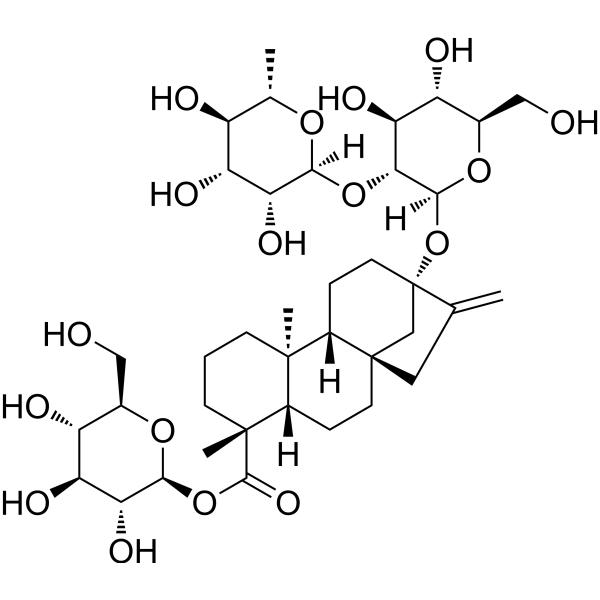
Dulcoside A
CAS No. 64432-06-0
Dulcoside A( —— )
Catalog No. M29134 CAS No. 64432-06-0
Dulcoside A is isolated from Stevia rebaudiana. Dulcoside A is a sweetener and has antioxidant activity.
Purity : >98% (HPLC)
 COA
Datasheet
HNMR
HPLC
MSDS
Handing Instructions
COA
Datasheet
HNMR
HPLC
MSDS
Handing Instructions
| Size | Price / USD | Stock | Quantity |
| 1 mL x 10 mM in DMSO | 187 | In Stock |


|
| 5MG | 312 | In Stock |
|
| 10MG | 467 | In Stock |
|
| 100MG | Get Quote | In Stock |
|
| 200MG | Get Quote | In Stock |
|
| 500MG | Get Quote | In Stock |
|
| 1G | Get Quote | In Stock |
|
Biological Information
-
Product NameDulcoside A
-
NoteResearch use only, not for human use.
-
Brief DescriptionDulcoside A is isolated from Stevia rebaudiana. Dulcoside A is a sweetener and has antioxidant activity.
-
DescriptionDulcoside A is isolated from Stevia rebaudiana. Dulcoside A is a sweetener and has antioxidant activity.
-
In Vitro——
-
In Vivo——
-
Synonyms——
-
PathwayOthers
-
TargetOther Targets
-
Recptor——
-
Research Area——
-
Indication——
Chemical Information
-
CAS Number64432-06-0
-
Formula Weight788.881
-
Molecular FormulaC38H60O17
-
Purity>98% (HPLC)
-
Solubility——
-
SMILESC[C@@H]1O[C@@H](O[C@@H]2[C@@H](O)[C@H](O)[C@@H](CO)O[C@H]2O[C@@]23C[C@]4(CC2=C)CC[C@H]2[C@@](C)(CCC[C@@]2(C)C(=O)O[C@@H]2O[C@H](CO)[C@@H](O)[C@H](O)[C@H]2O)[C@@H]4CC3)[C@H](O)[C@H](O)[C@H]1O
-
Chemical Name——
Shipping & Storage Information
-
Storage(-20℃)
-
ShippingWith Ice Pack
-
Stability≥ 2 years
Reference
molnova catalog



related products
-
Zinquin ethyl ester
Zinquin ethyl ester is a cell membrane-penetrating and selective fluorescent probe for zinc ions that measures intracellular levels of Zn(2+) and Ca(2+) ions and can be used to stain early embryos.
-
Torachrysone Trigluc...
Torachrysone Triglucoside is a glucoside isolated from cassia seeds with potential antitumor activity.
-
Fibronectin Adhesion...
Fibronectin Adhesion-promoting Peptide (Heparin Binding Peptide) is one of the heparin-binding amino acid sequences found in the carboxy-terminal heparin-binding domain of fibronectin.
