


 Cart
Cart
 sales@molnova.com



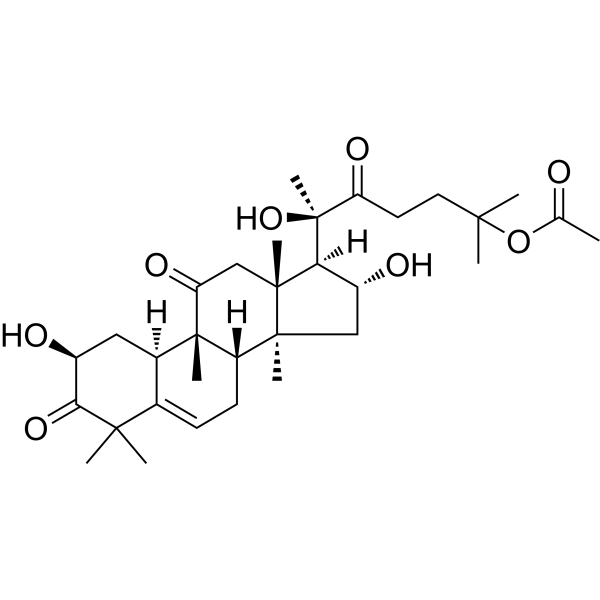
Dihydrocucurbitacin B
CAS No. 13201-14-4
Dihydrocucurbitacin B( 23,24-dihydrocucurbitacin B )
Catalog No. M29129 CAS No. 13201-14-4
Dihydrocucurbitacin B is isolated from the roots of Cayaponia tayuya with anti-cancer activity.
Purity : >98% (HPLC)
 COA
Datasheet
HNMR
HPLC
MSDS
Handing Instructions
COA
Datasheet
HNMR
HPLC
MSDS
Handing Instructions
| Size | Price / USD | Stock | Quantity |
| 2MG | 138 | In Stock |


|
| 5MG | 235 | In Stock |
|
| 10MG | 336 | In Stock |
|
| 25MG | 537 | In Stock |
|
| 100MG | Get Quote | In Stock |
|
| 200MG | Get Quote | In Stock |
|
| 500MG | Get Quote | In Stock |
|
| 1G | Get Quote | In Stock |
|
Biological Information
-
Product NameDihydrocucurbitacin B
-
NoteResearch use only, not for human use.
-
Brief DescriptionDihydrocucurbitacin B is isolated from the roots of Cayaponia tayuya with anti-cancer activity.
-
DescriptionDihydrocucurbitacin B is isolated from the roots of Cayaponia tayuya with anti-cancer activity.(In Vitro):Dihydrocucurbitacin B inhibits NFAT and delayed-type hypersensitivity and induces cell cycle arrest in the G0 phase.
-
In Vitro——
-
In Vivo——
-
Synonyms23,24-dihydrocucurbitacin B
-
PathwayApoptosis
-
TargetIL Receptor
-
RecptorIL Receptor
-
Research Area——
-
Indication——
Chemical Information
-
CAS Number13201-14-4
-
Formula Weight560.728
-
Molecular FormulaC32H48O8
-
Purity>98% (HPLC)
-
Solubility——
-
SMILES[H][C@@]12C[C@H](O)C(=O)C(C)(C)C1=CC[C@@]1([H])[C@]3(C)C[C@@H](O)[C@H]([C@@](C)(O)C(=O)CCC(C)(C)OC(C)=O)[C@@]3(C)CC(=O)[C@@]21C
-
Chemical Name——
Shipping & Storage Information
-
Storage(-20℃)
-
ShippingWith Ice Pack
-
Stability≥ 2 years
Reference
molnova catalog



related products
-
Ixekizumab
Ixekizumab (LY2439821) is a humanized IgG4 monoclonal antibody that selectively binds and neutralizes interleukin IL-17A with a Kd value of <3 pM. It blocks the binding of IL-17A to IL-17RA but not to other IL-17 family members.
-
Ordesekimab
Ordesekimab (AMG 714) is a human IgG1 κ-anti-IL-15 (Interleukin Related) monoclonal antibody.
-
Apilimod 2HCl
Apilimod 2HCl (STA 5326 2HCl) is a PIKFYVE kinase inhibitor that promotes NLRP3 inflammatory vesicle activation, IL-1β secretion, and cellular pyroptosis, and is used in the study of amyotrophic lateral sclerosis.
