


 Cart
Cart
 sales@molnova.com



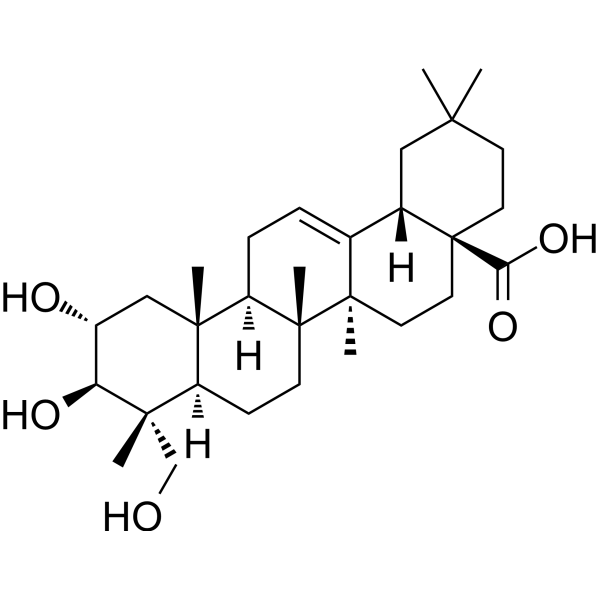
Arjunolic acid
CAS No. 465-00-9
Arjunolic acid( —— )
Catalog No. M29092 CAS No. 465-00-9
Arjunolic acid has antioxidant, anti-inflammatory, antinociceptive and anticholinesterasic (AChE and BuChE) activities, it may as promising targets for the development of innovative multi-functional medicines for Alzheimer desease treatment.
Purity : >98% (HPLC)
 COA
Datasheet
HNMR
HPLC
MSDS
Handing Instructions
COA
Datasheet
HNMR
HPLC
MSDS
Handing Instructions
| Size | Price / USD | Stock | Quantity |
| 1 mL x 10 mM in DMSO | 448 | In Stock |


|
| 5MG | 416 | In Stock |
|
| 10MG | 615 | In Stock |
|
| 25MG | 938 | In Stock |
|
| 50MG | 1283 | In Stock |
|
| 100MG | 1730 | In Stock |
|
| 200MG | Get Quote | In Stock |
|
| 500MG | Get Quote | In Stock |
|
| 1G | Get Quote | In Stock |
|
Biological Information
-
Product NameArjunolic acid
-
NoteResearch use only, not for human use.
-
Brief DescriptionArjunolic acid has antioxidant, anti-inflammatory, antinociceptive and anticholinesterasic (AChE and BuChE) activities, it may as promising targets for the development of innovative multi-functional medicines for Alzheimer desease treatment.
-
DescriptionArjunolic acid has antioxidant, anti-inflammatory, antinociceptive and anticholinesterasic (AChE and BuChE) activities, it may as promising targets for the development of innovative multi-functional medicines for Alzheimer desease treatment.(In Vitro):The multifunctional therapeutic application of Arjunolic acid has already been documented by its various biological functions including antioxidant, anti-fungal, anti-bacterial, anticholinesterase, antitumor, antiasthmatic, wound healing and insect growth inhibitor activities. The scientific basis behind its therapeutic application as a cardioprotective agent in traditional medicine is justified by its ability to prevent myocardial necrosis and apoptosis, platelet aggregation, coagulation and lowering of blood pressure, heart rate, as well as cholesterol levels. Its antioxidant property coupled with metal chelating property (by its two hydroxyl groups) protects different organs from metal and drug-induced organ pathophysiology. Arjunolic acid also plays a beneficial role in the pathogenesis of diabetes and its associated complications. The mechanism of cytoprotection of Arjunolic acid, at least in part, results from the detoxification of reactive oxygen species (ROS) produced in the respective pathophysiology. In addition to its other biological functions, it also possesses vibrant insecticidal properties and it has the potential to be used as a structural molecular framework for the design of molecular receptors in the general area of supramolecular chemistry and nanochemistry. Esters of Arjunolic acid function as organogelators which has wide application in designing thermochromic switches and sensor devices. Arjunolic acid derived crown ether is an attractive candidate for the design of molecular receptors, biomimetics and supramolecular systems capable of performing some biological functions.
-
In Vitro——
-
In Vivo——
-
Synonyms——
-
PathwayApoptosis
-
TargetIL Receptor
-
RecptorIL Receptor
-
Research Area——
-
Indication——
Chemical Information
-
CAS Number465-00-9
-
Formula Weight488.709
-
Molecular FormulaC30H48O5
-
Purity>98% (HPLC)
-
SolubilityIn Vitro:?DMSO : 100 mg/mL (204.62 mM)
-
SMILESCC1(C)CC[C@@]2(CC[C@]3(C)C(=CCC4[C@@]5(C)C[C@@H](O)[C@H](O)[C@@](C)(CO)C5CC[C@@]34C)C2C1)C(O)=O
-
Chemical Name——
Shipping & Storage Information
-
Storage(-20℃)
-
ShippingWith Ice Pack
-
Stability≥ 2 years
Reference
molnova catalog



related products
-
VGX-1027
VGX-1027(GIT27) is an isoxazole compound that exhibits various immunomodulatory properties; reduce the secretion of IL-1beta, TNF-alpha and IL-10 from purified murine macrophages.
-
(E)-Ferulic acid met...
Methyl (E)-ferulate is a possible inhibitor of the mitogen activated phosphor kinase pathway, it could be a potential anti-inflammatory agent isolated for the first time in medicinal plant S. tuberosa. Methyl (E)-ferulate has promising anthelmintic activity against Haemonchus contortus.
-
Bornyl acetate
Bornyl acetate is the main volatile constituent in numerous conifer oils and some Chinese traditional herbs.
