


 Cart
Cart
 sales@molnova.com



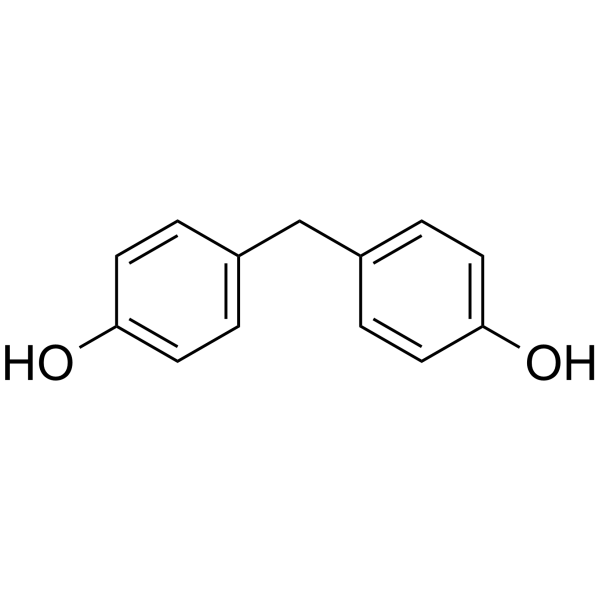
4,4'-Methylenediphenol
CAS No. 620-92-8
4,4'-Methylenediphenol( —— )
Catalog No. M29033 CAS No. 620-92-8
4,4'-Methylenediphenol is a high purity product from Gastrodia rhizome with antioxidant activities.
Purity : >98% (HPLC)
 COA
Datasheet
HNMR
HPLC
MSDS
Handing Instructions
COA
Datasheet
HNMR
HPLC
MSDS
Handing Instructions
| Size | Price / USD | Stock | Quantity |
| 1 mL x 10 mM in DMSO | 28 | In Stock |


|
| 100MG | Get Quote | In Stock |
|
| 200MG | Get Quote | In Stock |
|
| 500MG | Get Quote | In Stock |
|
| 1G | 27 | In Stock |
|
Biological Information
-
Product Name4,4'-Methylenediphenol
-
NoteResearch use only, not for human use.
-
Brief Description4,4'-Methylenediphenol is a high purity product from Gastrodia rhizome with antioxidant activities.
-
Description4,4'-Methylenediphenol is a high purity product from Gastrodia rhizome with antioxidant activities.(In Vitro):Gastrodia rhizome, a dried and steamed tuber of Gastrodia elata Blume (Orchidaceae), has been traditionally used in Korea, China and Japan for the treatment of neurological and nervous disorders such as headaches, dizziness, vertigo and convulsive illnesses. The ethyl acetate and water extracts of G. elata stimulated plasmin activity.
-
In Vitro——
-
In Vivo——
-
Synonyms——
-
PathwayOthers
-
TargetOther Targets
-
Recptor——
-
Research Area——
-
Indication——
Chemical Information
-
CAS Number620-92-8
-
Formula Weight200.237
-
Molecular FormulaC13H12O2
-
Purity>98% (HPLC)
-
SolubilityIn Vitro:?DMSO : 100 mg/mL (499.40 mM)
-
SMILESOc1ccc(Cc2ccc(O)cc2)cc1
-
Chemical Name——
Shipping & Storage Information
-
Storage(-20℃)
-
ShippingWith Ice Pack
-
Stability≥ 2 years
Reference
molnova catalog



related products
-
(Pyr6,Pro9)-Substanc...
Septide ((Pyr6,Pro9)-Substance P) is a potent NK1 receptor agonist with a Kd value of 0.55 nM.
-
Geranylacetone
Geranylacetone has trypanostatic activity and could protect animals against the T. congolense-induced anaemia through the inhibition of sialidase and/or the protection of the parasite-induced hepatosplenomegaly.
-
Fluoranthene
Fluoranthene is a chemical compound.
