


 Cart
Cart
 sales@molnova.com



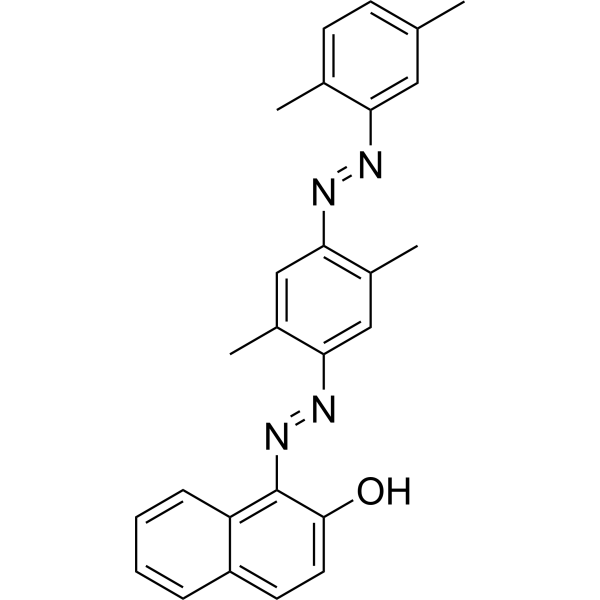
Oil Red O
CAS No. 1320-06-5
Oil Red O( —— )
Catalog No. M29023 CAS No. 1320-06-5
The dry dye Oil red O is used for the preparation of a staining solution that can be used for the detection of lipids in histological cryo sections.
Purity : >98% (HPLC)
 COA
Datasheet
HNMR
HPLC
MSDS
Handing Instructions
COA
Datasheet
HNMR
HPLC
MSDS
Handing Instructions
| Size | Price / USD | Stock | Quantity |
| 100MG | Get Quote | In Stock |


|
| 200MG | Get Quote | In Stock |
|
| 500MG | Get Quote | In Stock |
|
| 1G | Get Quote | In Stock |
|
Biological Information
-
Product NameOil Red O
-
NoteResearch use only, not for human use.
-
Brief DescriptionThe dry dye Oil red O is used for the preparation of a staining solution that can be used for the detection of lipids in histological cryo sections.
-
DescriptionThe dry dye Oil red O is used for the preparation of a staining solution that can be used for the detection of lipids in histological cryo sections.
-
In Vitro——
-
In Vivo——
-
Synonyms——
-
PathwayOthers
-
TargetOther Targets
-
Recptor——
-
Research Area——
-
Indication——
Chemical Information
-
CAS Number1320-06-5
-
Formula Weight408.49
-
Molecular FormulaC26H24N4O
-
Purity>98% (HPLC)
-
SolubilityIn Vitro:?DMSO : 4.17 mg/mL (10.21 mM)
-
SMILESOC1=CC=C2C=CC=CC2=C1/N=N/C3=CC=C(/N=N/C4=CC=CC(C)=C4C)C(C)=C3C
-
Chemical Name——
Shipping & Storage Information
-
Storage(-20℃)
-
ShippingWith Ice Pack
-
Stability≥ 2 years
Reference
molnova catalog



related products
-
4u8C
4μ8C is a potent and selective IRE1 Rnase inhibitor with IC50 of 76 nM.
-
(Ser8)-GLP-1 (7-36) ...
(Ser8)-GLP-1 (7-36) amide, human is a glucagon-like peptide 1 amide derived from glucagonogen, a cleavage product of the GLP-1 (1-36) amide peptide. (Ser8)-GLP-1 (7-36) amide, human is an entero-insulinotropic hormone that causes glucose-dependent release of insulin from pancreatic β-cells and affects gastrointestinal motility and secretion.
-
Theaflavin-3'-Gallat...
Theaflavin-3'-gallate, act as prooxidants and induce oxidative stress, with carcinoma cells more sensitive than normal fibroblasts.
