


 Cart
Cart
 sales@molnova.com



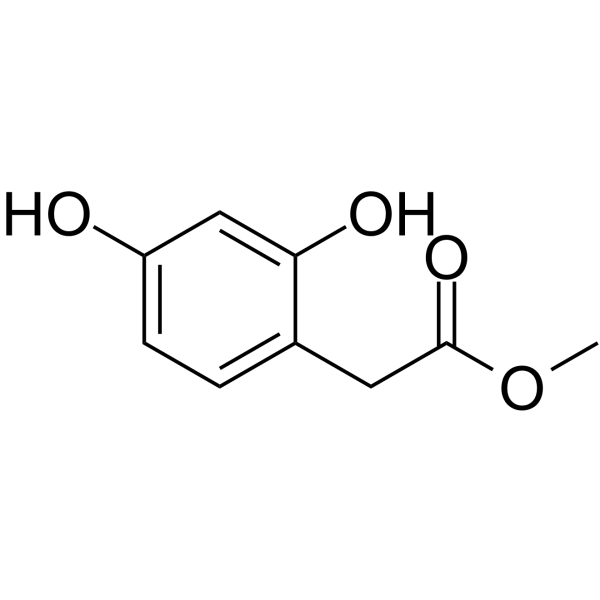
Methyl 2,4-dihydroxyphenylacetate
CAS No. 67828-42-6
Methyl 2,4-dihydroxyphenylacetate( —— )
Catalog No. M28968 CAS No. 67828-42-6
Methyl 2,4-dihydroxyphenylacetate is a natural product isolated from Nigella damascena seeds with selective phytotoxic effects.
Purity : >98% (HPLC)
 COA
Datasheet
HNMR
HPLC
MSDS
Handing Instructions
COA
Datasheet
HNMR
HPLC
MSDS
Handing Instructions
| Size | Price / USD | Stock | Quantity |
| 1 mL x 10 mM in DMSO | 37 | In Stock |


|
| 10MG | 42 | In Stock |
|
| 25MG | 67 | In Stock |
|
| 50MG | 91 | In Stock |
|
| 100MG | 138 | In Stock |
|
| 200MG | Get Quote | In Stock |
|
| 500MG | Get Quote | In Stock |
|
| 1G | Get Quote | In Stock |
|
Biological Information
-
Product NameMethyl 2,4-dihydroxyphenylacetate
-
NoteResearch use only, not for human use.
-
Brief DescriptionMethyl 2,4-dihydroxyphenylacetate is a natural product isolated from Nigella damascena seeds with selective phytotoxic effects.
-
DescriptionMethyl 2,4-dihydroxyphenylacetate is a natural product isolated from Nigella damascena seeds with selective phytotoxic effects.
-
In Vitro——
-
In Vivo——
-
Synonyms——
-
PathwayOthers
-
TargetOther Targets
-
RecptorPARP1|ARTD-1
-
Research Area——
-
Indication——
Chemical Information
-
CAS Number67828-42-6
-
Formula Weight182.175
-
Molecular FormulaC9H10O4
-
Purity>98% (HPLC)
-
SolubilityIn Vitro:?DMSO : 100 mg/mL (548.94 mM)
-
SMILESCOC(=O)Cc1ccc(O)cc1O
-
Chemical Name——
Shipping & Storage Information
-
Storage(-20℃)
-
ShippingWith Ice Pack
-
Stability≥ 2 years
Reference
1.Haikarainen T, et al. Evaluation and Structural Basis for the Inhibition of Tankyrases by PARP Inhibitors.ACS Med Chem Lett.?2013?Nov 20;5(1):18-22.
molnova catalog



related products
-
4-(4,5-dibromo-6-oxo...
4-(4,5-dibromo-6-oxo-1,6-dihydropyridazin-1-yl)benzene-1-sulfonamide is a chemical compound.
-
Hydrocortisone acepo...
Hydrocortisone aceponate (Hydrocortisone 17-propionate 21-acetate) is an effective topical glucocorticoid cream used to treat various skin diseases.
-
Cholecystokinin Octa...
Cholecystokinin Octapeptide free acid (desulfated)
