


 Cart
Cart
 sales@molnova.com



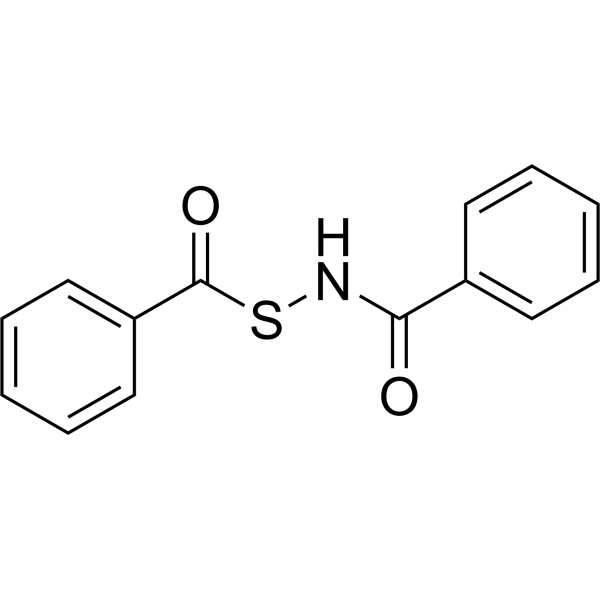
H2S Donor 5a
CAS No. 134861-13-5
H2S Donor 5a( —— )
Catalog No. M28791 CAS No. 134861-13-5
H2S Donor 5a is a H2S donor that could mimic the slow and continuous H(2)S generation process.
Purity : >98% (HPLC)
 COA
Datasheet
HNMR
HPLC
MSDS
Handing Instructions
COA
Datasheet
HNMR
HPLC
MSDS
Handing Instructions
| Size | Price / USD | Stock | Quantity |
| 1 mL x 10 mM in DMSO | 40 | In Stock |


|
| 5MG | 39 | In Stock |
|
| 10MG | 61 | In Stock |
|
| 25MG | 110 | In Stock |
|
| 50MG | 161 | In Stock |
|
| 100MG | 245 | In Stock |
|
| 200MG | Get Quote | In Stock |
|
| 500MG | Get Quote | In Stock |
|
| 1G | Get Quote | In Stock |
|
Biological Information
-
Product NameH2S Donor 5a
-
NoteResearch use only, not for human use.
-
Brief DescriptionH2S Donor 5a is a H2S donor that could mimic the slow and continuous H(2)S generation process.
-
DescriptionH2S Donor 5a is a H2S donor that could mimic the slow and continuous H(2)S generation process.
-
In Vitro——
-
In Vivo——
-
Synonyms——
-
PathwayProteasome/Ubiquitin
-
TargetEndogenous Metabolite
-
Recptor——
-
Research Area——
-
Indication——
Chemical Information
-
CAS Number134861-13-5
-
Formula Weight257.31
-
Molecular FormulaC14H11NO2S
-
Purity>98% (HPLC)
-
SolubilityIn Vitro:?DMSO : 100 mg/mL (388.64 mM)
-
SMILESO=C(NSC(=O)c1ccccc1)c1ccccc1
-
Chemical Name——
Shipping & Storage Information
-
Storage(-20℃)
-
ShippingWith Ice Pack
-
Stability≥ 2 years
Reference
1.Kawashima Y, et al. Preparations of agglomerated crystals of polymorphic mixtures and a new complex of indomethacin-epirizole by the spherical crystallization technique. J Pharm Sci. 1985 Nov;74(11):1152-6.
molnova catalog



related products
-
Alloepipregnanolone
Alloepipregnanolone is a pregnane with anesthetic hypnotic and sedative properties.
-
Dodecanedioic acid
Dodecanedioic acid is a dicarboxylic acid used in the synthesis of the engineering plastic nylon 612.Dodecanedioic acid is used as a base oil in industrial production.
-
Ac-Arg-OH
N-a-Acetyl-L-arginine also known as N-ac-L-arg-OH or N-alpha-acetylarginine belongs to the class of organic compounds known as n-acyl-l-alpha-amino acids.
