


 Cart
Cart
 sales@molnova.com



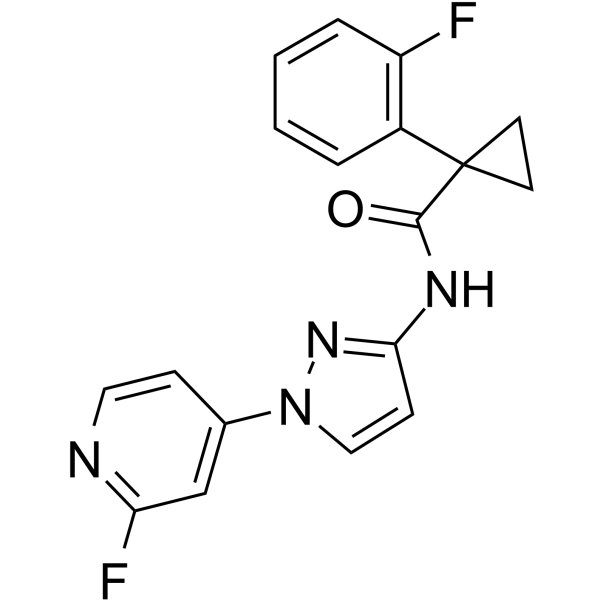
ELOVL1-IN-1
CAS No. 2227482-41-7
ELOVL1-IN-1( 1-(2-Fluorophenyl)-N-(1-(2-fluoropyridin-4-YL)-1H-pyrazol-3-YL)cyclopropane-1-carboxamide )
Catalog No. M28774 CAS No. 2227482-41-7
ELOVL1-IN-1 is an ELOVL1 inhibitor. ELOVL1-IN-1 can reduce the levels of very long chain fatty acids. ELOVL1-IN-1 can be used in the study of adrenoleukodystrophy (ALD).
Purity : >98% (HPLC)
 COA
Datasheet
HNMR
HPLC
MSDS
Handing Instructions
COA
Datasheet
HNMR
HPLC
MSDS
Handing Instructions
| Size | Price / USD | Stock | Quantity |
| 1 mL x 10 mM in DMSO | 353 | In Stock |


|
| 5MG | 321 | In Stock |
|
| 10MG | 472 | In Stock |
|
| 25MG | 846 | In Stock |
|
| 50MG | 1181 | In Stock |
|
| 100MG | 1535 | In Stock |
|
| 200MG | Get Quote | In Stock |
|
| 500MG | Get Quote | In Stock |
|
| 1G | Get Quote | In Stock |
|
Biological Information
-
Product NameELOVL1-IN-1
-
NoteResearch use only, not for human use.
-
Brief DescriptionELOVL1-IN-1 is an ELOVL1 inhibitor. ELOVL1-IN-1 can reduce the levels of very long chain fatty acids. ELOVL1-IN-1 can be used in the study of adrenoleukodystrophy (ALD).
-
DescriptionELOVL1-IN-1 is an ELOVL1 inhibitor. ELOVL1-IN-1 can reduce the levels of very long chain fatty acids. ELOVL1-IN-1 can be used in the study of adrenoleukodystrophy (ALD).(In Vitro):Administration of 1 nM-10 μM ELOVL1-IN-1 for 48 h reduces the level of VLCFA, lysophosphatidylcholine (LPC) in adrenoleukodystrophy (ALD) patient fibroblasts and healthy human fibroblasts, ALD patient B‐lymphocytes, and human microglia.(In Vivo):Oral dministration of ELOVL1-IN-1 reduces of a VLCFA level, specifically C26:0 LPC level in blood of ABCD1 knockout mice (0.5-64 mg/kg; 28 days), wild‐type (WT) rats (30-300 mg/kg; 7 days), and cynomolgous monkeys (30 mg/kg; 7 days).
-
In VitroELOVL1-IN-1 (compound 87) (1 nM-10 μM; 48 h) reduces the the level of VLCFA, lysophosphatidylcholine (LPC) in adrenoleukodystrophy (ALD) patient fibroblasts and healthy human fibroblasts, ALD patient B‐lymphocytes, and human microglia.
-
In VivoELOVL1-IN-1 (compound 87) reduces of a VLCFA level, specifically C26:0 LPC level in blood of ABCD1 knockout (KO) mice (0.5-64 mg/kg; p.o. once daily for 28 days), wild‐type (WT) rats (30-300 mg/kg; p.o. once daily for 7 days), and cynomolgous monkeys (30 mg/kg; p.o. once daily for 7 days).
-
Synonyms1-(2-Fluorophenyl)-N-(1-(2-fluoropyridin-4-YL)-1H-pyrazol-3-YL)cyclopropane-1-carboxamide
-
PathwayOthers
-
TargetOther Targets
-
RecptorAhR
-
Research Area——
-
Indication——
Chemical Information
-
CAS Number2227482-41-7
-
Formula Weight340.33
-
Molecular FormulaC18H14F2N4O
-
Purity>98% (HPLC)
-
SolubilityIn Vitro:?DMSO : 100 mg/mL (293.83 mM)
-
SMILESO=C(C1(CC1)c(cccc1)c1F)Nc(cc1)nn1-c1cc(F)ncc1
-
Chemical Name——
Shipping & Storage Information
-
Storage(-20℃)
-
ShippingWith Ice Pack
-
Stability≥ 2 years
Reference



-
Adenosine N1-oxide
Adenosine N1-oxide, which is found in royal jelly, inhibited the secretion of inflammatory mediators by activated macrophages and reduced lethality in lipopolysaccharide (LPS)-induced endotoxin shock.
-
Grb2 SH2 Domain Liga...
Grb2 SH2 Domain Ligand
-
Gly-Gly-Gly|H-Gly-Gl...
H-Gly-Gly-Gly-OH (Standard) is the analytical standard of H-Gly-Gly-Gly-OH. This product is intended for research and analytical applications. H-Gly-Gly-Gly-OH, also known as Triglycine, is a tripeptide composed of glycine, glycine and glycine, which are linked by peptide bonds. Often used as a model compound in the study of protein structure and function. Glycylglycylglycine also acts as a neurotransmitter in the central nervous system and has been shown to have antioxidant properties. Furthermore, it may have potential research roles in various diseases such as cancer, diabetes and neurodegenerative diseases.
