


 Cart
Cart
 sales@molnova.com



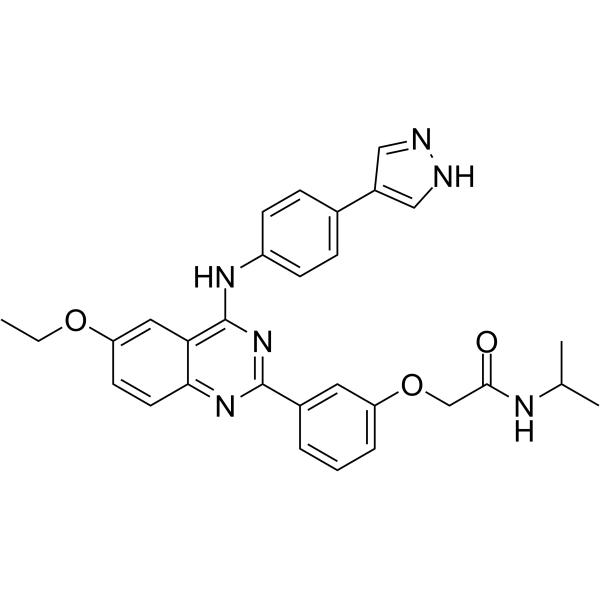
KL-11743
CAS No. 1369452-53-8
KL-11743( —— )
Catalog No. M28761 CAS No. 1369452-53-8
KL-11743 specifically blocks glucose metabolism, triggering an acute collapse in NADH pools and a striking accumulation of aspartate, indicating a dramatic shift toward oxidative phosphorylation in the mitochondria.
Purity : >98% (HPLC)
 COA
Datasheet
HNMR
HPLC
MSDS
Handing Instructions
COA
Datasheet
HNMR
HPLC
MSDS
Handing Instructions
| Size | Price / USD | Stock | Quantity |
| 1 mL x 10 mM in DMSO | 269 | In Stock |


|
| 5MG | 235 | In Stock |
|
| 10MG | 377 | In Stock |
|
| 25MG | 630 | In Stock |
|
| 50MG | 879 | In Stock |
|
| 100MG | 1190 | In Stock |
|
| 200MG | Get Quote | In Stock |
|
| 500MG | Get Quote | In Stock |
|
| 1G | Get Quote | In Stock |
|
Biological Information
-
Product NameKL-11743
-
NoteResearch use only, not for human use.
-
Brief DescriptionKL-11743 specifically blocks glucose metabolism, triggering an acute collapse in NADH pools and a striking accumulation of aspartate, indicating a dramatic shift toward oxidative phosphorylation in the mitochondria.
-
DescriptionKL-11743 specifically blocks glucose metabolism, triggering an acute collapse in NADH pools and a striking accumulation of aspartate, indicating a dramatic shift toward oxidative phosphorylation in the mitochondria.(In Vitro):Patient-derived xenograft models of succinate dehydrogenase A (SDHA)-deficient cancers are specifically sensitive to KL-11743, providing direct evidence that TCA cycle-mutant tumors are vulnerable to GLUT inhibitors in vivo.
-
In VitroKL-11743 (compound 8) competes with glucose for binding to GLUT1, with IC50s of 33 nM and 268 nM at 0.37 mM and 10 mM glucose, respectively.KL-11743 (39-10000 nM; 24-72 h) dose-dependently inhibits the growth of HT-1080 cells, with an IC50 of 677 nM.KL-11743 inhibits the growth of KEAP1-mutant lung cancer cells with more potency compared to KEAP1-WT lung cancer cells.KL-11743 (0.001-10 μM) induces a rapid increase in the phosphorylation of AMPK and acetyl-coenzyme A carboxylase in HT-1080 cells .KL-11743 (2 μM) inhibits glucose uptake in 786-O cells. KL-11743 increases NADP+/NADPH in NCl-H226 cells. KL-11743 induces cell death in SLC7A11-high cancer cell lines (NCl-H226 and UMRC6 cells).KL-11743 (0.001-10 μM) inhibits both glucose consumption, lactate secretion, and 2DG transport in HT-1080 fibrosarcoma cells, with IC50s of 228, 234, and 87 nM, respectively, and fully inhibited glycolytic ATP production in oligomycin-treated cells with an IC50 of 127 nM. Cell Viability Assay Cell Line:HT-1080 cells Concentration:39, 78, 156, 312, 625, 1250, 2500, 5000, 10000 nMIncubation Time:24, 48, 72 hoursResult:Inhibited the growth of HT-1080 cells in a dose-dependent manner.
-
In VivoKL-11743 (100 mg/kg; i.p. every two days for 5 weeks) decreases the growth of SLC7A11-high NCI-H226 xenograft tumors and was well-tolerated in vivo.KL-11743 (30-100 mg/kg; a single p.o.) significantly elevates blood glucose levels and delays glucose clearance in mice challenged with 5 g/kg glucose.KL-11743 significantly suppresses the growth of KEAP1 KO tumors.Plasma levels of KL-11743 (100 mg/kg; i.p.) are maintained at inhibitory levels for most of the 24-hour dosing period.KL-11743 (p.o) exhibits moderate oral between 30% and 15%, and favorable and dose-linear plasma exposure profile reaching concentrations of approximately 20 μM in mice (10-100 mg/kg) and rats (10-300 mg/kg).KL-11743 exhibits comparable half-lives ranging between 2.04 and 5.38 h in rats (10 mg/kg for i.v.; 10-300 mg/kg for p.o.), and 1.45-4.75 h in mice (10 mg/kg for i.v. and i.p.; 10-100 mg/kg for p.o.). Animal Model:4 to 6-week-old athymic nude mice (Foxn1nu/Foxn1nu) were injected with NCI-H226 cells.100 mg/kg Dosage:100 mg/kg Administration:I.p. every two days for 5 weeks Result:Inhibited the growth of tumors.Exhibited extensive necrotic cell death.Decreased PPP intermediate 6-phosphogluconate levels and increased NADP+/NADPH ratio.
-
Synonyms——
-
PathwayOthers
-
TargetOther Targets
-
Recptor——
-
Research Area——
-
Indication——
Chemical Information
-
CAS Number1369452-53-8
-
Formula Weight522.609
-
Molecular FormulaC30H30N6O3
-
Purity>98% (HPLC)
-
SolubilityIn Vitro:?DMSO : 25 mg/mL (47.84 mM)
-
SMILESCCOc1ccc2nc(nc(Nc3ccc(cc3)-c3cn[nH]c3)c2c1)-c1cccc(OCC(=O)NC(C)C)c1
-
Chemical Name——
Shipping & Storage Information
-
Storage(-20℃)
-
ShippingWith Ice Pack
-
Stability≥ 2 years
Reference
1.Krishnamoorthy G, et al. Experimental and theoretical studies on Gallic acid assisted EDC/NHS initiated crosslinked collagen scaffolds. Mater Sci Eng C Mater Biol Appl. 2014 Oct;43:164-71.
molnova catalog



related products
-
4-Hydroxy-5,7,3-trim...
4'-Hydroxy-5,7,3'-trimethoxyflavone
-
Antidepressant?agent...
Antidepressant?agent?5 is a 7-substituted tetrahydroisoquinoline derivative with antidepressant activity.
-
Angelic Acid
Angelic acid?is a?monocarboxylic?unsaturated organic acid. Angelic acid esters are the active components of herbal medicine used against a wide range of various health disturbances including pains, fever, gout, heartburn, etc.
