


 Cart
Cart
 sales@molnova.com



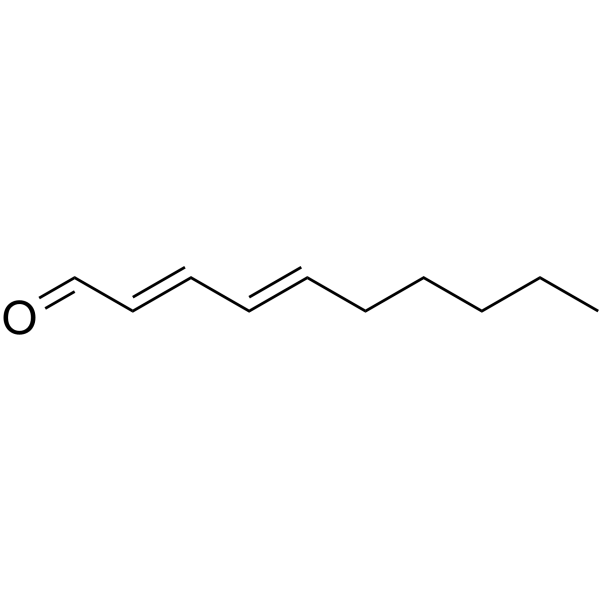
trans,trans-2,4-Decadienal
CAS No. 25152-84-5
trans,trans-2,4-Decadienal( trans,trans-2,4-Decadien-1-al )
Catalog No. M28723 CAS No. 25152-84-5
trans,trans-2,4-Decadienal is a lipid peroxidation product of linolieic acid
Purity : >98% (HPLC)
 COA
Datasheet
HNMR
HPLC
MSDS
Handing Instructions
COA
Datasheet
HNMR
HPLC
MSDS
Handing Instructions
| Size | Price / USD | Stock | Quantity |
| 1 mL x 10 mM in DMSO | 28 | In Stock |


|
| 100MG | Get Quote | In Stock |
|
| 200MG | Get Quote | In Stock |
|
| 500MG | Get Quote | In Stock |
|
| 1G | 27 | In Stock |
|
Biological Information
-
Product Nametrans,trans-2,4-Decadienal
-
NoteResearch use only, not for human use.
-
Brief Descriptiontrans,trans-2,4-Decadienal is a lipid peroxidation product of linolieic acid
-
Descriptiontrans,trans-2,4-Decadienal is a lipid peroxidation product of linolieic acid.
-
In VitroTwo metabolic pathways for the biotransformation of trans,trans-2,4-Decadienal (tt-DDE) in vivo are proposed: (i) the oxidation of tt-DDE to the corresponding carboxylic acid, 2,4-decadienoic acid, in liver cells and (ii) glutathione (GHS) conjugation, GSH breakdown, and aldehyde reduction, which generate cysteine-conjugated 2,4-decadien-1-ol in both liver and lung cells.
-
In Vivo——
-
Synonymstrans,trans-2,4-Decadien-1-al
-
PathwayOthers
-
TargetOther Targets
-
RecptorRXR|RAR/RXR?
-
Research Area——
-
Indication——
Chemical Information
-
CAS Number25152-84-5
-
Formula Weight152.237
-
Molecular FormulaC10H16O
-
Purity>98% (HPLC)
-
SolubilityIn Vitro:?DMSO : 100 mg/mL (656.90 mM)
-
SMILESCCCCC\C=C\C=C\C=O
-
Chemical Name——
Shipping & Storage Information
-
Storage(-20℃)
-
ShippingWith Ice Pack
-
Stability≥ 2 years
Reference
1.Iwata M,?et al. Retinoic acids exert direct effects on T cells to suppress Th1 development and enhance Th2 development via retinoic acid receptors. Int Immunol.?2003 Aug;15(8):1017-25.
molnova catalog



related products
-
2,6-Dibromo-4-(hydro...
2,6-Dibromo-4-(hydroxymethyl)phenol is a marine derived natural products found in Thelepus setosus.
-
Crocin E
Crocetin β-D-glucopyranoside is an active part of saffron pigments extracted from patent CN 105935363 A.
-
N-Methyltetrahydroco...
The tubers of Corydalis yanhusuo W. T. Wang.
