


 Cart
Cart
 sales@molnova.com



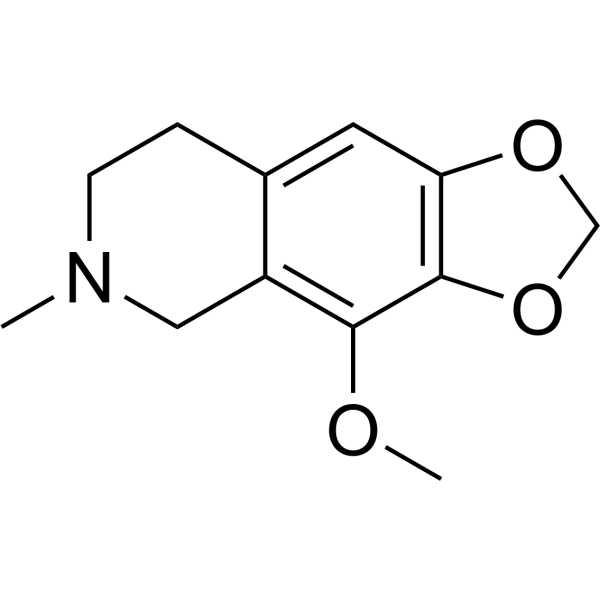
hydrocotarnine
CAS No. 550-10-7
hydrocotarnine( —— )
Catalog No. M28624 CAS No. 550-10-7
hydrocotarnine is an inhibitor of Cbl.
Purity : >98% (HPLC)
 COA
Datasheet
HNMR
HPLC
MSDS
Handing Instructions
COA
Datasheet
HNMR
HPLC
MSDS
Handing Instructions
| Size | Price / USD | Stock | Quantity |
| 1 mL x 10 mM in DMSO | 89 | In Stock |


|
| 5MG | 96 | In Stock |
|
| 10MG | 150 | In Stock |
|
| 25MG | 301 | In Stock |
|
| 50MG | 429 | In Stock |
|
| 100MG | 603 | In Stock |
|
| 200MG | 812 | In Stock |
|
| 500MG | Get Quote | In Stock |
|
| 1G | Get Quote | In Stock |
|
Biological Information
-
Product Namehydrocotarnine
-
NoteResearch use only, not for human use.
-
Brief Descriptionhydrocotarnine is an inhibitor of Cbl.
-
Descriptionhydrocotarnine is an inhibitor of Cbl.(In Vivo):In vivo, inhibition of Cbl with an analgesic drug, hydrocotarnine, increases inflammasome-mediated IL-18 secretion in the colon, and protects mice from dextran sulphate sodium-induced colitis. Together, our novel findings provide new insights into the role of the SFK-Cbl axis in suppressing NLRP3 inflammasome activation and identify a novel clinical utility of hydrocortanine for disease treatment.
-
In VitroHydrocotarnine is an analgesic agent (CRIN-2), with the patent ID of WO2011160016A2.Hydrocotarnine (10 μM; 1 h) elevates the secretion of IL-1β and IL-18, and (0.1-10 μM; 1 h) increases the global level of tyrosine-phosphorylated proteins in THP-1 cells. Hydrocotarnine (50 μM; 0-100 min) increases the glycolytic capacity and glycolytic reserve capacity in THP-1-derived macrophages.Hydrocotarnine (50 μM; 16 h) inhibits Cbl and increases the total GLUT1 protein in THP-1-derived macrophages.Hydrocotarnine is known to enhance the analgesic effect of opioids, and alleviates cancer pain. Western Blot Analysis Cell Line:THP-1 cells Concentration:0.1, 1, 10 μM Incubation Time:1 hour Result:Induced p-Pyk2 loss and increased the level of tyrosine-phosphorylated proteins in a dose-dependent manner.
-
In VivoHydrocotarnine (10 mg/kg/d; i.p.; 9 d) shows inhibitory effect on Cbl and results in increasing IL-18 levels, indicating that NLRP3 inflammasome activation is enhanced in mice.Hydrocotarnine (10 mg/kg/d; i.p.; 9 d) protects mice from DSS-induced colitis, with low scores of pathological evaluation of inflammation, epithelial defects, and crypt atrophy. Animal Model:DSS-induced colitis model in C57BL/6 mice (6-9 weeks old) Dosage:10 mg/kg Administration:Intraperitoneal injection; once daily; 9 days while 2.5% DSS treatment began on day 1 and ended on day 7 Result:Significantly attenuated the weight loss of DSS-induced colitis mice compared to PBS-treated control mice, indicating that decreasing negative regulation of the NLRP3 inflammasome activation could attenuate colitis in an animal model.
-
Synonyms——
-
PathwayOthers
-
TargetOther Targets
-
Recptor——
-
Research Area——
-
Indication——
Chemical Information
-
CAS Number550-10-7
-
Formula Weight221.25
-
Molecular FormulaC12H15NO3
-
Purity>98% (HPLC)
-
SolubilityIn Vitro:?DMSO : ≥ 100 mg/mL (451.98 mM)
-
SMILESCN(CC1)Cc2c1cc1OCOc1c2OC
-
Chemical Name——
Shipping & Storage Information
-
Storage(-20℃)
-
ShippingWith Ice Pack
-
Stability≥ 2 years
Reference
1.Pedro Molina, et al. Iminophosphorane-mediated imidazole ring formation: A new and general entry to aplysinopsin-type alkaloids of marine origin. Tetrahedron Lett. 1994;50(7): 2241-2254
molnova catalog



related products
-
Clindamycin
Clindamycin inhibits protein synthesis by acting on the 50S ribosomal.
-
3-O-α-L-Rhamnopyrano...
Antitumor agent-89 (Compd OTS-5), a natural compound, weakly suppresses fMLP-induced superoxide generation.
-
Fluorescein
A phthalic indicator dye that appears yellow-green in normal tear film and bright green in a more alkaline medium such as the aqueous humor, used as a diagnostic aid in corneal injuries and corneal trauma.
