


 Cart
Cart
 sales@molnova.com



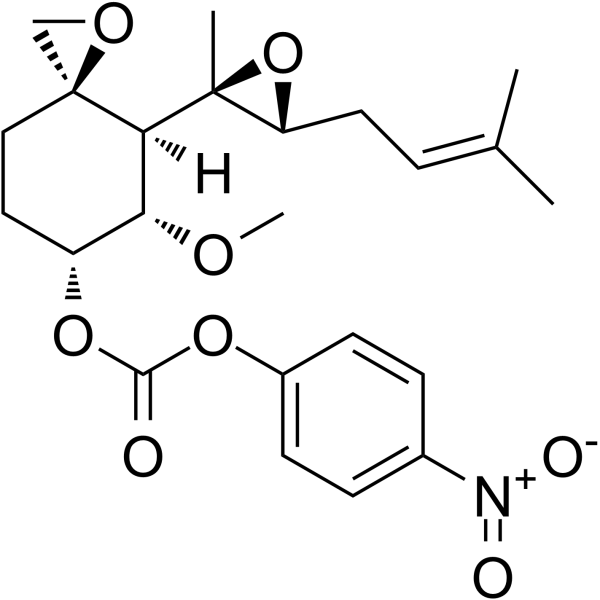
TSPO ligand-2?
CAS No. 1160640-95-8
TSPO ligand-2?( Carbonic acid )
Catalog No. M28491 CAS No. 1160640-95-8
TSPO ligand-2 is a ligand of AUTAC1 which contains a p-fluorobenzylguanine and a Fumagillol moiety.
Purity : >98% (HPLC)
 COA
Datasheet
HNMR
HPLC
MSDS
Handing Instructions
COA
Datasheet
HNMR
HPLC
MSDS
Handing Instructions
| Size | Price / USD | Stock | Quantity |
| 1 mL x 10 mM in DMSO | 161 | In Stock |


|
| 5MG | 141 | In Stock |
|
| 10MG | 212 | In Stock |
|
| 25MG | 358 | In Stock |
|
| 50MG | 499 | In Stock |
|
| 100MG | 681 | In Stock |
|
| 200MG | Get Quote | In Stock |
|
| 500MG | Get Quote | In Stock |
|
| 1G | Get Quote | In Stock |
|
Biological Information
-
Product NameTSPO ligand-2?
-
NoteResearch use only, not for human use.
-
Brief DescriptionTSPO ligand-2 is a ligand of AUTAC1 which contains a p-fluorobenzylguanine and a Fumagillol moiety.
-
DescriptionTSPO ligand-2 is a ligand of AUTAC1 which contains a p-fluorobenzylguanine and a Fumagillol moiety.
-
In Vitro——
-
In Vivo——
-
SynonymsCarbonic acid
-
PathwayOthers
-
TargetOther Targets
-
RecptorDNA polymerase
-
Research Area——
-
Indication——
Chemical Information
-
CAS Number1160640-95-8
-
Formula Weight447.48
-
Molecular FormulaC23H29NO8
-
Purity>98% (HPLC)
-
SolubilityIn Vitro:?DMSO : 50 mg/mL (111.74 mM)
-
SMILESC[C@]([C@@]1([H])[C@H](OC)[C@H](OC(OC2=CC=C([N+]([O-])=O)C=C2)=O)CC[C@]13CO3)(O4)[C@H]4C/C=C(C)/C
-
Chemical Name——
Shipping & Storage Information
-
Storage(-20℃)
-
ShippingWith Ice Pack
-
Stability≥ 2 years
Reference
molnova catalog



related products
-
Acetyl Dopamine Dime...
N-Acetyldopamine dimer-1 is a 2-(3',4'-dihydroxyphenyl)-1,4-benzodioxane derivative. N-Acetyldopamine dimer-1 is optically active, can be isolated from crude agent "Zentai," a cast-off shell of the cicada of Cryptotympana sp. (Cicadidae).
-
EZH2-IN-15
EZH2-IN-15 (SHR2554) is a specific inhibitor of the zeste 2 histone modification enhancer (EZH2).EZH2 is aberrantly overexpressed in many human cancers and controls adaptive responses by regulating Treg activity.
-
Macrophage Inhibitor...
Macrophage Inhibitory Peptide
