


 Cart
Cart
 sales@molnova.com



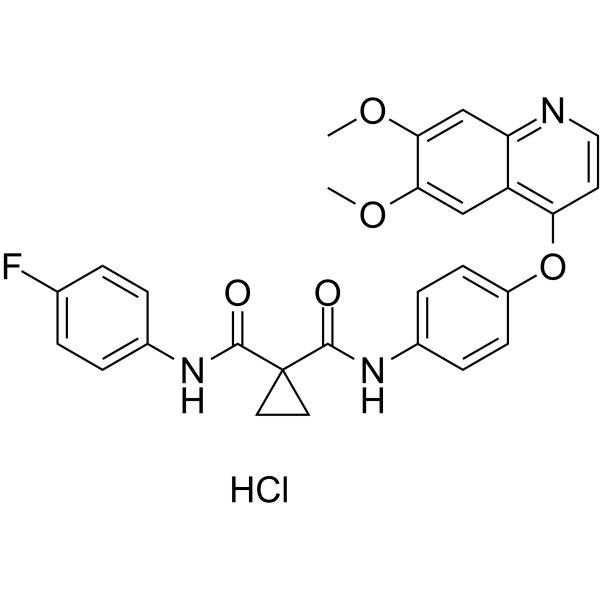
Cabozantinib hydrochloride
CAS No. 1817759-42-4
Cabozantinib hydrochloride( XL184 | BMS-907351 | Cabozantinib hydrochloride (849217-68-1(free base)) )
Catalog No. M28470 CAS No. 1817759-42-4
Cabozantinib (XL184) is a potent pan-tyrosine kinases inhibitor that inhibits VEGFR2, c-Met, Kit, Axl, and Flt4 (IC50s: 0.035, 1.3, 4.6, 7 and 6 nM).
Purity : >98% (HPLC)
 COA
Datasheet
HNMR
HPLC
MSDS
Handing Instructions
COA
Datasheet
HNMR
HPLC
MSDS
Handing Instructions
| Size | Price / USD | Stock | Quantity |
| 2MG | 48 | In Stock |


|
| 5MG | 60 | In Stock |
|
| 10MG | 93 | In Stock |
|
| 25MG | 163 | In Stock |
|
| 50MG | 242 | In Stock |
|
| 100MG | 341 | In Stock |
|
| 200MG | 556 | In Stock |
|
| 500MG | 889 | In Stock |
|
| 1G | Get Quote | In Stock |
|
Biological Information
-
Product NameCabozantinib hydrochloride
-
NoteResearch use only, not for human use.
-
Brief DescriptionCabozantinib (XL184) is a potent pan-tyrosine kinases inhibitor that inhibits VEGFR2, c-Met, Kit, Axl, and Flt4 (IC50s: 0.035, 1.3, 4.6, 7 and 6 nM).
-
DescriptionCabozantinib (XL184) is a potent pan-tyrosine kinases inhibitor that inhibits VEGFR2, c-Met, Kit, Axl, and Flt4 (IC50s: 0.035, 1.3, 4.6, 7 and 6 nM).(In Vitro):SR1001 binds specifically to the ligand-binding domains of RORα and RORγt, inducing a conformational change within the ligand-binding domain, resulting in suppression of the receptors' transcriptional activity. SR1001 inhibited the development of murine T(H)17 cells. Furthermore, SR1001 inhibited the expression of cytokines when added to differentiated murine or human T(H)17 cells . Treatment with the RORγT inhibitor SR1001 to abrogate Th17 cell function reduced Th17-dependent learned helplessness .(In Vivo):After myelin oligodendrocyte glycoprotein (MOG35–55) immunization at day 0, experimental autoimmune encephalomyelitis (EAE) mice were treated with SR1001 (25 mg/kg, b.i.d. i.p.) for the duration of the study. Further analysis of spinal cords from mice harvested at day 18 post-immunization revealed that SR1001 repressed Il17a mRNA expression by ~60%, as well as reduced Il21, and Il22 mRNA expression . When these mice were injected with SR1001, the circadian rhythm of CS expression was eliminated .
-
In VitroCabozantinib hydrochloride inhibits phosphorylation of MET and VEGFR2, as well as KIT, FLT3, and AXL with IC50 values of 7.8, 1.9, 5.0, 7.5, and 42 μM, respectively.Cabozantinib hydrochloride (4.6 nM) inhibits tubule formation with no evidence of cytotoxicity, with IC50 values of 6.7, 5.1, 4.1, 7.7, and 4.7 nM in HMVEC, MDA-MB-231, A431, HT1080, and B16F10 cells, respectively.Cabozantinib hydrochloride (0-370 nM, 24 h) inhibits cellular migration and invasion.Cabozantinib hydrochloride (48 h) inhibits tumor cell proliferation in a variety of tumor types.Cell Proliferation Assay Cell Line:SNU-5, Hs746T, SNU-1, SNU-16, MDA-MB-231, U87MG, H441, H69, and PC3 cells Concentration:Incubation Time:48 hours Result:Inhibited tumor cell proliferation, with IC50 of 19, 9.9, 5223, 1149, 6421, 1851, 21700, 20200, and 10800 nM, respectively.Cell Migration Assay Cell Line:B16F10 cells Concentration:0, 41, 123, and 370 nM Incubation Time:24 hours Result:Potently inhibited HGF-induced migration (IC50 = 31 nM) of B16F10 cells.Cell Invasion Assay Cell Line:B16F10 cells Concentration:0, 1.5, 14, and 123 nM Incubation Time:24 hours Result:Potently inhibited HGF-induced invasion (IC50 = 9 nM) of B16F10 cells.
-
In VivoCabozantinib hydrochloride (100 mg/kg, Orally, once) inhibits MET and VEGFR2 phosphorylation in mice.Cabozantinib hydrochloride (100 mg/kg, Orally, once) significantly increases tumor hypoxia and apoptosis. Cabozantinib hydrochloride (0-60 mg/kg, Orally, once daily for 14 days) inhibits tumor growth in a dose-dependent manner. Animal Model:Female mice bearing MBA-MB-231 tumor (5 per group)Dosage:0, 100 mg/kg Administration:Orally, once Result:Inhibited MET and VEGFR2 phosphorylation.Animal Model:Mice bearing MBA-MB-231 tumor Dosage:1, 3, 10, 30, 60 mg/kg Administration:Orally, once daily for 14 days Result:Inhibited tumor growth in a dose-dependent manner.
-
SynonymsXL184 | BMS-907351 | Cabozantinib hydrochloride (849217-68-1(free base))
-
PathwayAngiogenesis
-
TargetVEGFR
-
RecptorJAK2|JAK2 (V617F)
-
Research Area——
-
Indication——
Chemical Information
-
CAS Number1817759-42-4
-
Formula Weight537.96
-
Molecular FormulaC28H25ClFN3O5
-
Purity>98% (HPLC)
-
Solubility——
-
SMILESCl.COc1cc2nccc(Oc3ccc(NC(=O)C4(CC4)C(=O)Nc4ccc(F)cc4)cc3)c2cc1OC
-
Chemical Name——
Shipping & Storage Information
-
Storage(-20℃)
-
ShippingWith Ice Pack
-
Stability≥ 2 years
Reference
molnova catalog



related products
-
Semaxinib
Semaxanib (SU5416) is a potent and selective VEGFR(Flk-1/KDR) inhibitor.
-
GSK269962A
GSK269962 is a selective ROCK(Rho-associated protein kinase) inhibitor with IC50 values of 1.6 and 4 nM for ROCK1 and ROCK2, respectively.
-
Vorolanib
Vorolanib is an orally active VEGFR/PDGFR dual inhibitor.
