


 Cart
Cart
 sales@molnova.com



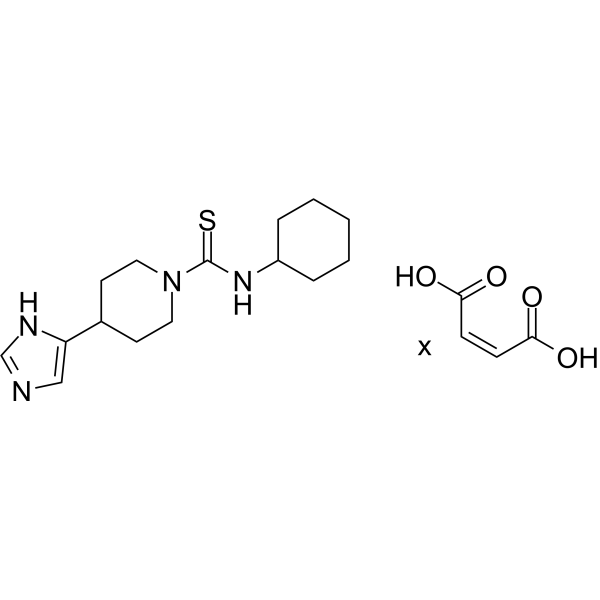
Thioperamide maleate
CAS No. 148440-81-7
Thioperamide maleate( MR-12842 maleate )
Catalog No. M28347 CAS No. 148440-81-7
Thioperamide maleate is an effective and selective antagonist of H3 receptor (Ki = 4.3 nM) for inhibition of [3H]histamine synthesis (Ki = 31 nM).
Purity : >98% (HPLC)
 COA
Datasheet
HNMR
HPLC
MSDS
Handing Instructions
COA
Datasheet
HNMR
HPLC
MSDS
Handing Instructions
| Size | Price / USD | Stock | Quantity |
| 1 mL x 10 mM in DMSO | 95 | In Stock |


|
| 5MG | 77 | In Stock |
|
| 10MG | 123 | In Stock |
|
| 100MG | Get Quote | In Stock |
|
| 200MG | Get Quote | In Stock |
|
| 500MG | Get Quote | In Stock |
|
| 1G | Get Quote | In Stock |
|
Biological Information
-
Product NameThioperamide maleate
-
NoteResearch use only, not for human use.
-
Brief DescriptionThioperamide maleate is an effective and selective antagonist of H3 receptor (Ki = 4.3 nM) for inhibition of [3H]histamine synthesis (Ki = 31 nM).
-
DescriptionThioperamide maleate is an effective and selective antagonist of H3 receptor (Ki = 4.3 nM) for inhibition of [3H]histamine synthesis (Ki = 31 nM).(In Vitro):Thioperamide maleate (0.01, 0.1, 1, 10, 100 μM) promotes the viability of NE-4C stem cells in a concentration-dependent manner. Thioperamide maleate displays similar potencies at human H4 and H3 receptors with Kis of 43 and 60 nM, respectively. Thioperamide maleate inhibits [3H]-(R)α-MeHA binding rat brain and guinea-pig lung with Kis of 2.1 nM and 2.0 nM, respectively. Thioperamide maleate competitively blocks H3-autoreceptors regulating [3H]histamine release with a mean apparent Ki of 4 nM.(In Vivo):In C57BL/6J mice, Thioperamide (5-20 mg/kg; i.p.) facilitates reconsolidation of a contextually-conditioned fear memory.
-
In VitroThioperamide inhibits [3H]-(R)α-MeHA binding rat brain and guinea-pig lung with Kis of 2.1 nM and 2.0 nM, respectively. Thioperamide competitively blocks H3-autoreceptors regulating [3H]histamine release with a mean apparent Ki of 4 nM.Thioperamide (0.01-100 μM; 24 hours) promotes the viability of NE-4C stem cells in a concentration-dependent manner.Thioperamide displays similar potencies at human H4 and H3 receptors (Ki=43 and 60 nM, respectively).Cell Viability Assay Cell Line:NE-4C stem cells Concentration:0.01, 0.1, 1, 10, 100 μM Incubation Time:24 hours Result:The viability of NE-4C stem cells increased significantly to 150.83±6.91% when (1 μM) was administrated, and increased to 145.11±14.52% and 132.02%±25.65% when 10 μM and 100 μM were administrated respectively.
-
In VivoThioperamide (5-20 mg/kg; i.p.) is able to facilitate reconsolidation of a contextually-conditioned fear memory in C57BL/6J mice. Animal Model:Naive female C57BL/6J mice Dosage:5, 10 or 20 mg/kg Administration:Injections (i.p.)Result:Facilitated reconsolidation of a contextually-conditioned fear memory.
-
SynonymsMR-12842 maleate
-
PathwayGPCR/G Protein
-
TargetHistamine Receptor
-
Recptor——
-
Research Area——
-
Indication——
Chemical Information
-
CAS Number148440-81-7
-
Formula Weight408.52
-
Molecular FormulaC19H28N4O4S
-
Purity>98% (HPLC)
-
SolubilityIn Vitro:?H2O : 100 mg/mL
-
SMILESOC(=O)\C=C/C(O)=O.S=C(NC1CCCCC1)N1CCC(CC1)c1cnc[nH]1
-
Chemical Name——
Shipping & Storage Information
-
Storage(-20℃)
-
ShippingWith Ice Pack
-
Stability≥ 2 years
Reference
1.Wang R, et al. Capsaicinoids from hot pepper (Capsicum annuum L.) and their phytotoxic effect on seedling growth of lettuce (Lactuca sativa L.). Nat Prod Res. 2020 Jun;34(11):1597-1601.
molnova catalog



related products
-
LML-134
LML-134 is an inverse agonist of Histamine 3 receptor (H3R)(hH3R cAMP and hH3R bdg with Kis of 0.3 nM and 12 nM).
-
Carebastine
Carebastine, the active metabolite of Ebastine, is an antagonist of the histamine H1 receptor.
-
Diphenhydramine
Diphenhydramine, a first-generation antihistamine possessing antiemetic, antitussive, anticholinergic, and sedative properties, is mainly used in the treatment of allergies.
