


 Cart
Cart
 sales@molnova.com



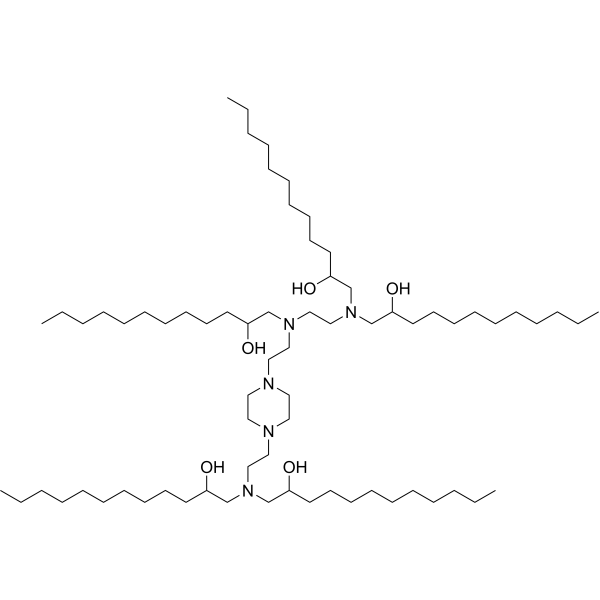
C12-200
CAS No. 1220890-25-4
C12-200( —— )
Catalog No. M28191 CAS No. 1220890-25-4
C12-200 is a benchmark ionizable cationic lipidoid along with helper lipids. C12-200 is commonly used for mRNA delivery.
Purity : >98% (HPLC)
 COA
Datasheet
HNMR
HPLC
MSDS
Handing Instructions
COA
Datasheet
HNMR
HPLC
MSDS
Handing Instructions
| Size | Price / USD | Stock | Quantity |
| 1 mL x 10 mM in DMSO | 145 | In Stock |


|
| 5MG | 69 | In Stock |
|
| 10MG | 117 | In Stock |
|
| 25MG | 188 | In Stock |
|
| 50MG | 346 | In Stock |
|
| 100MG | 576 | In Stock |
|
| 200MG | 816 | In Stock |
|
| 500MG | Get Quote | In Stock |
|
| 1G | Get Quote | In Stock |
|
Biological Information
-
Product NameC12-200
-
NoteResearch use only, not for human use.
-
Brief DescriptionC12-200 is a benchmark ionizable cationic lipidoid along with helper lipids. C12-200 is commonly used for mRNA delivery.
-
DescriptionC12-200 is a benchmark ionizable cationic lipidoid along with helper lipids. C12-200 is commonly used for mRNA delivery.
-
In Vitro——
-
In Vivo——
-
Synonyms——
-
PathwayOthers
-
TargetOther Targets
-
RecptorCB2
-
Research Area——
-
Indication——
Chemical Information
-
CAS Number1220890-25-4
-
Formula Weight1136.93
-
Molecular FormulaC70H145N5O5
-
Purity>98% (HPLC)
-
SolubilityIn Vitro:?DMSO : 100 mg/mL (87.96 mM)
-
SMILES——
-
Chemical Name——
Shipping & Storage Information
-
Storage(-20℃)
-
ShippingWith Ice Pack
-
Stability≥ 2 years
Reference
1.Andrew John Eatherton, et al. Pyrimidine derivatives and their use as cb2 modulators. WO2004018433.
molnova catalog



related products
-
PQ-912
PQ-912 (PQ 912, PQ912)?is a potent glutaminyl cyclase (QC) inhibitor that inhibits human, rat, and mouse QC with Ki of 20-65 nM.
-
Aflatoxin G2
Aflatoxin G2 is a major naturally produced aflatoxin. Aflatoxin G2 is a mycotoxin produced by the fungi Aspergillus flavus and Aspergillus parasiticus.The level of toxicity associated with Aflatoxin is AflatoxinB1>Aflatoxin M1>Aflatoxin G1>Aflatoxin B2>Aflatoxin M2>Aflatoxin G2.
-
Prolactin Releasing ...
Prolactin Releasing Peptide (1-31), human is a high affinity GPR10 ligand that cause the release of the prolactin. Human and rat Prolactin Releasing Peptide (1-31) binds to GPR10 with Kis of 1.03 and 0.33 nM, respectively.Prolactin-releasing peptide is a specific prolactin releasing peptide.
