


 Cart
Cart
 sales@molnova.com



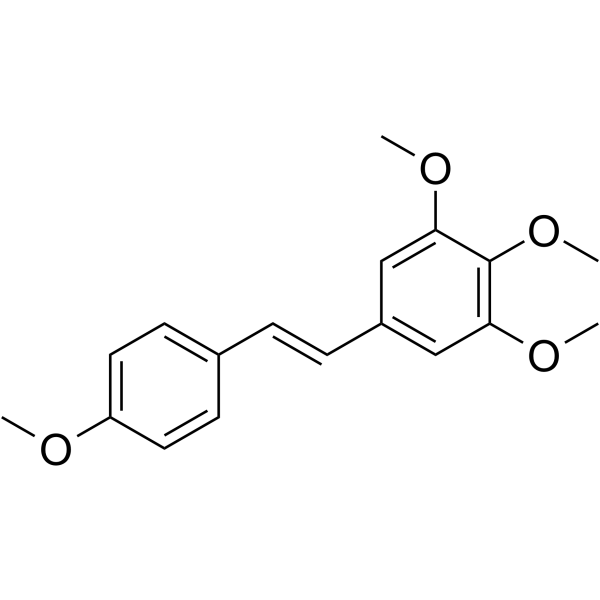
DMU-212
CAS No. 134029-62-2
DMU-212( —— )
Catalog No. M28078 CAS No. 134029-62-2
DMU-212, a methylated form of Resveratrol, shows antimitotic, antiproliferative, and antioxidant activities. DMU-212 induces mitotic arrest through the activation of ERK1/2 protein and the promotion of apoptosis.
Purity : >98% (HPLC)
 COA
Datasheet
HNMR
HPLC
MSDS
Handing Instructions
COA
Datasheet
HNMR
HPLC
MSDS
Handing Instructions
| Size | Price / USD | Stock | Quantity |
| 1 mL x 10 mM in DMSO | 51 | In Stock |


|
| 2MG | 29 | In Stock |
|
| 5MG | 46 | In Stock |
|
| 10MG | 76 | In Stock |
|
| 25MG | 155 | In Stock |
|
| 50MG | 268 | In Stock |
|
| 100MG | 398 | In Stock |
|
| 200MG | Get Quote | In Stock |
|
| 500MG | 901 | In Stock |
|
| 1G | Get Quote | In Stock |
|
Biological Information
-
Product NameDMU-212
-
NoteResearch use only, not for human use.
-
Brief DescriptionDMU-212, a methylated form of Resveratrol, shows antimitotic, antiproliferative, and antioxidant activities. DMU-212 induces mitotic arrest through the activation of ERK1/2 protein and the promotion of apoptosis.
-
DescriptionDMU-212, a methylated form of Resveratrol, shows antimitotic, antiproliferative, and antioxidant activities. DMU-212 induces mitotic arrest through the activation of ERK1/2 protein and the promotion of apoptosis.(In Vitro):DMU-212 (0.3125-40 μM) inhibited the cellular proliferation of human melanoma cells at submicromolar or micromolar concentrations (IC50=0.5 μM, 0.5 μM, 1.25 μM, and 1.25 μM for A375, Bro, MeWo, and M5 human melanoma cells, respectively.).(In Vivo):In SCID female mice, DMU-212 (50 mg/kg; i.g.) inhibited tumor growth and lowered tumor burden.
-
In VitroCell Proliferation Assay Cell Line:A375 cells, MeWo cells, M5 cells, Bro cells Concentration:0.3125 μM, 0,625 μM, 1.25 μM, 2.5 μM, 5 μM, 10 μM, 20 μM, 40 μM Incubation Time:96 hours Result:Inhibited the cellular proliferation of human melanoma cells at submicromolar or micromolar concentrations (IC50=0.5 μM for A375 and Bro and IC50= 1.25 μM for MeWo and M5 cells).Cell Cycle Analysis Cell Line:A375 cells Concentration:20 μM, 30 μM, 50 μM Incubation Time:24 hoursResult:Caused a marked increase in the levels of p21, p53 and cyclin B1 proteins with a concomitant decrease in the levels of cyclin A2.Western Blot Analysis Cell Line:A375 cells Concentration:20 μM, 30 μM, 50 μM Incubation Time:24 hours Result:Significant upregulated Bax, caspase 3 and caspase 9 protein levels, while decreased the levels of the anti-apoptotic protein Bcl-2.Apoptosis Analysis Cell Line:A375 cells Concentration:10 μM, 20 μM Incubation Time:24 hours, 36 hoursResult:Induced apoptosis.
-
In VivoAnimal Model:6-weeks-old SCID female mice (20-24 g), with ovarian cancer xenografts Dosage:50 mg/kg Administration:Oral gavage, three times a week, for 14 days Result:Lowered tumor burden.
-
Synonyms——
-
PathwayApoptosis
-
TargetApoptosis
-
RecptorTubulin polymerization
-
Research Area——
-
Indication——
Chemical Information
-
CAS Number134029-62-2
-
Formula Weight300.35
-
Molecular FormulaC18H20O4
-
Purity>98% (HPLC)
-
SolubilityIn Vitro:?DMSO : 20 mg/mL (66.59 mM)
-
SMILESCOC1=CC=C(/C=C/C2=CC(OC)=C(OC)C(OC)=C2)C=C1
-
Chemical Name——
Shipping & Storage Information
-
Storage(-20℃)
-
ShippingWith Ice Pack
-
Stability≥ 2 years
Reference



-
CTA 056
CTA 056 is an interleukin-2 induced T cell kinase (ITK) inhibitor, inhibits the growth of MOLT-4 xenograft tumors in mice, induces apoptosis in Jurkat cells, and can be used in the study of autoimmune disorders and T cell malignancies.
-
Galgravin
Galgravin has anti-inflammatory, and neuroprotective effects, it can promote neuronal survival and neurite outgrowth, protect hippocampal neurons against amyloid beta peptide (Abeta25-35)-induced cytotoxicity, and protect against neuronal death from 1-methyl-4-phenylpyridinium ion (MPP+)-induced toxicity in cultured rat hippocampal neurons.
-
SACLAC
SACLAC is a cysteine asparaginase activation inhibitor with antitumor activity that decreases AML cell viability, inhibits AML cell proliferation, increases AML cell death, and induces apoptosis of AML cells, and is used in the study of acute myeloid leukemia and cancer.
