


 Cart
Cart
 sales@molnova.com



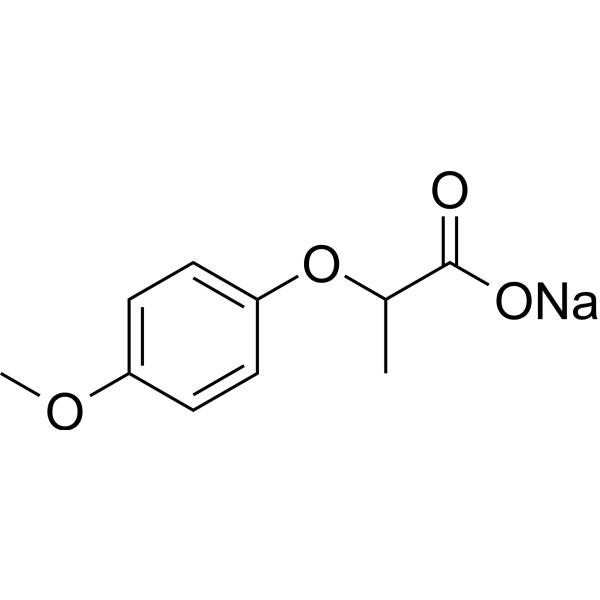
Lactisole
CAS No. 150436-68-3
Lactisole( 2-(4-Methoxyphenoxy)propanoic acid )
Catalog No. M28055 CAS No. 150436-68-3
Lactisole is an inhibitor of the glucose-sensing receptor.
Purity : >98% (HPLC)
 COA
Datasheet
HNMR
HPLC
MSDS
Handing Instructions
COA
Datasheet
HNMR
HPLC
MSDS
Handing Instructions
| Size | Price / USD | Stock | Quantity |
| 1 mL x 10 mM in DMSO | 31 | In Stock |


|
| 100MG | Get Quote | In Stock |
|
| 200MG | Get Quote | In Stock |
|
| 500MG | 27 | In Stock |
|
| 1G | Get Quote | In Stock |
|
Biological Information
-
Product NameLactisole
-
NoteResearch use only, not for human use.
-
Brief DescriptionLactisole is an inhibitor of the glucose-sensing receptor.
-
DescriptionLactisole is an inhibitor of the glucose-sensing receptor.(In Vitro):In MIN6 cells, in a dose-dependent manner, lactisole inhibited insulin secretion induced by sweeteners, acesulfame-K, sucralose and glycyrrhizin. The IC50 was ~4 mmol/l. Lactisole attenuated the elevation of cytoplasmic Ca2+ concentration ([Ca2+]c) evoked by sucralose and acesulfame-K but did not affect the elevation of intracellular cAMP concentration ([cAMP]c) induced by these sweeteners. Lactisole also inhibited the action of glucose in MIN6 cells. Thus, lactisole significantly reduced elevations of intracellular [NADH] and intracellular [ATP] induced by glucose, and also inhibited glucose-induced insulin secretion.
-
In Vitro——
-
In Vivo——
-
Synonyms2-(4-Methoxyphenoxy)propanoic acid
-
PathwayOthers
-
TargetOther Targets
-
RecptorApoptosis|PKG
-
Research Area——
-
Indication——
Chemical Information
-
CAS Number150436-68-3
-
Formula Weight218.184
-
Molecular FormulaC10H11NaO4
-
Purity>98% (HPLC)
-
SolubilityIn Vitro:?DMSO : 125 mg/mL (572.92 mM)
-
SMILES[Na+].COc1ccc(OC(C)C([O-])=O)cc1
-
Chemical Name——
Shipping & Storage Information
-
Storage(-20℃)
-
ShippingWith Ice Pack
-
Stability≥ 2 years
Reference
1.Singh T, et al. Nitric oxide donor exisulind is an effective inhibitor of murine photocarcinogenesis. Photochem Photobiol. 2012 Sep-Oct;88(5):1141-8.
molnova catalog



related products
-
SN6
SN 6 is a selective Na+/Ca2+ exchanger (NCX) inhibitor?(IC50s of NCX1: 2.9 μM NCX2: 16 μM NCX3: 8.6 μM).
-
Quercetin 3,4-dimeth...
Quercetin 3,4'-dimethyl ether shows anti-lipid peroxidation activity (IC 50 values of 0.3 uM), it also shows anti-inflammatory activity.
-
Longistylin C
Longistylin A and longistylin C show some cytotoxic effects, with IC(50) values of 0.7-14.7 microM against the range of cancer cell lines.
