


 Cart
Cart
 sales@molnova.com



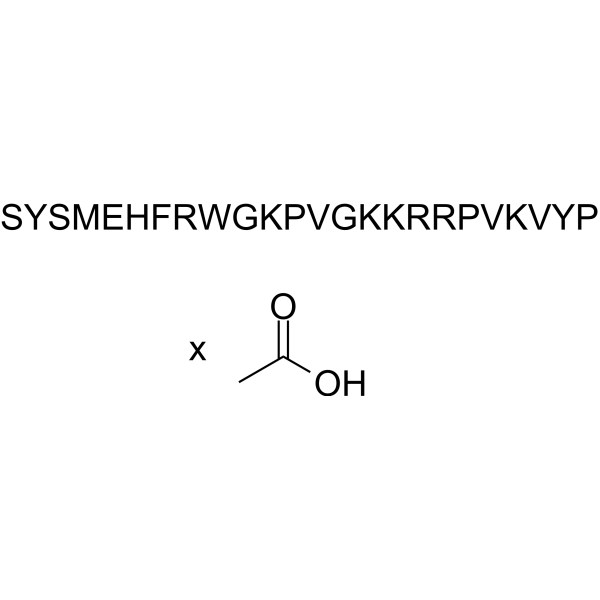
Tetracosactide acetate
CAS No. 60189-34-6
Tetracosactide acetate( Tetracosactrin acetate )
Catalog No. M28050 CAS No. 60189-34-6
Cosyntropin (acetate) stimulates the release of corticosteroids such as cortisol from the adrenal gland.
Purity : >98% (HPLC)
 COA
Datasheet
HNMR
HPLC
MSDS
Handing Instructions
COA
Datasheet
HNMR
HPLC
MSDS
Handing Instructions
| Size | Price / USD | Stock | Quantity |
| 5MG | 112 | In Stock |


|
| 10MG | 183 | In Stock |
|
| 25MG | 312 | In Stock |
|
| 50MG | 440 | In Stock |
|
| 100MG | 603 | In Stock |
|
| 200MG | 812 | In Stock |
|
| 500MG | Get Quote | In Stock |
|
| 1G | Get Quote | In Stock |
|
Biological Information
-
Product NameTetracosactide acetate
-
NoteResearch use only, not for human use.
-
Brief DescriptionCosyntropin (acetate) stimulates the release of corticosteroids such as cortisol from the adrenal gland.
-
DescriptionCosyntropin (acetate) stimulates the release of corticosteroids such as cortisol from the adrenal gland.
-
In Vitro——
-
In Vivo——
-
SynonymsTetracosactrin acetate
-
PathwayOthers
-
TargetOther Targets
-
Recptor——
-
Research Area——
-
Indication——
Chemical Information
-
CAS Number60189-34-6
-
Formula Weight2993.5
-
Molecular FormulaC136H210N40O31S.XC2H4O2
-
Purity>98% (HPLC)
-
Solubility——
-
SMILESN/A
-
Chemical Name——
Shipping & Storage Information
-
Storage(-20℃)
-
ShippingWith Ice Pack
-
Stability≥ 2 years
Reference
1.Zhang M, et al. Improving the flame retardancy of poly(lactic acid) using an efficient ternary hybrid flame retardant by dual modification of graphene oxide with phenylphosphinic acid and nano MOFs. J Hazard Mater. 2020 Feb 15;384:121260.
molnova catalog



related products
-
N-BENZYLFORMAMIDE
N-BENZYLFORMAMIDE is a natural product from Lepidium meyenii Walp.
-
SU 5214
SU 5214 is a modulator of tyrosine kinase signal transduction.
-
ACTH (1-16), human
ACTH (1-16) (human) (Adrenocorticotropic hormone (1-16)) is an ACTH fragment. ACTH (1-16) (human) improves cardiovascular function and survival in experimental hemorrhagic shock.
