


 Cart
Cart
 sales@molnova.com



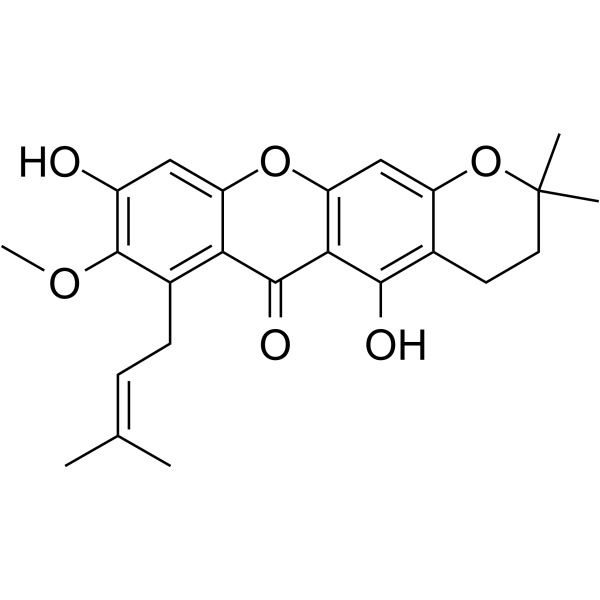
3-Isomangostin
CAS No. 19275-46-8
3-Isomangostin( —— )
Catalog No. M27955 CAS No. 19275-46-8
3-Isomangostin is an acetylcholinesterase selective inhibitor and a potent human aldose reductase inhibitor with an IC50 of 3.48 uM.
Purity : >98% (HPLC)
 COA
Datasheet
HNMR
HPLC
MSDS
Handing Instructions
COA
Datasheet
HNMR
HPLC
MSDS
Handing Instructions
| Size | Price / USD | Stock | Quantity |
| 1 mL x 10 mM in DMSO | 122 | In Stock |


|
| 5MG | 101 | In Stock |
|
| 10MG | 170 | In Stock |
|
| 25MG | 282 | In Stock |
|
| 50MG | 421 | In Stock |
|
| 100MG | Get Quote | In Stock |
|
| 200MG | Get Quote | In Stock |
|
| 500MG | Get Quote | In Stock |
|
| 1G | Get Quote | In Stock |
|
Biological Information
-
Product Name3-Isomangostin
-
NoteResearch use only, not for human use.
-
Brief Description3-Isomangostin is an acetylcholinesterase selective inhibitor and a potent human aldose reductase inhibitor with an IC50 of 3.48 uM.
-
Description3-Isomangostin is an acetylcholinesterase selective inhibitor and a potent human aldose reductase inhibitor with an IC50 of 3.48 uM. 3-Isomangostin has free radical scavenging activity and inhibits MutT homolog 1 (MTH1) with an IC50 of 52 nM. It shows antiplasmodial activity with an IC50 values in the range of 4.71-11.40 uM. 3-Isomangostin can be used to develop anticancer agents as well.(In Vitro):Species of Garcinia have been used to combat malaria in traditional African and Asian medicines, including Ayurveda. In the current study, we have identified antiplasmodial benzophenone and xanthone compounds from edible Garcinia species by testing for in vitro inhibitory activity against Plasmodium falciparum. Whole fruits of Garcinia xanthochymus, G. mangostana, G. spicata, and G. livingstonei were extracted and tested for antiplasmodial activity. Garcinia xanthochymus was subjected to bioactivity-guided fractionation to identify active partitions. Purified benzophenones (1-9) and xanthones (10-18) were then screened in the plasmodial lactate dehydrogenase assay and tested for cytotoxicity against mammalian (Vero) cells. The benzophenones guttiferone E (4), isoxanthochymol (5), and guttiferone H (6), isolated from G. xanthochymus, and the xanthones α-mangostin (15), β-mangostin (16), and 3-Isomangostin (17), known from G. mangostana, showed antiplasmodial activity with an IC50 values in the range of 4.71-11.40 μM. Artemisinin and chloroquine were used as positive controls and exhibited an IC50 values in the range of 0.01-0.24 μM.
-
In Vitro——
-
In Vivo——
-
Synonyms——
-
PathwayOthers
-
TargetOther Targets
-
RecptorAntibiotic|Bacterial
-
Research Area——
-
Indication——
Chemical Information
-
CAS Number19275-46-8
-
Formula Weight410.46
-
Molecular FormulaC24H26O6
-
Purity>98% (HPLC)
-
SolubilityIn Vitro:?DMSO : 100 mg/mL (243.63 mM)
-
SMILESCC(C)(CC1)Oc(cc2Oc(cc3O)c4c(CC=C(C)C)c3OC)c1c(O)c2C4=O
-
Chemical Name——
Shipping & Storage Information
-
Storage(-20℃)
-
ShippingWith Ice Pack
-
Stability≥ 2 years
Reference
1.Bhuta P, et al. Analogues of chloramphenicol: circular dichroism spectra, inhibition of ribosomal peptidyltransferase, and possible mechanism of action. J Med Chem. 1980 Dec;23(12):1299-305.
molnova catalog



related products
-
7-Ethoxycoumarin
7-Ethoxycoumarin a typical human P450 substrate is catalyzed by both wild-type and mutant forms of CYP102A1.
-
SH2 Domain Ligand (3...
SH2 Domain Ligand (3)
-
IFN alpha-IFNAR-IN-1...
IFN alpha-IFNAR-IN-1 hydrochloride is an inhibitor of the interaction between IFN-α and IFNAR. IFN alpha-IFNAR-IN-1 hydrochloride inhibits MVA-induced IFN-α responses by BM-pDCs with IC50 of 2-8 μM.
