


 Cart
Cart
 sales@molnova.com



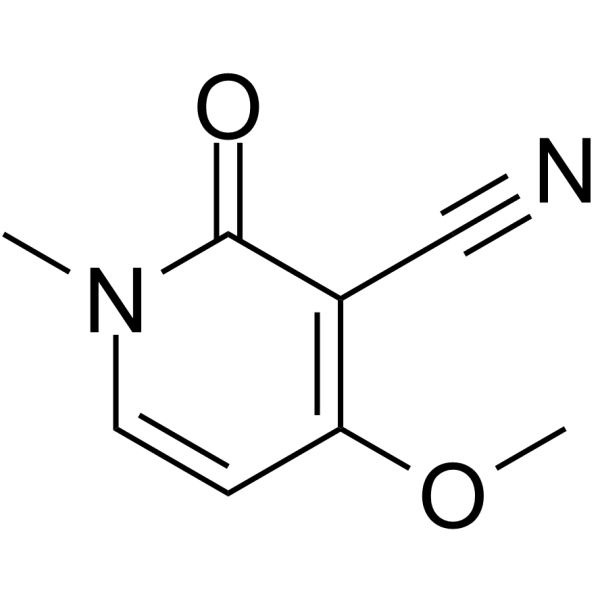
Ricinine
CAS No. 524-40-3
Ricinine( Ricinin | Ritsinin | 1,2-Dihydro-4-methoxy-1-methyl-2-oxonicotinonitrile )
Catalog No. M27792 CAS No. 524-40-3
Ricinine is a major alkaloid in Ricinus communis plant with hepatoprotection in CCl4 -induced liver damage.
Purity : >98% (HPLC)
 COA
Datasheet
HNMR
HPLC
MSDS
Handing Instructions
COA
Datasheet
HNMR
HPLC
MSDS
Handing Instructions
| Size | Price / USD | Stock | Quantity |
| 1 mL x 10 mM in DMSO | 42 | In Stock |


|
| 2MG | 29 | In Stock |
|
| 5MG | 49 | In Stock |
|
| 10MG | 70 | In Stock |
|
| 25MG | 116 | In Stock |
|
| 50MG | 183 | In Stock |
|
| 100MG | 254 | In Stock |
|
| 200MG | Get Quote | In Stock |
|
| 500MG | Get Quote | In Stock |
|
| 1G | Get Quote | In Stock |
|
Biological Information
-
Product NameRicinine
-
NoteResearch use only, not for human use.
-
Brief DescriptionRicinine is a major alkaloid in Ricinus communis plant with hepatoprotection in CCl4 -induced liver damage.
-
DescriptionRicinine is a major alkaloid in Ricinus communis plant with hepatoprotection in CCl4 -induced liver damage.
-
In Vitro——
-
In Vivo——
-
SynonymsRicinin | Ritsinin | 1,2-Dihydro-4-methoxy-1-methyl-2-oxonicotinonitrile
-
PathwayOthers
-
TargetOther Targets
-
RecptorP. falciparum
-
Research Area——
-
Indication——
Chemical Information
-
CAS Number524-40-3
-
Formula Weight164.164
-
Molecular FormulaC8H8N2O2
-
Purity>98% (HPLC)
-
Solubility——
-
SMILESCOc1ccn(C)c(=O)c1C#N
-
Chemical Name——
Shipping & Storage Information
-
Storage(-20℃)
-
ShippingWith Ice Pack
-
Stability≥ 2 years
Reference
1.Singh AP, et al. Lipophilic bisphosphonates are potent inhibitors of Plasmodium liver-stage growth. Antimicrob Agents Chemother. 2010 Jul;54(7):2987-93.
molnova catalog



related products
-
L48H37
L48H37 is an analog of Curcumin (HY-N0005) with improved chemical stability. L48H37 is a potent and specific myeloid differentiation protein 2 (MD2) inhibitor and inhibits the interaction and signaling transduction of LPS-TLR4/MD2.
-
N(p-Tosyl)-GPR-pNA
N(p-Tosyl)-GPR-pNA
-
Isorhoifolin
Isorhoifolin and vicenin II are main compounds of ethyl acetate fraction (EAcF) obtained from Erythrina velutina leaves, EAcF increases the cardiac contractile force by increasing the l-type calcium current and activating the adrenergic receptor pathway.
