


 Cart
Cart
 sales@molnova.com



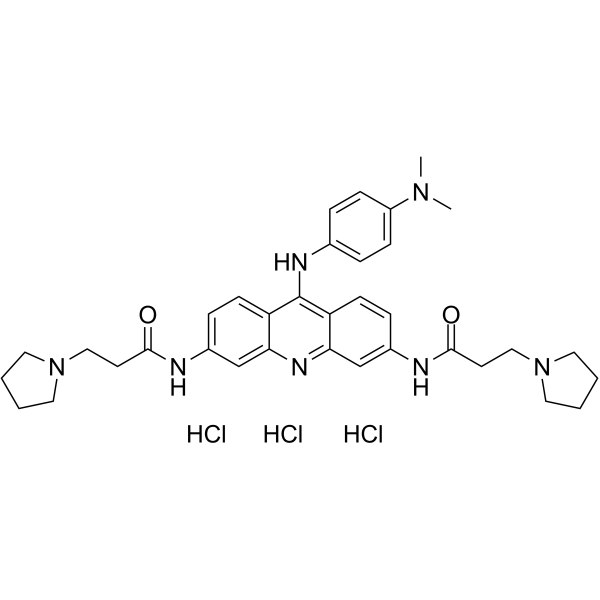
Braco-19 trihydrochloride
CAS No. 1177798-88-7
Braco-19 trihydrochloride( BRACO19 3HCl )
Catalog No. M27756 CAS No. 1177798-88-7
BRACO19 is a telomerase inhibitor. It also stabilizes G-quadruplexes, targeting telomeric G-quadruplexes.
Purity : >98% (HPLC)
 COA
Datasheet
HNMR
HPLC
MSDS
Handing Instructions
COA
Datasheet
HNMR
HPLC
MSDS
Handing Instructions
| Size | Price / USD | Stock | Quantity |
| 2MG | 65 | In Stock |


|
| 5MG | 107 | In Stock |
|
| 10MG | 180 | In Stock |
|
| 25MG | 392 | In Stock |
|
| 50MG | 538 | In Stock |
|
| 100MG | 732 | In Stock |
|
| 200MG | 995 | In Stock |
|
| 500MG | Get Quote | In Stock |
|
| 1G | Get Quote | In Stock |
|
Biological Information
-
Product NameBraco-19 trihydrochloride
-
NoteResearch use only, not for human use.
-
Brief DescriptionBRACO19 is a telomerase inhibitor. It also stabilizes G-quadruplexes, targeting telomeric G-quadruplexes.
-
DescriptionBRACO19 is a telomerase inhibitor. It also stabilizes G-quadruplexes, targeting telomeric G-quadruplexes.(In Vitro):The IC50 for BRACO-19 trihydrochloride (1.0-10 μM) in UXF1138L cells is 2.5 μM, the IC100 is 5 μM. BRACO-19 trihydrochloride (1 μM) dramatically reduces the expression of nuclear hTERT. BRACO-19 trihydrochloride (0-40 μM) dose-dependently decreases the AdV virus growth in eGFP-transinfected HEK 293 cells. BRACO-19 trihydrochloride (0-150 μM) decreases band intensity in an increasing concentration-dependent manner.(In Vivo):In nude mice established UXF1138LX Xenografts, BRACO-19 trihydrochloride (2 mg/kg; i.p.) significantly inhibits tumor growth and shows marked single-agent antitumor activity. some animals in the group shows complete regressions (5 of 12 tumors).
-
In VitroCell Viability Assay Cell Line:HEK 293 cells Concentration:20 μM; 40 μM Incubation Time:24 hours Result:Displayed low cytotoxicity and decreased the eGFP fluorescence.
-
In VivoAnimal Model:Established UXF1138LX Xenografts in nude mice Dosage:2 mg/kg Administration:Intraperitoneal injection; 3 weeks; starting 6 days after transplantation of UXF1138LX fragments Result:Showed partial tumor regressions with an optimal T/C on day 28 of 4.1%, equal to 95.9% inhibition of tumor growth compared with control.
-
SynonymsBRACO19 3HCl
-
PathwayOthers
-
TargetOther Targets
-
RecptorAngiotensin II
-
Research Area——
-
Indication——
Chemical Information
-
CAS Number1177798-88-7
-
Formula Weight703.15
-
Molecular FormulaC35H46Cl3N7O2
-
Purity>98% (HPLC)
-
SolubilityIn Vitro:?DMSO : 50 mg/mL (71.11 mM)
-
SMILESCl.Cl.Cl.CN(C)c1ccc(Nc2c3ccc(NC(=O)CCN4CCCC4)cc3nc3cc(NC(=O)CCN4CCCC4)ccc23)cc1
-
Chemical Name——
Shipping & Storage Information
-
Storage(-20℃)
-
ShippingWith Ice Pack
-
Stability≥ 2 years
Reference



-
Gymnoside I
Gymnoside I (compound 1) is a glycosidoxybenzyl 2-isobutylmalic acid. Gymnoside I shows antiallergic activity in passive cutaneous allergic reaction (PCA) in mice. Gymnoside I can be used in research to treat asthma, neurasthenia and chronic hepatitis.
-
Sodium mesoxalate mo...
Mesoxalic acid is primarily located in the cytoplasm within the cell. Mesoxalic acid can be biosynthesized from malonic acid. Outside of the human body mesoxalic acid can be found in cereals and cereal products common pea and herbs and spices.
-
ML-180
ML-180 is a potent orphan nuclear receptor liver receptor homolog 1 (LRH-1; NR5A2) inverse agonist (IC50 of 3.7 μM) .ML-180 (0.5-5 μM; 24 hours) shows a significant inhibition of cyclin-D1 and cyclin-E1 expression in hepatic cells, but has little effect on repression in SK-OV-3 cells[2]. ML-180 (5 μM; 24 hours) leads to a rapid decrease of LRH-1 expression and efficiently represses endogenous LRH-1 signaling.
