


 Cart
Cart
 sales@molnova.com



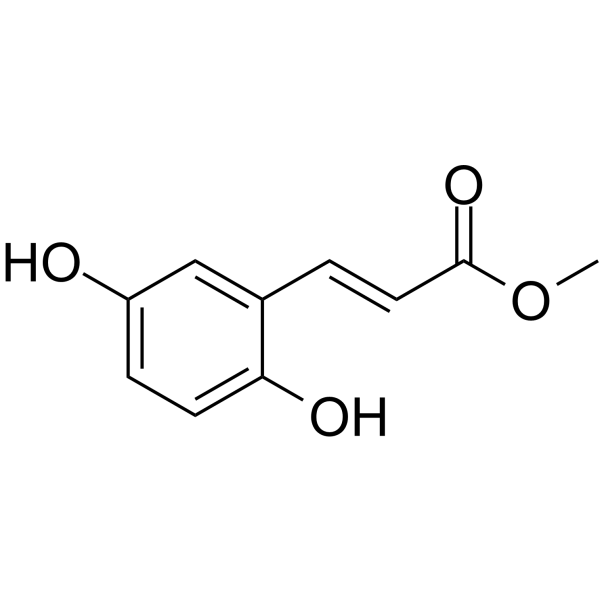
Methyl 2,5-dihydroxycinnamate
CAS No. 63177-57-1
Methyl 2,5-dihydroxycinnamate( —— )
Catalog No. M27654 CAS No. 63177-57-1
Methyl 2,5-dihydroxycinnamate is an EGF receptor-associated tyrosine kinases inhibitor.
Purity : >98% (HPLC)
 COA
Datasheet
HNMR
HPLC
MSDS
Handing Instructions
COA
Datasheet
HNMR
HPLC
MSDS
Handing Instructions
| Size | Price / USD | Stock | Quantity |
| 1 mL x 10 mM in DMSO | 52 | In Stock |


|
| 5MG | 52 | In Stock |
|
| 10MG | 92 | In Stock |
|
| 25MG | 187 | In Stock |
|
| 50MG | 346 | In Stock |
|
| 100MG | 517 | In Stock |
|
| 200MG | Get Quote | In Stock |
|
| 500MG | Get Quote | In Stock |
|
| 1G | Get Quote | In Stock |
|
Biological Information
-
Product NameMethyl 2,5-dihydroxycinnamate
-
NoteResearch use only, not for human use.
-
Brief DescriptionMethyl 2,5-dihydroxycinnamate is an EGF receptor-associated tyrosine kinases inhibitor.
-
DescriptionMethyl 2,5-dihydroxycinnamate is an EGF receptor-associated tyrosine kinases inhibitor.
-
In Vitro——
-
In Vivo——
-
Synonyms——
-
PathwayAngiogenesis
-
TargetEGFR
-
RecptorApoptosis|BiP
-
Research Area——
-
Indication——
Chemical Information
-
CAS Number63177-57-1
-
Formula Weight194.186
-
Molecular FormulaC10H10O4
-
Purity>98% (HPLC)
-
SolubilityIn Vitro:?DMSO : 125 mg/mL (643.73 mM)
-
SMILESCOC(=O)\C=C\c1cc(O)ccc1O
-
Chemical Name——
Shipping & Storage Information
-
Storage(-20℃)
-
ShippingWith Ice Pack
-
Stability≥ 2 years
Reference
1.Oida Y, et al. Induction of BiP, an ER-resident protein, prevents the neuronal death induced by transient forebrain ischemia in gerbil. Brain Res. 2008 May 7;1208:217-24.
molnova catalog



related products
-
AZD-9291
A potent, selective, third-generation irreversible inhibitor of mutant EGFR with IC50s of 1/12/5 nM for L858R-T790M/L858R/L861Q respectively.
-
PAT-505 B
PAT-505 is an orally available, selective and potent inhibitor of autologous epidermal growth factor (IC50 2 nM in Hep3B cells, 9.7 nM in human blood, 62 nM in mouse plasma).
-
VUF 10166
VUF10166 is a novel, potent and competitive antagonist for 5-HT3A receptor with Ki of 0.04 nM, its affinity at 5-HT3AB receptor is significantly lower.
