


 Cart
Cart
 sales@molnova.com



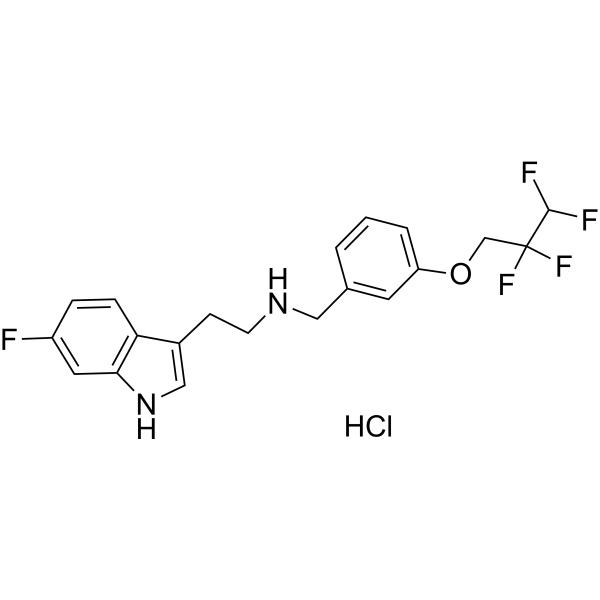
Idalopirdine Hydrochloride
CAS No. 467458-02-2
Idalopirdine Hydrochloride( Lu AE58054 Hydrochloride | Idalopirdine hydrochloride | Idalopirdine HCl )
Catalog No. M27650 CAS No. 467458-02-2
Lu AE58054 hydrochloride is an in-vivo binding affinity and effect, in-vitro selectivity and potency of 5-HT(6)R antagonist (Ki: 0.83 nM).
Purity : >98% (HPLC)
 COA
Datasheet
HNMR
HPLC
MSDS
Handing Instructions
COA
Datasheet
HNMR
HPLC
MSDS
Handing Instructions
| Size | Price / USD | Stock | Quantity |
| 1 mL x 10 mM in DMSO | 85 | In Stock |


|
| 5MG | 79 | In Stock |
|
| 10MG | 113 | In Stock |
|
| 25MG | 198 | In Stock |
|
| 50MG | 290 | In Stock |
|
| 100MG | 410 | In Stock |
|
| 200MG | 551 | In Stock |
|
| 500MG | Get Quote | In Stock |
|
| 1G | Get Quote | In Stock |
|
Biological Information
-
Product NameIdalopirdine Hydrochloride
-
NoteResearch use only, not for human use.
-
Brief DescriptionLu AE58054 hydrochloride is an in-vivo binding affinity and effect, in-vitro selectivity and potency of 5-HT(6)R antagonist (Ki: 0.83 nM).
-
DescriptionLu AE58054 hydrochloride is an in-vivo binding affinity and effect, in-vitro selectivity and potency of 5-HT(6)R antagonist (Ki: 0.83 nM).(In Vitro):In the 5-HT(6) GTP gamma S efficacy assay, Lu AE58054 showed potent inhibition of 5-HT-mediated activation. Apart from medium affinity to adrenergic alpha (1B)- and alpha(1A)-adrenoreceptors, Lu AE58054 shows >50-fold selectivity compared with more than 70 targets examined.(In Vivo):In the rats model, Orally administered Lu AE58054 inhibited binding of the 5-HT6 antagonist Lu AE60157 (ED50: 2.7 mg/kg). Administration of Lu AE58054 in a dose range (5–20 mg/kg) leading to above 65% 5-HT6R binding, which reversed cognitive impairment in rats treatment with phencyclidine. These results indicate that Lu AE58054 is a potent antagonist of 5-HT6Rs with good oral bioavailability in the rat model of cognitive impairment in schizophrenia.
-
In Vitro——
-
In VivoIdalopirdine (intraperitoneal injection, 5?mg/kg, daily, 28 days) Hydrochloride can reduce food intake and body weight in over-eating rat models.Idalopirdine (1 or 2?mg/kg, i.v) Hydrochloride can dose-dependently increase the gamma power during nPO electrical stimulation, enhance effect of donepezil on cortical gamma oscillations but no alteration of sleep-wake patterns in rats. Animal Model:Male Wistar rats Dosage:5?mg/kg Administration:intraperitoneal injection, daily, 28 days Result:Significantly reduced the amount of calories consumed by animals in a palatable diet and significantly reduced plasma levels of glucose, triglycerides and cholesterol.Animal Model:Male Sprague-Dawley rats Dosage:1 or 2?mg/kg Administration:i.v.Result:No significant increase in the gamma power at 1 mg/kg and significantly increased the gamma power at 2 mg/kg.Significantly enhanced and/or prolonged effect of low-dose donepezil (0.3 mg/kg) on gamma power during 60-minute nPO stimulation after donepezil administration.
-
SynonymsLu AE58054 Hydrochloride | Idalopirdine hydrochloride | Idalopirdine HCl
-
PathwayEndocrinology/Hormones
-
Target5-HT Receptor
-
Recptor——
-
Research Area——
-
Indication——
Chemical Information
-
CAS Number467458-02-2
-
Formula Weight434.84
-
Molecular FormulaC20H20ClF5N2O
-
Purity>98% (HPLC)
-
SolubilityIn Vitro:?DMSO : ≥ 25 mg/mL (57.49 mM)
-
SMILESCl.FC(F)C(F)(F)COc1cccc(CNCCc2c[nH]c3cc(F)ccc23)c1
-
Chemical Name——
Shipping & Storage Information
-
Storage(-20℃)
-
ShippingWith Ice Pack
-
Stability≥ 2 years
Reference
1.Lux G, R?sch W. [Conservative treatment of gastric ulcer]. Med Klin. 1980 Aug 29;75(18):638-44. Review. German.
molnova catalog



related products
-
KW-2478
KW-2478 is a non-ansamycin HSP90 inhibitor with IC50 of 3.8 nM.
-
Quetiapin
Quetiapine is indicated for the treatment of schizophrenia as well as for the treatment of acute manic episodes associated with bipolar I disorder.
-
Procaine hydrochlori...
A local anesthetic of the ester type that has a slow onset and a short duration of action. It is mainly used for infiltration anesthesia, peripheral nerve block, and spinal block.
