


 Cart
Cart
 sales@molnova.com



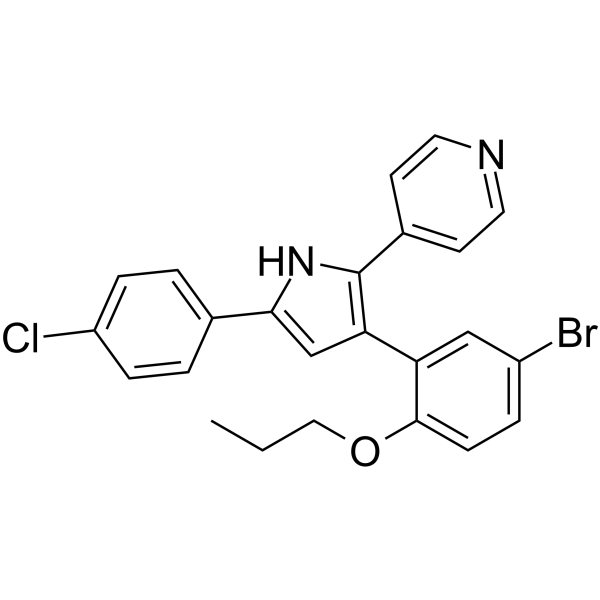
L-168049
CAS No. 191034-25-0
L-168049( L-168,049 )
Catalog No. M27645 CAS No. 191034-25-0
human glucagon receptor (hGR) antagonist.
Purity : >98% (HPLC)
 COA
Datasheet
HNMR
HPLC
MSDS
Handing Instructions
COA
Datasheet
HNMR
HPLC
MSDS
Handing Instructions
| Size | Price / USD | Stock | Quantity |
| 1 mL x 10 mM in DMSO | 119 | In Stock |


|
| 5MG | 107 | In Stock |
|
| 10MG | 180 | In Stock |
|
| 25MG | 377 | In Stock |
|
| 50MG | 548 | In Stock |
|
| 100MG | 784 | In Stock |
|
| 200MG | Get Quote | In Stock |
|
| 500MG | 1609 | In Stock |
|
| 1G | Get Quote | In Stock |
|
Biological Information
-
Product NameL-168049
-
NoteResearch use only, not for human use.
-
Brief Descriptionhuman glucagon receptor (hGR) antagonist.
-
Descriptionhuman glucagon receptor (hGR) antagonist(In Vitro):In Chinese hamster ovary cells expressing the human glucagon receptor, L-168049 increases the apparent EC50 of glucagon-stimulated adenylate cyclase and decreases maximal glucagon stimulation with a Kb of 25 nM. L-168049 blocks glucagon-stimulated cAMP formation in mouse liver membrane and inhibits glucagon (100 pM)-stimulated cAMP synthesis in CHO cells expressing the human glucagon receptor with IC50 of 41 nM .(In Vivo):In the liver of L-G6pc-/- mice, L-168049 (50 mg/kg body; p.o.) reduces Pck1 mRNA expression by half within 6 hours. L-168049 prevents the increase in G6pc expression in the kidney and gut .
-
In VitroL-168049 (compound 49) inhibits glucagon (100 pM) stimulated cAMP synthesis in CHO cells expressing the human glucagon receptor (hGIAR) (IC50 of 41 nM). L-168049 blocks cAMP formation stimulated by glucagon in murine liver membranes. L-168049 increases the apparent EC50 for glucagon stimulation of adenylyl cyclase in Chinese hamster ovary cells expressing the human glucagon receptor and decreases the maximal glucagon stimulation observed, with a Kb of 25 nM.
-
In VivoIn the liver of L-G6pc?/- mice, Pck1 mRNA expression is decreased by half 6 h after the administration of L-168049 (50 mg/kg body; p.o.), demonstrating the efficiency of the suppression of glucagon signaling. In agreement with the role of glucagon in the induction of extrahepatic gluconeogenesis, the administration of the L-168049 prevents the increase of the G6pc expression in both the kidneys and intestine of 6 h-fasted L-G6pc?/- mice.
-
SynonymsL-168,049
-
PathwayOthers
-
TargetOther Targets
-
Recptor——
-
Research Area——
-
Indication——
Chemical Information
-
CAS Number191034-25-0
-
Formula Weight467.79
-
Molecular FormulaC24H20BrClN2O
-
Purity>98% (HPLC)
-
SolubilityIn Vitro:?DMSO : ≥ 50 mg/mL (106.89 mM)
-
SMILESCCCOc1ccc(Br)cc1-c1cc([nH]c1-c1ccncc1)-c1ccc(Cl)cc1
-
Chemical Name——
Shipping & Storage Information
-
Storage(-20℃)
-
ShippingWith Ice Pack
-
Stability≥ 2 years
Reference
1.García González M, et al. [Droxicam-induced hepatitis. Description of 3 new cases and review of the literature]. Rev Clin Esp. 1994 Mar;194(3):170-2. Review. Spanish.
molnova catalog



related products
-
Tamgermanetin
Tamgermanetin demonstrates potential cytotoxic effect against three different tumor cell lines, namely liver (Huh-7), breast (MCF-7) and prostate (PC-3).
-
α-?Amyrin acetate
α-Amyrin acetate is a natural product( triterpeno), with anti-inflammatory activity, antispasmodic profile and the relaxant effect.
-
Dimethoate
Dimethoate is a systemic and contact insecticide for control of cattle grubs and certain other insect pests of farm animals.
