


 Cart
Cart
 sales@molnova.com



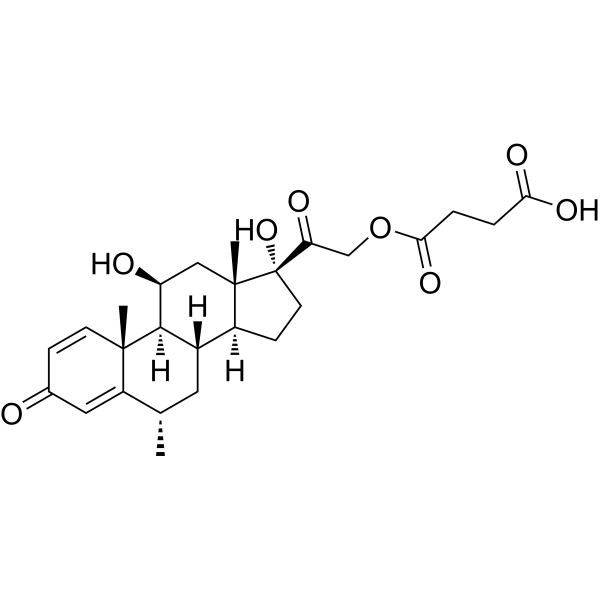
Methylprednisolone succinate
CAS No. 2921-57-5
Methylprednisolone succinate( Methylprednisolone hydrogen succinate | Methylprednisolone hemisuccinate )
Catalog No. M27565 CAS No. 2921-57-5
Methylprednisolone succinate is a synthetic glucocorticoid and is widely used as an anti-inflammatory agent.
Purity : >98% (HPLC)
 COA
Datasheet
HNMR
HPLC
MSDS
Handing Instructions
COA
Datasheet
HNMR
HPLC
MSDS
Handing Instructions
| Size | Price / USD | Stock | Quantity |
| 1 mL x 10 mM in DMSO | 29 | In Stock |


|
| 25MG | 36 | In Stock |
|
| 50MG | 60 | In Stock |
|
| 100MG | Get Quote | In Stock |
|
| 200MG | Get Quote | In Stock |
|
| 500MG | Get Quote | In Stock |
|
| 1G | Get Quote | In Stock |
|
Biological Information
-
Product NameMethylprednisolone succinate
-
NoteResearch use only, not for human use.
-
Brief DescriptionMethylprednisolone succinate is a synthetic glucocorticoid and is widely used as an anti-inflammatory agent.
-
DescriptionMethylprednisolone succinate is a synthetic glucocorticoid and is widely used as an anti-inflammatory agent.
-
In Vitro——
-
In Vivo——
-
SynonymsMethylprednisolone hydrogen succinate | Methylprednisolone hemisuccinate
-
PathwayCytoskeleton/Cell Adhesion Molecules
-
TargetGlucokinase
-
Recptorp38|JNK
-
Research Area——
-
Indication——
Chemical Information
-
CAS Number2921-57-5
-
Formula Weight474.55
-
Molecular FormulaC26H34O8
-
Purity>98% (HPLC)
-
Solubility——
-
SMILESCC1CC2C3CCC(O)(C(=O)COC(=O)CCC(O)=O)C3(C)CC(O)C2C2(C)C=CC(=O)C=C12
-
Chemical Name——
Shipping & Storage Information
-
Storage(-20℃)
-
ShippingWith Ice Pack
-
Stability≥ 2 years
Reference
1.Leandro J Carre?o, et al. The Half-Life of the T-cell receptor/peptide-major Histocompatibility Complex Interaction Can Modulate T-cell Activation in Response to Bacterial Challenge. Immunology. 2007 Jun;121(2):227-37.
molnova catalog



related products
-
3PO
3PO is a small-molecule inhibitor of PFKFB3 (IC50: 22.9 μM), inhibiting the proliferation of several human malignant hematopoietic and adenocarcinoma cell lines (IC50: 1.4-24 μM).
-
Dorzagliatin
Dorzagliatin (HMS-5552, HMS5552)?is a novel potent, fourth-generation glucokinase (GK) activator.
-
MK-0941
MK-0941 (MK0941) is a novel potent, orally active Glucokinase (GK) activator with EC50 of 0.240 and 0.065 uM in 2.5 and 10 mM glucose, respectively.
