


 Cart
Cart
 sales@molnova.com



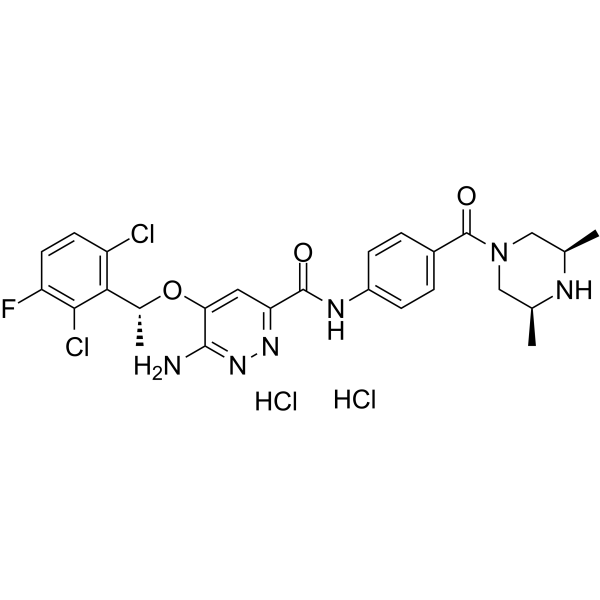
Ensartinib hydrochloride
CAS No. 2137030-98-7
Ensartinib hydrochloride( Ensartinib dihydrochloride | X-396 dihydrochloride )
Catalog No. M27551 CAS No. 2137030-98-7
Ensartinib dihydrochloride is a potent new-generation ALK inhibitor with high activity against CNS metastases and a broad range of known crizotinib-resistant ALK mutations.
Purity : >98% (HPLC)
 COA
Datasheet
HNMR
HPLC
MSDS
Handing Instructions
COA
Datasheet
HNMR
HPLC
MSDS
Handing Instructions
| Size | Price / USD | Stock | Quantity |
| 1 mL x 10 mM in DMSO | 169 | In Stock |


|
| 5MG | 123 | In Stock |
|
| 10MG | 188 | In Stock |
|
| 25MG | 404 | In Stock |
|
| 50MG | 631 | In Stock |
|
| 100MG | 918 | In Stock |
|
| 200MG | 1237 | In Stock |
|
| 500MG | Get Quote | In Stock |
|
| 1G | Get Quote | In Stock |
|
Biological Information
-
Product NameEnsartinib hydrochloride
-
NoteResearch use only, not for human use.
-
Brief DescriptionEnsartinib dihydrochloride is a potent new-generation ALK inhibitor with high activity against CNS metastases and a broad range of known crizotinib-resistant ALK mutations.
-
DescriptionEnsartinib dihydrochloride is a potent new-generation ALK inhibitor with high activity against CNS metastases and a broad range of known crizotinib-resistant ALK mutations. It potently inhibits both wild-type ALK and ALK variants (C1156Y, F1174, G1202R, L1196M, S1206R, and T1151 mutants) with in vitro IC50s of <4 nM.(In Vitro):Ensartinib potently inhibits both wild-type ALK and all evaluated ALK variants (C1156Y, F1174, G1202R, L1196M, S1206R, and T1151 mutants) with in vitro IC50s of <4 nM. Besides ALK, ensartinib also potently inhibits GOPC-ROS1, TPM3-TRKA, and TRKC with an IC50 of <1 nM, and inhibits EphA1, EphA2, EphB1 and c-MET with an IC50 of 1-10 nM.
-
In VitroEnsartinib (X-396) dihydrochloride is a potent and dual ALK/MET inhibitor with IC50s of <0.4 nM and 0.74 nM, respectively. Ensartinib dihydrochloride is potent in H3122 lung cancer cells harboring EML4-ALK E13;A20 (IC50: 15 nM). Ensartinib dihydrochloride is also potent in H2228 lung cancer cells harboring EML4-ALK E6a/b; A20 (IC50: 45 nM). Furthermore, X-376 is potent in SUDHL-1 lymphoma cells harboring NPM-ALK (IC50: 9 nM).
-
In VivoEnsartinib (X-396) dihydrochloride shows substantial bioavailability and moderate half-lives in vivo. Nude mice harboring H3122 xenografts are treated with Ensartinib dihydrochloride at 25 mg/kg bid. Ensartinib dihydrochloride significantly delays the growth of tumors compared to vehicle alone. In the xenograft experiments, Ensartinib dihydrochloride appears well-tolerated in vivo. Mouse weight is unaffected by Ensartinib dihydrochloride treatment. Drug-treated mice appear healthy and do not display any signs of compound related toxicity. To further assess potential side effects of Ensartinib dihydrochloride, additional systemic toxicity and toxico-kinetic studies are performed in Sprague Dawley (SD) rats. Following 10 days of repeated oral administration of Ensartinib dihydrochloride at 20, 40, 80 mg/kg in SD rats, all animals survive to study termination. The no significant toxicity (NST) levels are determined to be 80 mg/kg for Ensartinib dihydrochloride. At NST levels, Ensartinib dihydrochloride achieves an AUC of 66 μM×hr and a Cmax of 7.19 μM.
-
SynonymsEnsartinib dihydrochloride | X-396 dihydrochloride
-
PathwayOthers
-
TargetOther Targets
-
Recptormitochondrial cytochrome bc1
-
Research Area——
-
Indication——
Chemical Information
-
CAS Number2137030-98-7
-
Formula Weight634.36
-
Molecular FormulaC26H29Cl4FN6O3
-
Purity>98% (HPLC)
-
SolubilityIn Vitro:?DMSO : 35.71 mg/mL (56.29 mM)
-
SMILESCl.Cl.CC(Oc1cc(nnc1N)C(=O)Nc1ccc(cc1)C(=O)N1CC(C)NC(C)C1)c1c(Cl)ccc(F)c1Cl
-
Chemical Name——
Shipping & Storage Information
-
Storage(-20℃)
-
ShippingWith Ice Pack
-
Stability≥ 2 years
Reference
1.Benjamin M Vincent, et al. A Fungal-Selective Cytochrome Bc 1 Inhibitor Impairs Virulence and Prevents the Evolution of Drug Resistance.Cell Chem Biol. 2016 Aug 18;23(8):978-991.
molnova catalog



related products
-
iso-proylFerulic aci...
Isopropyl ferulate, isolated from Notopterygium incisum, is used in the reduction of pharmaceuticals, preparation of antifungal agents, cosmetics and as antioxidant agent and so forth.
-
BPN14770
BPN14770 is an allosteric inhibitor of selective phosphodiesterase 4D (PDE4D; IC50s: 7.8 nM and 7.4 nM for PDE4D7 and PDE4D3).
-
Acetyltrialanine
Acetyltrialanine is a dipeptide compound that binds at two sites on the Tb+3-pancreatic elastase complex and can be used as a nitrogen source.
