


 Cart
Cart
 sales@molnova.com



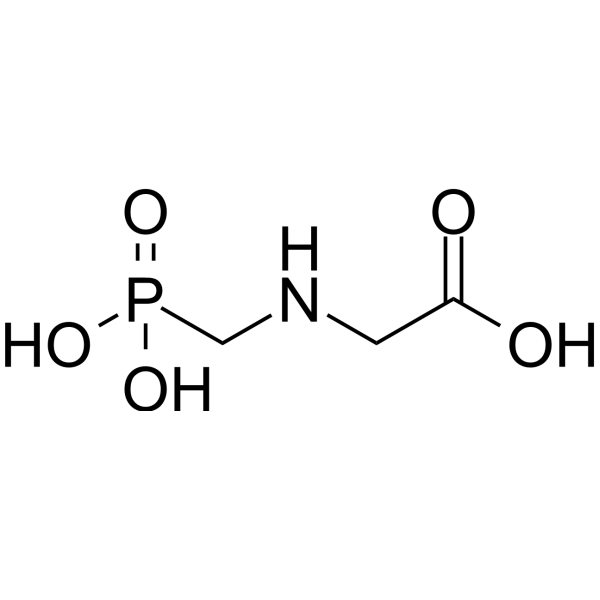
Glyphosate
CAS No. 1071-83-6
Glyphosate( Atila | Folusen | Lancer )
Catalog No. M27176 CAS No. 1071-83-6
Glyphosate is an herbicide. It also is a possible carcinogen to humans.
Purity : >98% (HPLC)
 COA
Datasheet
HNMR
HPLC
MSDS
Handing Instructions
COA
Datasheet
HNMR
HPLC
MSDS
Handing Instructions
| Size | Price / USD | Stock | Quantity |
| 100MG | Get Quote | In Stock |


|
| 200MG | Get Quote | In Stock |
|
| 500MG | 36 | In Stock |
|
| 1G | Get Quote | In Stock |
|
Biological Information
-
Product NameGlyphosate
-
NoteResearch use only, not for human use.
-
Brief DescriptionGlyphosate is an herbicide. It also is a possible carcinogen to humans.
-
DescriptionGlyphosate is an herbicide. It also is a possible carcinogen to humans.(In Vitro):Glyphosate exposure interferes with mouse oocyte maturation by generating oxidative stress and early apoptosis. Glyphosate induces early apoptosis and autophagy in mouse oocytes.
-
In Vitro——
-
In Vivo——
-
SynonymsAtila | Folusen | Lancer
-
PathwayApoptosis
-
TargetApoptosis
-
RecptorGPR120
-
Research Area——
-
Indication——
Chemical Information
-
CAS Number1071-83-6
-
Formula Weight169.073
-
Molecular FormulaC3H8NO5P
-
Purity>98% (HPLC)
-
SolubilityIn Vitro:?H2O : 13.89 mg/mL (82.16 mM)
-
SMILESOC(=O)CNCP(O)(O)=O
-
Chemical Name——
Shipping & Storage Information
-
Storage(-20℃)
-
ShippingWith Ice Pack
-
Stability≥ 2 years
Reference
1.Oh DY, et al. A Gpr120-selective agonist improves insulin resistance and chronic inflammation in obese mice. Nat Med. 2014 Aug;20(8):942-7.
molnova catalog



related products
-
2’-OMe-Guanosine
2'-OMe-Guanosine is a modified nucleoside produced by the action of tRNA guanosine-2'-o-methyltransferase. 2'-OMe-Guanosine has a certain pro-apoptotic effect.
-
RSH-7
RSH-7 is a potent dual inhibitor of BTK and FLT3, with IC50s of 47 and 12 nM, respectively.RSH-7 has antiproliferative and antitumor activities, inducing apoptosis and inhibiting BTK and FLT3 signaling.
-
2-Thiocytidine
2-Thiocytidine is a purine nucleoside analog that targets malignant tumors of the inert lymphatic system and possesses a broad spectrum of antitumor activity. It induces apoptosis by inhibiting DNA synthesis.
