


 Cart
Cart
 sales@molnova.com



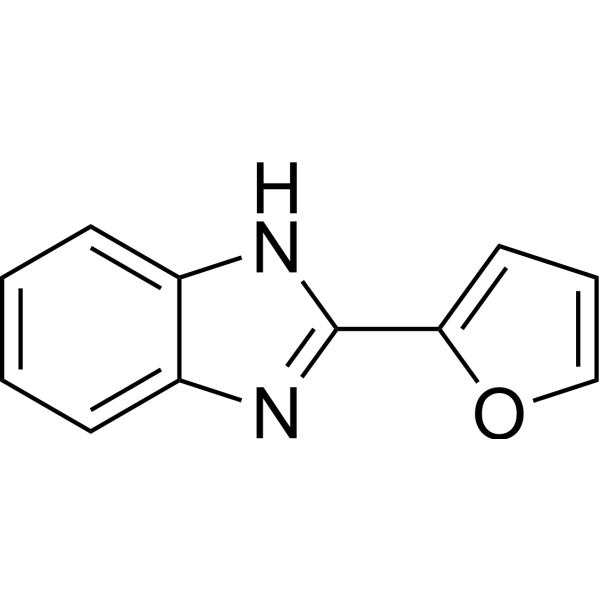
Fuberidazole
CAS No. 3878-19-1
Fuberidazole( —— )
Catalog No. M27127 CAS No. 3878-19-1
Fuberidazole is an antifungal agent.
Purity : >98% (HPLC)
 COA
Datasheet
HNMR
HPLC
MSDS
Handing Instructions
COA
Datasheet
HNMR
HPLC
MSDS
Handing Instructions
| Size | Price / USD | Stock | Quantity |
| 25MG | 40 | In Stock |


|
| 50MG | 50 | In Stock |
|
| 100MG | 61 | In Stock |
|
| 200MG | Get Quote | In Stock |
|
| 500MG | Get Quote | In Stock |
|
| 1G | Get Quote | In Stock |
|
Biological Information
-
Product NameFuberidazole
-
NoteResearch use only, not for human use.
-
Brief DescriptionFuberidazole is an antifungal agent.
-
DescriptionFuberidazole is an antifungal agent.
-
In Vitro——
-
In Vivo——
-
Synonyms——
-
PathwayGPCR/G Protein
-
TargetAntibacterial
-
Recptor——
-
Research Area——
-
Indication——
Chemical Information
-
CAS Number3878-19-1
-
Formula Weight184.198
-
Molecular FormulaC11H8N2O
-
Purity>98% (HPLC)
-
SolubilityIn Vitro:?DMSO : 125 mg/mL (678.65 mM)
-
SMILESc1coc(c1)-c1nc2ccccc2[nH]1
-
Chemical Name——
Shipping & Storage Information
-
Storage(-20℃)
-
ShippingWith Ice Pack
-
Stability≥ 2 years
Reference



-
3-Hydroxy-C4-HSL
3-Hydroxy-C4-HSL (N-3-hydroxybutyryl-L-Homoserine lactone) is an N-acyl homoserine lactone obtained from pathogenic Vibrio vulnificus in fish and is a bacterial group sensing (QS) inducer that modulates bacterial signaling and can be used in the study of bacterial infections.
-
Terminolic acid
Terminolic acid is a pentacyclic triterpenoid glucoside isolated from Combretum racemosum,?can inhibit the pro-inflammatory cytokines by binding to receptor active site of IL-1β and IL-6, and enhance anti-inflammatory cytokines by binding to IL-4 receptor binding sites.
-
Kasugamycin hydrochl...
Kasugamycin hydrochloride hydrate(Ksg) specifically inhibits translation initiation of canonical but not of leaderless messenger RNAs. Ksg inhibition is thought to occur by direct competition with initiator transfer RNA.
