


 Cart
Cart
 sales@molnova.com



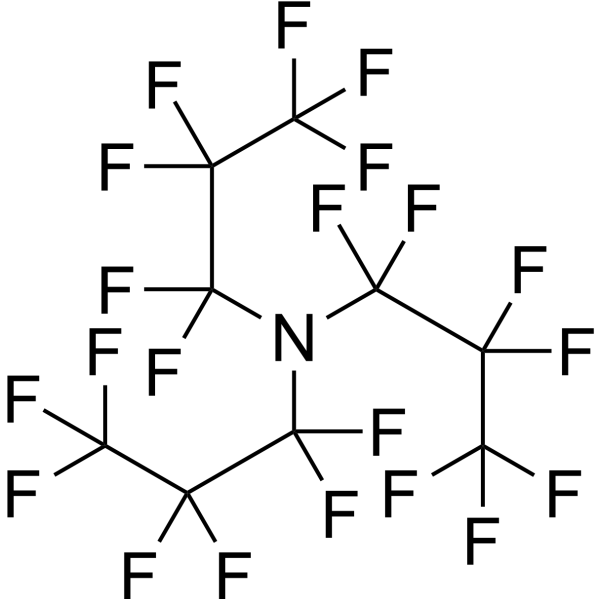
Perfluamine
CAS No. 338-83-0
Perfluamine( Perfluorotripropylamine | FTPA | Tris(perfluoropropyl)amine )
Catalog No. M27102 CAS No. 338-83-0
Perfluamine is a hydrophobic carrier fluid and can be used as a blood substitute.
Purity : >98% (HPLC)
 COA
Datasheet
HNMR
HPLC
MSDS
Handing Instructions
COA
Datasheet
HNMR
HPLC
MSDS
Handing Instructions
| Size | Price / USD | Stock | Quantity |
| 50MG | 27 | In Stock |


|
| 100MG | Get Quote | In Stock |
|
| 200MG | Get Quote | In Stock |
|
| 500MG | Get Quote | In Stock |
|
| 1G | Get Quote | In Stock |
|
Biological Information
-
Product NamePerfluamine
-
NoteResearch use only, not for human use.
-
Brief DescriptionPerfluamine is a hydrophobic carrier fluid and can be used as a blood substitute.
-
DescriptionPerfluamine is a hydrophobic carrier fluid and can be used as a blood substitute.
-
In Vitro——
-
In Vivo——
-
SynonymsPerfluorotripropylamine | FTPA | Tris(perfluoropropyl)amine
-
PathwayOthers
-
TargetOther Targets
-
RecptorA2B
-
Research Area——
-
Indication——
Chemical Information
-
CAS Number338-83-0
-
Formula Weight521.072
-
Molecular FormulaC9F21N
-
Purity>98% (HPLC)
-
Solubility——
-
SMILESFC(F)(F)C(F)(F)C(F)(F)N(C(F)(F)C(F)(F)C(F)(F)F)C(F)(F)C(F)(F)C(F)(F)F
-
Chemical Name——
Shipping & Storage Information
-
Storage(-20℃)
-
ShippingWith Ice Pack
-
Stability≥ 2 years
Reference
1.Rüsing D, et al. The impact of adenosine and A(2B) receptors on glucose homoeostasis. J Pharm Pharmacol. 2006 Dec;58(12):1639-45.
molnova catalog



related products
-
Monatepil maleate
Monatepil maleate (AJ-2615 maleate) is an orally active Ca2+-channel and α1-adrenoceptor antagonist and non-competitive heparanoyl-coenzyme A:cholesterol acyltransferase (ACAT) inhibitor with antihypertensive activity.
-
Mas7
Amphiphilic peptide Mas7, a structural analogue of mastoparan is a known activator of heterotrimeric Gi-proteins and its downstream effectors.
-
Pherocon (4-(4-Aceto...
Pherocon (4-(4-Acetoxyphenyl)-2-butanone) is a standard melon fly attractant.
