


 Cart
Cart
 sales@molnova.com



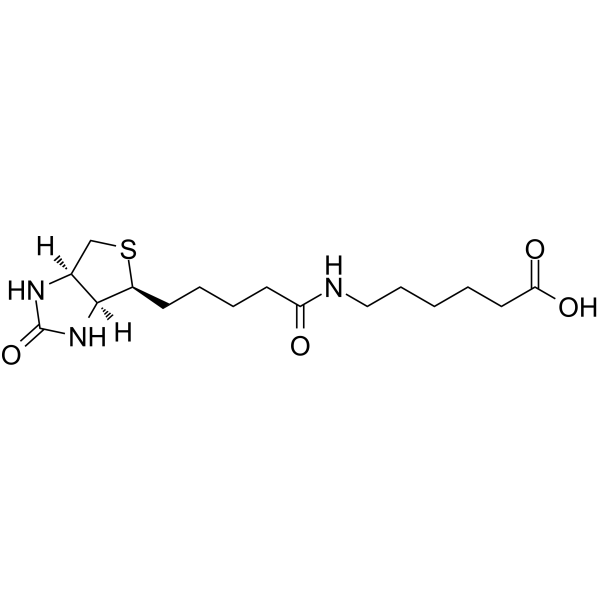
N-Biotinyl-6-aminohexanoic acid
CAS No. 72040-64-3
N-Biotinyl-6-aminohexanoic acid( N-(+)-Biotinyl-6-aminohexanoic acid )
Catalog No. M27092 CAS No. 72040-64-3
N-Biotinyl-6-aminohexanoic acid can be used to perform N-terminal biotinylation.
Purity : >98% (HPLC)
 COA
Datasheet
HNMR
HPLC
MSDS
Handing Instructions
COA
Datasheet
HNMR
HPLC
MSDS
Handing Instructions
| Size | Price / USD | Stock | Quantity |
| 100MG | Get Quote | In Stock |


|
| 200MG | 27 | In Stock |
|
| 500MG | Get Quote | In Stock |
|
| 1G | Get Quote | In Stock |
|
Biological Information
-
Product NameN-Biotinyl-6-aminohexanoic acid
-
NoteResearch use only, not for human use.
-
Brief DescriptionN-Biotinyl-6-aminohexanoic acid can be used to perform N-terminal biotinylation.
-
DescriptionN-Biotinyl-6-aminohexanoic acid can be used to perform N-terminal biotinylation.(In Vitro):The SERS (surface-enhanced Raman scattering) of cyclohexyl isocyanide that silver nanoparticles modified with N-Biotinyl-6-aminohexanoic acid and cyclohexyl isocyanide can be anchored on a separate biotinylated substrate via the avidin-biotin interaction.Synthesis of p-nitrophenyl N-acetyllactosaminide with β-D-galactosidase, chemical reduction of the p-nitrophenyl group, and sialylation with sialyltransferase. The p-aminophenyl glycosides are successfully biotin-labeled through the coupling with N-Biotinyl-6-aminohexanoic acid to afford biotinylated oligosaccharides with an aminohexanosyl group and phenyl group as the spacers between the biotin and glycan. The biotin-labeled sugars were shown to be useful for immobilization and assay of the carbohydrate-lectin interactions by an optical biosensor based on surface plasmon resonance.
-
In VitroSynthesis of p-nitrophenyl N-acetyllactosaminide with β-D-galactosidase, chemical reduction of the p-nitrophenyl group, and sialylation with sialyltransferase. The p-aminophenyl glycosides are then successfully biotin-labeled through the coupling with N-(+)-biotinyl-6- aminohexanoic acid to afford biotinylated oligosaccharides with an aminohexanosyl group and phenyl group as the spacers between the biotin and glycan.The SERS (surface-enhanced Raman scattering) of cyclohexyl isocyanide that silver nanoparticles modified with N-(+)-biotinyl-6-aminocaproic acid and cyclohexyl isocyanide can be anchored on a separate biotinylated substrate via the avidin-biotin interaction.
-
In Vivo——
-
SynonymsN-(+)-Biotinyl-6-aminohexanoic acid
-
PathwayOthers
-
TargetOther Targets
-
Recptor——
-
Research Area——
-
Indication——
Chemical Information
-
CAS Number72040-64-3
-
Formula Weight357.47
-
Molecular FormulaC16H27N3O4S
-
Purity>98% (HPLC)
-
Solubility——
-
SMILESO=C(O)CCCCCNC(CCCC[C@@H]1SC[C@]([C@]1([H])N2)([H])NC2=O)=O
-
Chemical Name——
Shipping & Storage Information
-
Storage(-20℃)
-
ShippingWith Ice Pack
-
Stability≥ 2 years
Reference
1.Kim KH, et al. 1-Carbomethoxy-β-Carboline,?Derived?from?Portulaca?oleracea?L.,?Ameliorates?LPS-Mediated?Inflammatory?Response?Associated?with?MAPK?Signaling?and?Nuclear?Translocation?of NF-κB.Molecules.?2019 Nov 7;24(22). pii: E4042.
molnova catalog



related products
-
Fosravuconazole L-ly...
FosravuconazoleL-lysine ethanolate is a broad-spectrum antifungal agent. In Japan, it is approved for the treatment of onychomycosis, a fungal infection of the nail. It is a prodrug that is converted into ravuconazole.
-
Dihydroalpinumisofla...
Dihydroalpinumisoflavone is a natural product derived from the leaves and stems of Crotalaria madurensis.
-
(22S,23S)-Homobrassi...
(22S,23S)-Homobrassinolide induces plant growth in various plant bioassay systems.
