


 Cart
Cart
 sales@molnova.com



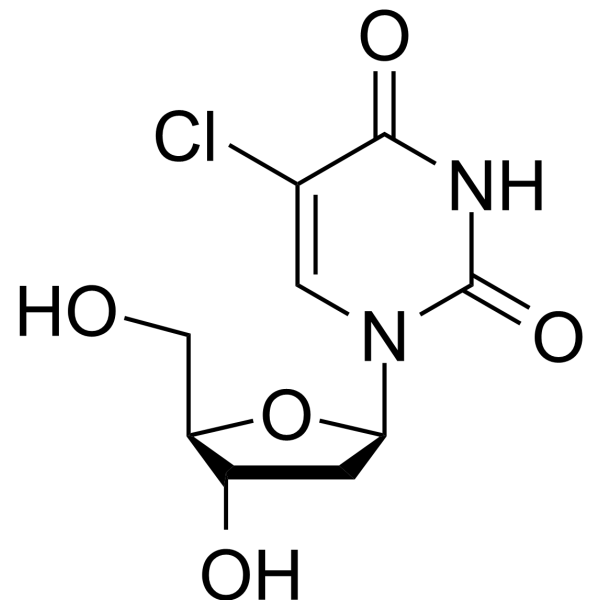
5-Chloro-2-deoxyuridine
CAS No. 50-90-8
5-Chloro-2-deoxyuridine( 5-Chlorodeoxyuridine | CldU )
Catalog No. M27059 CAS No. 50-90-8
5-Chloro-2'-deoxyuridine is a thymine analog. It can be used to study the potential of hypochlorous acid damage to DNA and DNA precursors.
Purity : >98% (HPLC)
 COA
Datasheet
HNMR
HPLC
MSDS
Handing Instructions
COA
Datasheet
HNMR
HPLC
MSDS
Handing Instructions
| Size | Price / USD | Stock | Quantity |
| 1 mL x 10 mM in DMSO | 41 | In Stock |


|
| 25MG | 29 | In Stock |
|
| 50MG | 37 | In Stock |
|
| 100MG | Get Quote | In Stock |
|
| 200MG | Get Quote | In Stock |
|
| 500MG | Get Quote | In Stock |
|
| 1G | Get Quote | In Stock |
|
Biological Information
-
Product Name5-Chloro-2-deoxyuridine
-
NoteResearch use only, not for human use.
-
Brief Description5-Chloro-2'-deoxyuridine is a thymine analog. It can be used to study the potential of hypochlorous acid damage to DNA and DNA precursors.
-
Description5-Chloro-2'-deoxyuridine is a thymine analog. It can be used to study the potential of hypochlorous acid damage to DNA and DNA precursors.(In Vitro):When 5-Chloro-2’-deoxyuridine (ClDU) is placed into the tissue culture medium, mammalian cells incorporate the analog into DNA. It is observed that a 10 μM concentration of 5-Chloro-2’-deoxyuridine in the media does not alter cell division kinetics. Previously it has been shown that 5-Chloro-2’-deoxyuridine is metabolized and incorporated into DNA using antibodies that bind selectively to DNA containing halogenated bases. In the studies reported here, 5-Chloro-2’-deoxyuridine is more similar to BrdU in acting as a T analog. The toxicity of 5-Chloro-2’-deoxyuridine could in part be attributed to inhibition of thymidylate synthase .
-
In VitroWhen 5-Chloro-2’-deoxyuridine (ClDU) is placed into tissue culture medium, mammalian cells incorporate the analog into DNA. It is observed that 10 μM concentration of 5-Chloro-2’-deoxyuridine in the media does not alter cell division kinetics. Previously it has been shown that 5-Chloro-2’-deoxyuridine is metabolized and incorporated into DNA using antibodies that bind selectively to DNA containing halogenated bases. In the studies reported here, 5-Chloro-2’-deoxyuridine is more similar to BrdU in acting as a T analog. The toxicity of 5-Chloro-2’-deoxyuridine could in part be attributed to inhibition of thymidylate synthase.
-
In Vivo——
-
Synonyms5-Chlorodeoxyuridine | CldU
-
PathwayOthers
-
TargetOther Targets
-
RecptorTRPM4
-
Research Area——
-
Indication——
Chemical Information
-
CAS Number50-90-8
-
Formula Weight262.65
-
Molecular FormulaC9H11ClN2O5
-
Purity>98% (HPLC)
-
SolubilityIn Vitro:?DMSO : 250 mg/mL (951.84 mM)
-
SMILESOC[C@H]1O[C@H](C[C@@H]1O)n1cc(Cl)c(=O)[nH]c1=O
-
Chemical Name——
Shipping & Storage Information
-
Storage(-20℃)
-
ShippingWith Ice Pack
-
Stability≥ 2 years
Reference
1.Hilmar BADING, et al. Novel means to modulate nmda receptor-mediated toxicity. WO2020078554A1
molnova catalog



related products
-
guvacine hydrobromid...
Guvacine hydrobromide, an alkaloid found in the nut of Areca catechu, is a potent GABA uptakp inhibitor. Guvacine hydrobromide inhibits rat GAT-1, rat GAT-2 and rat GAT-3 with IC50 values of 39 μM, 58 μM and 378 μM, respectively.
-
Notoginsenoside L13
Reference standards.
-
Boc-(Asp(OBzl)16)-Ga...
Boc-(Asp(OBzl)16)-Gastrin I (13-17) (human)
