


 Cart
Cart
 sales@molnova.com



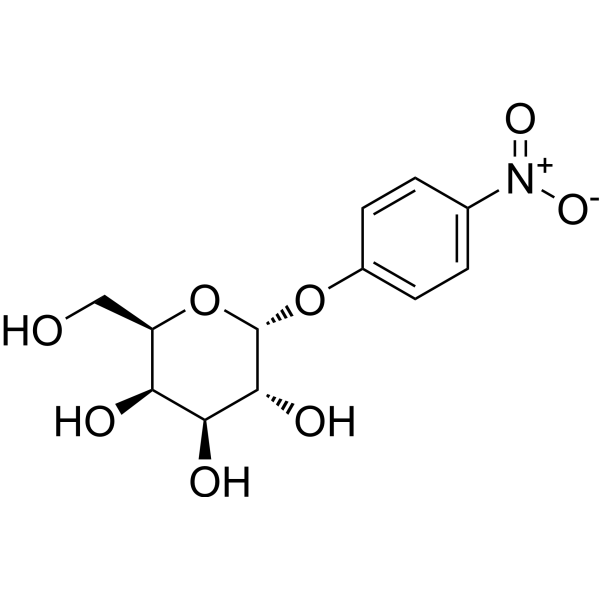
4-Nitrophenyl α-D-galactopyranoside
CAS No. 7493-95-0
4-Nitrophenyl α-D-galactopyranoside( PNP-alpha-D-Gal | PNP-α-D-Gal )
Catalog No. M27057 CAS No. 7493-95-0
4-Nitrophenyl α-D-galactopyranoside (PNP-alpha-D-Gal) is an artificial substrate of 4-nitrophenyl (pNP) glycopyranoside for detecting α-galactosidase activity.
Purity : >98% (HPLC)
 COA
Datasheet
HNMR
HPLC
MSDS
Handing Instructions
COA
Datasheet
HNMR
HPLC
MSDS
Handing Instructions
| Size | Price / USD | Stock | Quantity |
| 1 mL x 10 mM in DMSO | 37 | In Stock |


|
| 100MG | 28 | In Stock |
|
| 200MG | Get Quote | In Stock |
|
| 500MG | Get Quote | In Stock |
|
| 1G | Get Quote | In Stock |
|
Biological Information
-
Product Name4-Nitrophenyl α-D-galactopyranoside
-
NoteResearch use only, not for human use.
-
Brief Description4-Nitrophenyl α-D-galactopyranoside (PNP-alpha-D-Gal) is an artificial substrate of 4-nitrophenyl (pNP) glycopyranoside for detecting α-galactosidase activity.
-
Description4-Nitrophenyl α-D-galactopyranoside (PNP-alpha-D-Gal) is an artificial substrate of 4-nitrophenyl (pNP) glycopyranoside for detecting α-galactosidase activity. The amount of released pNP is significantly increased when 4-Nitrophenyl α-D-galactopyranoside is used as substrates.(In Vitro):Using 4-nitrophenol (pNP)-glycopyranosides as pseudosubstrates, the amount of liberated pNP from the 4-Nitrophenyl α-D-galactopyranoside is significantly higher than that from the other pNP-glycopyranosides at pH 4.0 whereas no activity was detected at pH 7.0. The digestion assays using pNP glycopyranosides as artificial substrates show that yielding liberated galactose residues from 4-Nitrophenyl α-D-galactopyranoside mainly at pH 4.0, i.e. the pH level where yield threshold is decreased at most.
-
In VitroUsing 4-nitorophenol (pNP)-glycopyranosides as pseudosubstrates, the amount of liberated pNP from the 4-Nitrophenyl α-D-galactopyranoside is significantly higher than that from the other pNP-glycopyranosides at pH 4.0 whereas no activity was detected at pH 7.0. The digestion assays using 4-nitrophenyl (pNP) glycopyranosides as artificial substrates shows that yieldin liberated galactose residues from 4-Nitrophenyl α-D-galactopyranoside mainly at pH 4.0, i.e. the pH level where yield threshold is decreased at most.
-
In Vivo——
-
SynonymsPNP-alpha-D-Gal | PNP-α-D-Gal
-
PathwayOthers
-
TargetOther Targets
-
RecptorAlkyl-Chain| Non-cleavable
-
Research Area——
-
Indication——
Chemical Information
-
CAS Number7493-95-0
-
Formula Weight301.25
-
Molecular FormulaC12H15NO8
-
Purity>98% (HPLC)
-
SolubilityIn Vitro:?H2O : 16.67 mg/mL (55.34 mM)
-
SMILESO[C@@H]1[C@H](O)[C@@H](O)[C@@H](OC2=CC=C([N+]([O-])=O)C=C2)O[C@@H]1CO
-
Chemical Name——
Shipping & Storage Information
-
Storage(-20℃)
-
ShippingWith Ice Pack
-
Stability≥ 2 years
Reference
1.Nalawansha DA, et al. PROTACs: An Emerging Therapeutic Modality in Precision Medicine. Cell Chem Biol. 2020;27(8):998-985.
molnova catalog



related products
-
Fulacimstat
Fulacimstat (BAY 1142524, BAY1142524) is a potent, orally available chymase inhibitor with IC50 of 4 nM and 3 nM for human and hamster chymase enzyme, respectively.
-
L-4FPG
L-4FPG inhibits the neutral amino acid transporters ASCT1 and ASCT2. It also shows good brain penetration and potently reduces amphetamine-induced hyperlocomotion.
-
Bromosporine
Bromosporine is a broad spectrum inhibitor for bromodomains for BRD2/4/9 and CECR2 (IC50: 0.41/0.29/0.122/0.017 μM), respectively.
