


 Cart
Cart
 sales@molnova.com



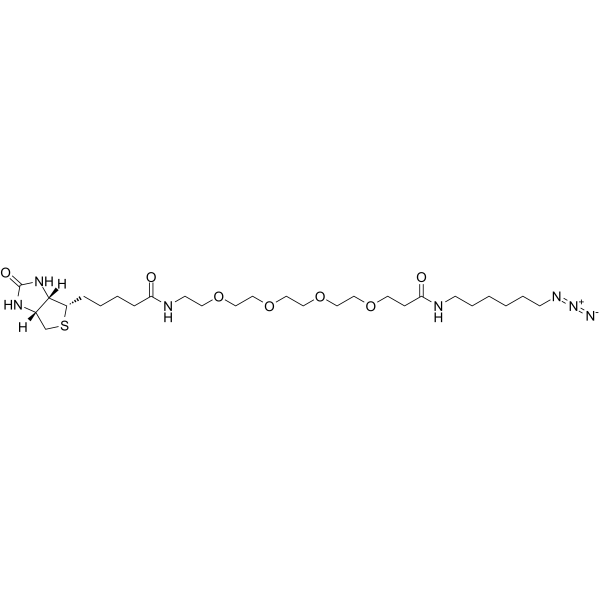
Biotin-PEG4-Amide-C6-Azide
CAS No. 1006592-62-6
Biotin-PEG4-Amide-C6-Azide( —— )
Catalog No. M26907 CAS No. 1006592-62-6
Biotin-PEG4-Amide-C6-Azide is a PEG-based PROTAC linker that can be used in the synthesis of PROTACs.
Purity : >98% (HPLC)
 COA
Datasheet
HNMR
HPLC
MSDS
Handing Instructions
COA
Datasheet
HNMR
HPLC
MSDS
Handing Instructions
| Size | Price / USD | Stock | Quantity |
| 1 mL x 10 mM in DMSO | 71 | In Stock |


|
| 2MG | 29 | In Stock |
|
| 5MG | 48 | In Stock |
|
| 10MG | 72 | In Stock |
|
| 25MG | 121 | In Stock |
|
| 50MG | 160 | In Stock |
|
| 100MG | 237 | In Stock |
|
| 200MG | 352 | In Stock |
|
| 500MG | Get Quote | In Stock |
|
| 1G | Get Quote | In Stock |
|
Biological Information
-
Product NameBiotin-PEG4-Amide-C6-Azide
-
NoteResearch use only, not for human use.
-
Brief DescriptionBiotin-PEG4-Amide-C6-Azide is a PEG-based PROTAC linker that can be used in the synthesis of PROTACs.
-
DescriptionBiotin-PEG4-Amide-C6-Azide is a PEG-based PROTAC linker that can be used in the synthesis of PROTACs.(In Vitro):PROTACs contain two different ligands connected by a linker; one is a ligand for an E3 ubiquitin ligase and the other is for the target protein. PROTACs exploit the intracellular ubiquitin-proteasome system to selectively degrade target proteins.
-
In VitroPROTACs contain two different ligands connected by a linker; one is a ligand for an E3 ubiquitin ligase and the other is for the target protein. PROTACs exploit the intracellular ubiquitin-proteasome system to selectively degrade target proteins.
-
In Vivo——
-
Synonyms——
-
PathwayOthers
-
TargetOther Targets
-
Recptor——
-
Research Area——
-
Indication——
Chemical Information
-
CAS Number1006592-62-6
-
Formula Weight615.79
-
Molecular FormulaC27H49N7O7S
-
Purity>98% (HPLC)
-
SolubilityIn Vitro:?DMSO : 100 mg/mL (162.39 mM)
-
SMILES[H][C@]12CS[C@@H](CCCCC(=O)NCCOCCOCCOCCOCCC(=O)NCCCCCCN=[N+]=[N-])[C@@]1([H])NC(=O)N2
-
Chemical Name——
Shipping & Storage Information
-
Storage(-20℃)
-
ShippingWith Ice Pack
-
Stability≥ 2 years
Reference
1.D T Vo, et al. Insect nicotinic acetylcholine receptor agonists as flea adulticides in small animals. J Vet Pharmacol Ther. 2010 Aug;33(4):315-22.
molnova catalog



related products
-
H-Phe-Ala-Arg-Lys-Gl...
H-Phe-Ala-Arg-Lys-Gly-Ala-Leu-Arg-Gln-OH
-
Tenilsetam
Tenilsetam is an endonuclease modulator; a nootropic agent and advanced glycation end product (AGE) inhibitor having potential for Alzheimer's disease (AD) treatment.
-
FEN1-IN-2
FEN1-IN-2 is a selective and potent inhibitor of flap endonuclease 1 (FEN1), inhibits FEN1 and XPG, has potential anticancer activity, and can be used to study DNA damage repair.
