


 Cart
Cart
 sales@molnova.com



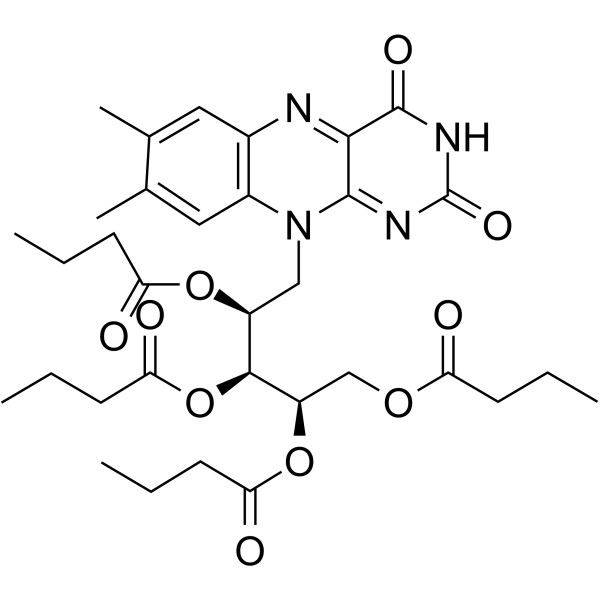
Riboflavin Tetrabutyrate
CAS No. 752-56-7
Riboflavin Tetrabutyrate( —— )
Catalog No. M26805 CAS No. 752-56-7
Riboflavin Tetrabutyrate is a lipophilic flavin derivative. Riboflavin Tetrabutyrate has antioxidative and lipid peroxide-removing activity.
Purity : >98% (HPLC)
 COA
Datasheet
HNMR
HPLC
MSDS
Handing Instructions
COA
Datasheet
HNMR
HPLC
MSDS
Handing Instructions
| Size | Price / USD | Stock | Quantity |
| 1 mL x 10 mM in DMSO | 48 | In Stock |


|
| 50MG | 31 | In Stock |
|
| 100MG | Get Quote | In Stock |
|
| 200MG | Get Quote | In Stock |
|
| 500MG | Get Quote | In Stock |
|
| 1G | Get Quote | In Stock |
|
Biological Information
-
Product NameRiboflavin Tetrabutyrate
-
NoteResearch use only, not for human use.
-
Brief DescriptionRiboflavin Tetrabutyrate is a lipophilic flavin derivative. Riboflavin Tetrabutyrate has antioxidative and lipid peroxide-removing activity.
-
DescriptionRiboflavin Tetrabutyrate is a lipophilic flavin derivative. Riboflavin Tetrabutyrate has antioxidative and lipid peroxide-removing activity.(In Vitro):Riboflavin Tetrabutyrate is suppressive against both NADPH-coupled and ascorbate-induced microsomal lipid peroxidation. Riboflavin Tetrabutyrate inhibits oxygen uptake by lipid peroxidation. Riboflavin Tetrabutyrate seems to exhibit its antioxidative action at or after the hydrogen atom is abstracted as a free radical from an active methylene group of polyunsaturated fatty acids during the process of enzymic oxidation-reduction reaction .(In Vivo):Riboflavin Tetrabutyrate might improve the metabolism of lipids in patients suffering from atherosclerosis, diabetes, fatty liver, and so on through the inhibition of lipid peroxide, resulting in a decrease of the elevated serum lipid. The increase in hepatic 3-ketoacyl-CoA thiolase activity suggests that prolonged Riboflavin Tetrabutyrate administration induces an increased beta-oxidation of fatty acid in the liver. Feeding of Riboflavin Tetrabutyrate causes an increase in the hepatic activity of 3-ketoacyl-CoA thiolase by 50% of the control level, while the activities of renal 3-ketoacyl-CoA thiolase and of hepatic and renal acyl-CoA synthetase and acyl-CoA dehydrogenase remain unaffected .
-
In VitroRiboflavin Tetrabutyrate inhibits oxygen uptake by lipid peroxidation. Riboflavin Tetrabutyrate is suppressive against both NADPH-coupled and ascorbate-induced microsomal lipid peroxidation. Riboflavin Tetrabutyrate seems to exhibit its antioxidative action at or after the hydrogen atom is abstracted as a free radical from an active methylene group of polyunsaturated fatty acids during the process of enzymic oxidation-reduction reaction.
-
In VivoRiboflavin Tetrabutyrate might improve the metabolism of lipids in patients suffering from atherosclerosis, diabetes, fatty liver and so on through the inhibition of lipid peroxide, resulting in the decrease of the elevated serum lipid. Feeding of Riboflavin Tetrabutyrate results in an increase in the hepatic activity of 3-ketoacyl-CoA thiolase by 50% of the control level, while the activities of renal 3-ketoacyl-CoA thiolase and of hepatic and renal acyl-CoA synthetase and acyl-CoA dehydrogenase remain unaffected. The increase in hepatic 3-ketoacyl-CoA thiolase activity suggests that prolonged Riboflavin Tetrabutyrate administration results in an increased beta-oxidation of fatty acid in the liver .
-
Synonyms——
-
PathwayImmunology/Inflammation
-
TargetROS
-
Recptor——
-
Research Area——
-
Indication——
Chemical Information
-
CAS Number752-56-7
-
Formula Weight656.733
-
Molecular FormulaC33H44N4O10
-
Purity>98% (HPLC)
-
SolubilityIn Vitro:?DMSO : ≥ 100 mg/mL (152.27 mM)
-
SMILESCCCC(=O)OC[C@@H](OC(=O)CCC)[C@@H](OC(=O)CCC)[C@H](Cn1c2cc(C)c(C)cc2nc2c(O)nc(=O)nc12)OC(=O)CCC
-
Chemical Name——
Shipping & Storage Information
-
Storage(-20℃)
-
ShippingWith Ice Pack
-
Stability≥ 2 years
Reference
1.Itkin M, et al. The biosynthetic pathway of the nonsugar, high-intensity sweetener mogroside V from Siraitia grosvenorii.Proc Natl Acad Sci U S A. 2016 Nov 22;113(47):E7619-E7628.
molnova catalog



related products
-
NS309
NS309 is a nonselective activator of small- and intermediate-conductance Ca2+-activated K+ (SK/KCa2 and IK/KCa3.1) channels (EC50s range from 0.12-1.2 μM for SK channels and 10-90 nM for IK channels).
-
2-benzylsulfanyl-6-m...
2-benzylsulfanyl-6-methoxy-4-methylquinazoline can be used as a TRPML modulator for the treatment of diseases associated with TRPML activity, such as lysosomal storage disease, muscular dystrophy, oxidative stress or reactive oxygen species (ROS)-related diseases and ageing.
-
Carminic acid
Carminic acid, the well-known red dyestuff from cochineal insects (Dactylopius spp.), is a potent feeding deterrent to ants.
