


 Cart
Cart
 sales@molnova.com



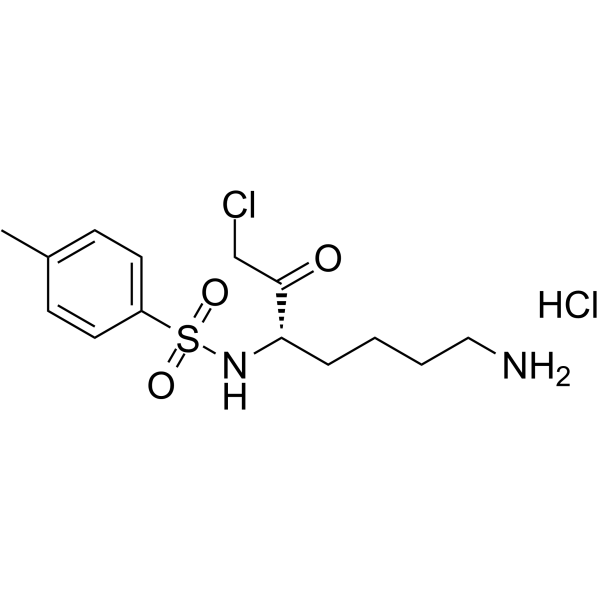
N-alpha-Tosyl-L-lysine chloromethyl ketone hydrochloride
CAS No. 4272-74-6
N-alpha-Tosyl-L-lysine chloromethyl ketone hydrochloride( N-alpha-Tosyl-L-lysine_chloromethyl_ketone_hydrochloride | N-alpha-Tosyl-L-lysine chloromethyl ketone hydrochloride )
Catalog No. M26766 CAS No. 4272-74-6
N-alpha-Tosyl-L-lysine chloromethyl ketone hydrochloride is an inhibitor of trypsin-like protease.
Purity : >98% (HPLC)
 COA
Datasheet
HNMR
HPLC
MSDS
Handing Instructions
COA
Datasheet
HNMR
HPLC
MSDS
Handing Instructions
| Size | Price / USD | Stock | Quantity |
| 1 mL x 10 mM in DMSO | 50 | In Stock |


|
| 2MG | 29 | In Stock |
|
| 5MG | 46 | In Stock |
|
| 10MG | 69 | In Stock |
|
| 25MG | 123 | In Stock |
|
| 50MG | 172 | In Stock |
|
| 100MG | Get Quote | In Stock |
|
| 200MG | Get Quote | In Stock |
|
| 500MG | Get Quote | In Stock |
|
| 1G | Get Quote | In Stock |
|
Biological Information
-
Product NameN-alpha-Tosyl-L-lysine chloromethyl ketone hydrochloride
-
NoteResearch use only, not for human use.
-
Brief DescriptionN-alpha-Tosyl-L-lysine chloromethyl ketone hydrochloride is an inhibitor of trypsin-like protease.
-
DescriptionN-alpha-Tosyl-L-lysine chloromethyl ketone hydrochloride is an inhibitor of trypsin-like protease. N-alpha-Tosyl-L-lysine chloromethyl ketone hydrochloride exhibits an inhibitory effect on IFN-γ activities.(In Vitro):A lower concentration of anti-Fas (10 ng/mL) is used to examine the interaction among the three effectors simultaneously, that is, anti-Fas, TLCK, and IFN-γ. N-alpha-Tosyl-L-lysine chloromethyl ketone hydrochloride (50 μM) exhibits a small decrease in cell viability. Beyond 50 μM, a dose-dependent decrease in cell viability is observed. IFN-γ slightly reduces cell viability on its own. The addition of anti-Fas (10 ng/mL) results in a slight decrease in cell survival, which is enhanced more than additively in the presence of TLCK, most prominently between 50 and 100 μM. Upon addition of both anti-Fas and IFN-γ, a decrease (≈46%) in cell viability is observed. Moreover, the decrease in cell survival is further enhanced by the addition of higher concentrations of TLCK, 25 μM, and more.
-
In VitroN-alpha-Tosyl-L-lysine chloromethyl ketone exhibits an inhibitory effect on IFN-γ activities. The effect of TLCK is studied on the IFN-γ sensitization of HeLa cells towards cell death mediated by anti-Fas. Lower concentration of anti-Fas (10 ng/mL) are used to examine the interaction among the three effectors simultaneously, that is, anti-Fas, TLCK and IFN-γ. TLCK by itself up to 50 μM concentration exhibits a small decrease in cell viability. Beyond 50 μM, a dose dependent decrease in cell viability is observed. IFN-γ slightly reduces cell viability on its own. Addition of anti-Fas (10 ng/mL) results in a slight decrease in cell survival, which is enhanced more than additively in the presence of TLCK, most prominently between 50 and 100 μM. Upon addition of both anti-Fas and IFN-γ, a decrease (≈46%) in cell viability is observed. Moreover, the decrease in cell survival is further enhanced upon addition of higher concentrations of TLCK, 25 μM and more.
-
In Vivo——
-
SynonymsN-alpha-Tosyl-L-lysine_chloromethyl_ketone_hydrochloride | N-alpha-Tosyl-L-lysine chloromethyl ketone hydrochloride
-
PathwayOthers
-
TargetOther Targets
-
Recptor——
-
Research Area——
-
Indication——
Chemical Information
-
CAS Number4272-74-6
-
Formula Weight369.31
-
Molecular FormulaC14H22Cl2N2O3S
-
Purity>98% (HPLC)
-
SolubilityIn Vitro:?DMSO : 250 mg/mL (676.94 mM)
-
SMILESO=S(C1=CC=C(C)C=C1)(N[C@H](C(CCl)=O)CCCCN)=O.Cl
-
Chemical Name——
Shipping & Storage Information
-
Storage(-20℃)
-
ShippingWith Ice Pack
-
Stability≥ 2 years
Reference
1.Lim B, et al. A Unique Recombinant Fluoroprobe Targeting Activated Platelets Allows In Vivo Detection of Arterial Thrombosis and Pulmonary Embolism Using a Novel Three-Dimensional Fluorescence Emission Computed Tomography (FLECT) Technology. Theranostics. 2017 Feb 26;7(5):1047-1061.
molnova catalog



related products
-
Oxindole
Oxindole is an aromatic heterocyclic building block.?2-indolinone derivatives have become lead compounds in the research of kinase inhibitors.Oxindole structure has been used in receptor tyrosine kinases (RTKs) inhibitors such as SU4984 and intedanib, the RTK family represents an important therapeutic target for anti-cancer drug development.
-
Nrf2 activator-4
Nrf2 activator-4 is an Nrf2 activator that inhibits the production of reactive oxygen species in microglia for the treatment of fatty liver disease associated with metabolic dysfunction in humans.
-
Dlin-MeOH
Dlin-MeOH is a lipid membrane and a potential nucleic acid carrier for the synthesis of DLin-MC3-DMA.
