


 Cart
Cart
 sales@molnova.com



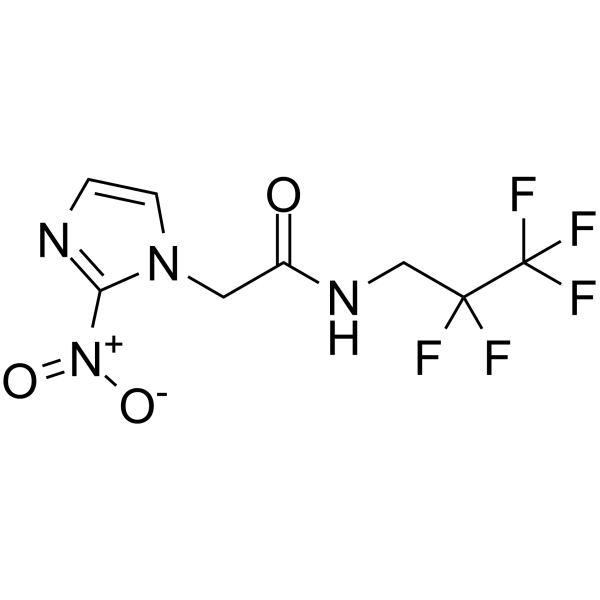
EF-5
CAS No. 152721-37-4
EF-5( EF5 | 2-Nitroimidazole )
Catalog No. M26676 CAS No. 152721-37-4
EF-5 is a agent of hypoxia labeling. It is used to identify hypoxia in cells.
Purity : >98% (HPLC)
 COA
Datasheet
HNMR
HPLC
MSDS
Handing Instructions
COA
Datasheet
HNMR
HPLC
MSDS
Handing Instructions
| Size | Price / USD | Stock | Quantity |
| 1 mL x 10 mM in DMSO | 45 | In Stock |


|
| 5MG | 41 | In Stock |
|
| 10MG | 69 | In Stock |
|
| 25MG | 141 | In Stock |
|
| 50MG | 221 | In Stock |
|
| 100MG | 328 | In Stock |
|
| 200MG | 458 | In Stock |
|
| 500MG | Get Quote | In Stock |
|
| 1G | Get Quote | In Stock |
|
Biological Information
-
Product NameEF-5
-
NoteResearch use only, not for human use.
-
Brief DescriptionEF-5 is a agent of hypoxia labeling. It is used to identify hypoxia in cells.
-
DescriptionEF-5 is a agent of hypoxia labeling. It is used to identify hypoxia in cells.(In Vitro):EF-5 binding and metabolic reduction of the prodrugs are highly correlated in a panel of 14 hypoxic tumor cell lines. Overexpression of CYPOR causes similar 2- to 4-fold increases in EF-5 binding and metabolic reduction of tirapazamine and CEN-209 in SiHa and HCT116 cell lines. Which is similar enhancement of γH2AX formation.(In Vivo):EF-5 binding is a promising stratification biomarker for benzotriazine-N-oxide bioreductive prodrugs. Binding and detection using a monoclonal antibody in 9L gliomas is specific and oxygen dependent, following intravenous injection of EF-5. Modification of tumor hypoxia causes similar changes to the bioreductive activation of both agents, resulting in a strong correlation between EF-5 binding and CEN209-induced DNA damage at the individual tumor level. Detection of binding using fluorescence microscopy can be performed on frozen tissues; tissue sections can be counterstained with haematoxylin and eosin for light microscopic analysis. The distribution of hypoxia in a tumor can be inferred by examining individual tumor cells using flow cytometric techniques.
-
In VitroOverexpression of CYPOR induces similar 2- to 4-fold increases in EF-5 binding and metabolic reduction of tirapazamine and CEN-209 in SiHa and HCT116 cell lines, and similar enhancement of γH2AX formation. EF-5 binding and metabolic reduction of the prodrugs are highly correlated in a panel of 14 hypoxic tumor cell lines.
-
In VivoEF-5 binding is a promising stratification biomarker for benzotriazine-N-oxide bioreductive prodrugs. In HCT116 xenografts, CYPOR overexpression also significantly increases EF-5 binding and CEN-209 reduction, and modification of tumor hypoxia causes similar changes to the bioreductive activation of both agents, resulting in a strong correlation between EF-5 binding and CEN209-induced DNA damage at the individual tumor level. Following intravenous injection of EF-5, binding and detection using a monoclonal antibody in 9L gliomas is specific and oxygen dependent. Detection of binding using fluorescence microscopy can be performed on frozen tissues; tissue sections can be counterstained with haematoxylin and eosin for light microscopic analysis. Alternatively, the distribution of hypoxia in a tumor can be inferred by examining individual tumor cells using flow cytometric techniques.
-
SynonymsEF5 | 2-Nitroimidazole
-
PathwayOthers
-
TargetOther Targets
-
RecptorHuman Endogenous Metabolite
-
Research Area——
-
Indication——
Chemical Information
-
CAS Number152721-37-4
-
Formula Weight302.161
-
Molecular FormulaC8H7F5N4O3
-
Purity>98% (HPLC)
-
SolubilityIn Vitro:?DMSO : 125 mg/mL (413.69 mM)
-
SMILES[O-][N+](=O)c1nccn1CC(=O)NCC(F)(F)C(F)(F)F
-
Chemical Name——
Shipping & Storage Information
-
Storage(-20℃)
-
ShippingWith Ice Pack
-
Stability≥ 2 years
Reference



-
Epithalon TFA
Epitalon TFA is an anti-aging agent and telomerase activator.Addition of Epithalon peptide in telomerase-negative human fetal fibroblast culture induced expression of the catalytical subunit, enzymatic activity of telomerase, and telomere elongation, which can be due to reactivation of telomerase gene in somatic cells and indicates the possibility of prolonging life span of a cell population and of the whole organism.
-
Mito-TEMPO
Mito-TEMPO is a mitochondria-targeted superoxide dismutase mimetic. Mito-TEMPO with superoxide and alkyl radical scavenging properties.
-
22':5'2''-Terthiophe...
22':5'2''-Terthiophene (α-Terthiophene) is an oligomer of the heterocycle thiophene. 22':5'2''-Terthiophene has been employed as building block for the organic semi-conductor polythiophene.
