


 Cart
Cart
 sales@molnova.com



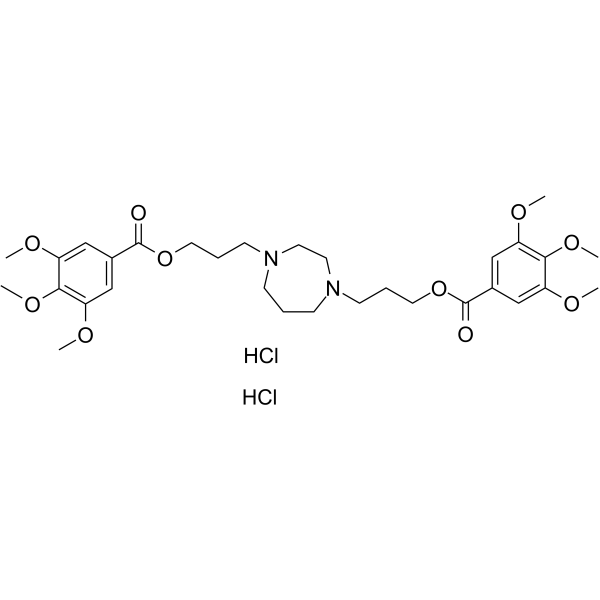
Dilazep dihydrochloride
CAS No. 20153-98-4
Dilazep dihydrochloride( —— )
Catalog No. M26668 CAS No. 20153-98-4
Dilazep dihydrochloride is an adenosine uptake inhibitor. Dilazep dihydrochloride also inhibits the ischemic damage, membrane transport of nucleosides and platelet aggregation.
Purity : >98% (HPLC)
 COA
Datasheet
HNMR
HPLC
MSDS
Handing Instructions
COA
Datasheet
HNMR
HPLC
MSDS
Handing Instructions
| Size | Price / USD | Stock | Quantity |
| 1 mL x 10 mM in DMSO | 56 | In Stock |


|
| 5MG | 37 | In Stock |
|
| 10MG | 61 | In Stock |
|
| 25MG | 122 | In Stock |
|
| 50MG | 198 | In Stock |
|
| 100MG | 323 | In Stock |
|
| 200MG | 463 | In Stock |
|
| 500MG | Get Quote | In Stock |
|
| 1G | Get Quote | In Stock |
|
Biological Information
-
Product NameDilazep dihydrochloride
-
NoteResearch use only, not for human use.
-
Brief DescriptionDilazep dihydrochloride is an adenosine uptake inhibitor. Dilazep dihydrochloride also inhibits the ischemic damage, membrane transport of nucleosides and platelet aggregation.
-
DescriptionDilazep dihydrochloride is an adenosine uptake inhibitor. Dilazep dihydrochloride also inhibits the ischemic damage, membrane transport of nucleosides and platelet aggregation. Dilazep dihydrochloride has cerebral and coronary vasodilating action through enhancement of effect of adenosine.(In Vitro):Dilazep, NBI and Dipyridamole have been reported to inhibit the uptake of adenosine into different cells. The uptake mechanism has been studied extensively in vitro. In these compounds, Dilazep and NBI are almost 10 times more effective than Dipyridamole. Only Dilazep is water soluble and no solubility aiding organic solvent is needed for preparing an aqueous solution.(In Vivo):Dilazep inhibits the phospholipase activation in reperfused heart mitochondria and also inhibits the lipid peroxidation caused by cerebral ischemia and reperfusion. Dilazep may prevent ischemic cerebral injury due to an increase in cerebral blood flow and/or its protective effects on vascular endothelial cell membrane. After administration of Dilazep, even low doses (0.04-0.1 mg/kg/min) of exogenous adenosine significantly increases superior mesenteric arterial conductance (SMAC) and elevates arterial plasma adenosine concentration. The increased adenosine levels were highly correlated with the increased percentage of change of SMAC and values for Rmax and EC50 were 193.4% change of SMAC and 2.8 μM, respectively. Administration of bolus doses of 8-phenyltheophylline abolishes the ability of Dilazep to potentiate vasodilation. However, it did not affect isoproterenol-induced relaxation.
-
In VitroThe uptake mechanism has been studied extensively in vitro and Dilazep, NBI and Dipyridamole have been reported to inhibit the uptake of adenosine into different cells. Of these compounds, Dilazep and NBI are almost 10 times more potent than Dipyridamole. In addition, only Dilazep is water soluble and no solubility aiding organic solvent is needed for preparing an aqueous solution.
-
In VivoAfter administration of Dilazep, even low doses (0.04-0.1 mg/kg/min) of exogenous adenosine significantly increases superior mesenteric arterial conductance (SMAC) and elevates arterial plasma adenosine concentration. The increased adenosine levels were highly correlated with the increased percentage of change of SMAC and values for Rmax and EC50 were 193.4% change of SMAC and 2.8 μM, respectively. Administration of bolus doses of 8-phenyltheophylline abolishes the ability of Dilazep to potentiate vasodilation, but did not affect isoproterenol-induced relaxation.Dilazep inhibits the phospholipase activation in reperfused heart mitochondria and also inhibits the lipid peroxidation caused by cerebral ischemia and reperfusion. Dilazep may prevent ischemic cerebral injury due to an increase in cerebral blood flow and/or its protective effects on vascular endothelial cell membrane.
-
Synonyms——
-
PathwayOthers
-
TargetOther Targets
-
RecptorCOX-2
-
Research Area——
-
Indication——
Chemical Information
-
CAS Number20153-98-4
-
Formula Weight677.61
-
Molecular FormulaC31H46Cl2N2O10
-
Purity>98% (HPLC)
-
SolubilityIn Vitro:?H2O : ≥ 100 mg/mL (147.58 mM))
-
SMILESCl.Cl.COc1cc(cc(OC)c1OC)C(=O)OCCCN1CCCN(CCCOC(=O)c2cc(OC)c(OC)c(OC)c2)CC1
-
Chemical Name——
Shipping & Storage Information
-
Storage(-20℃)
-
ShippingWith Ice Pack
-
Stability≥ 2 years
Reference
1.Cho, Eui Hwan, et al.Pharmaceutical composition comprising rebamipide precursor for oral administration for preventing or treating immune disease and metabolic disease.WO2017138717A1.
molnova catalog



related products
-
5β-Hydroxybufotalin
5β-Hydroxybufotalin (compound 6) is an anticancer agent that can effectively inhibit the growth activity of cancer cells. 5β-Hydroxybufotalin is also a natural product obtained from the chinese traditional drug Ch'an Su.
-
AICAR monophosphate
AICAR monophosphate, a purine precursor with antineoplastic activity, is important in the treatment of metabolic diseases such as type 2 diabetes as well as a possible treatment of various cancer types.
-
Moreollic acid
Moreollic acid has moderate antibacterial activity against methicillin-resistant Staphylococcus aureus with an MIC of 25 microg/ml.
