


 Cart
Cart
 sales@molnova.com



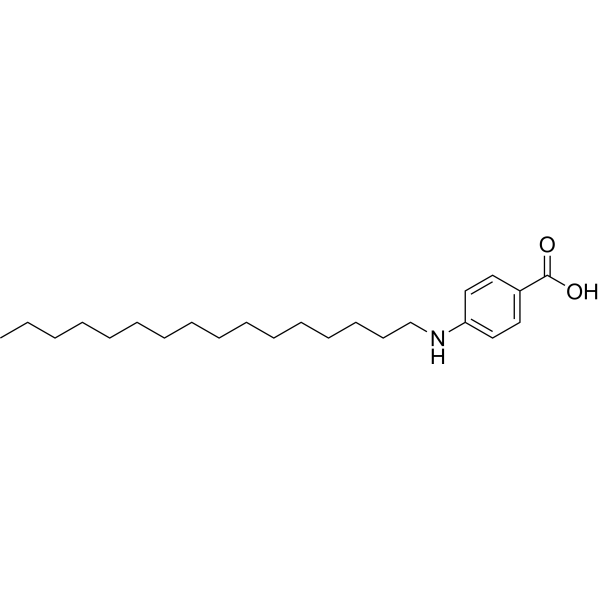
Cetaben
CAS No. 55986-43-1
Cetaben( —— )
Catalog No. M26644 CAS No. 55986-43-1
Cetaben is a PPARα-independent peroxisome proliferator. Cetaben is a non-fibrotic lipid-lowering drug that effectively reduces cholesterol and triglyceride concentrations.
Purity : >98% (HPLC)
 COA
Datasheet
HNMR
HPLC
MSDS
Handing Instructions
COA
Datasheet
HNMR
HPLC
MSDS
Handing Instructions
| Size | Price / USD | Stock | Quantity |
| 1 mL x 10 mM in DMSO | 42 | In Stock |


|
| 5MG | 38 | In Stock |
|
| 10MG | 61 | In Stock |
|
| 25MG | 140 | In Stock |
|
| 50MG | 222 | In Stock |
|
| 100MG | 361 | In Stock |
|
| 200MG | Get Quote | In Stock |
|
| 500MG | Get Quote | In Stock |
|
| 1G | Get Quote | In Stock |
|
Biological Information
-
Product NameCetaben
-
NoteResearch use only, not for human use.
-
Brief DescriptionCetaben is a PPARα-independent peroxisome proliferator. Cetaben is a non-fibrotic lipid-lowering drug that effectively reduces cholesterol and triglyceride concentrations.
-
DescriptionCetaben is a PPARα-independent peroxisome proliferator. Cetaben is a non-fibrotic lipid-lowering drug that effectively reduces cholesterol and triglyceride concentrations.(In Vitro):The administration of 10 μM Cetaben for 24 hours induces severe micromorphological and ultrastructural changes in HepG2 and MH1C1 cells. After the administration of 10 μM Cetaben for 24 hours, cells were characterized by a striking heterogeneity of the peroxisomal population with the occurrence of dumbbell-shaped and cup-shaped peroxisomal profiles in MH1C1cells. After administration with 100 μM cetaben, cells contained several Golgi regions, most of them disintegrated into vesicles.(In Vivo):Administration of 50-100 mg/kg Cetaben for over 10 days shows an obvious rise in the activities of peroxisomal enzymes in both the liver and kidney. However, the maximal effect is observed at 250 mg/kg.
-
In VitroCetaben (10 μM; 24 hours) induces severe micromorphological and ultrastructural changes in HepG2 and MH1C1 cells. After treatment with 100 μM cetaben, cells contained several Golgi regions, most of them disintegrated into vesicles. Cetaben-treated (10 μM; 24 hours) cells were characterized by a striking heterogeneity of the peroxisomal population with the occurrence of dumbbell-shaped and cup-shaped peroxisomal profiles in MH1C1cells.
-
In VivoCetaben reveales a significant rise in the activities of peroxisomal enzymes in both the liver and kidney at doses of 50-100 mg/kg body over 10 days, but the maximal effect is observed at 250 mg/kg. Animal Model:Male Wistar rats Dosage:10,25,50,100,250 and 500 mg/kg Administration:Gavage; 10 dayResult:Revealed a significant rise in the activities of peroxisomal enzymes in both the liver and kidney at doses of 50-100 mg/kg body over 10 days, but the maximal effect was observed at 250 mg/kg.
-
Synonyms——
-
PathwayOthers
-
TargetOther Targets
-
RecptorEndogenous Metabolite| Influenza A
-
Research Area——
-
Indication——
Chemical Information
-
CAS Number55986-43-1
-
Formula Weight361.57
-
Molecular FormulaC23H39NO2
-
Purity>98% (HPLC)
-
SolubilityIn Vitro:?DMSO : 25 mg/mL (69.14 mM)
-
SMILESCCCCCCCCCCCCCCCCNc1ccc(cc1)C(O)=O
-
Chemical Name——
Shipping & Storage Information
-
Storage(-20℃)
-
ShippingWith Ice Pack
-
Stability≥ 2 years
Reference
1.Takahashi T, et al. N-glycolylneuraminic acid on human epithelial cells prevents entry of influenza A viruses that possess N-glycolylneuraminic acid binding ability. J Virol. 2014 Aug;88(15):8445-56.
molnova catalog



related products
-
Aniline mustard
Aniline mustard is alkylating mustard with anti-neoplastic activity.
-
(±)5(6)-EpETE methyl...
(±)5(6)-EpETE methyl ester is a derivative of 5(6)-EpETE which is stable enough to ship and handle routinely.(±) 5(6)-EpETE methyl ester is a chemically less reactive derivative of 5(6)-EpETE.
-
Melittin
Melittin, a small protein containing 26 amino acid residues, is the principal toxic component of bee venom. Melittin is a PLA2 activator, stimulates the activity of the low molecular weight PLA2, while it does not the increase activity of the high molecular weight PLA2.
